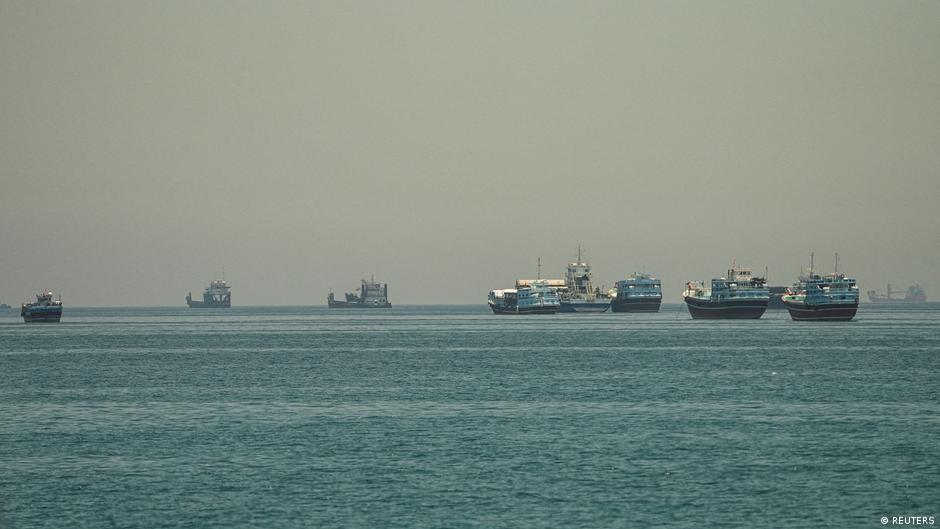
On Wednesday evening, US President Donald Trump said that if Oman attempted to team up with Iran to take control of the Strait of Hormuz, the US would launch a military strike against the country on the southern tip of the Arabian Peninsula.
He was responding to a report by Iranian state television which claimed that an informal draft agreement existed to restore shipping traffic in the Strait of Hormuz. The draft reportedly called for Iran and Oman to jointly regulate traffic in the waterway.
Asked whether he would accept such an agreement, Trump told reporters, “Oman will behave like everybody else, or we’ll have to blow them up.”
The unusually strong threat is directed at a country that has long been considered the arbiter in the Middle East.
“Oman has traditionally played a mediating role between the Arab Gulf states and Iran,” Markus Schneider, head of the regional project at the Friedrich Ebert Foundation for Peace and Security in the Middle East in Beirut, told DW.
Among the Gulf countries, Oman has always maintained the closest relations with Tehran.
Stephen Lucas, founder of the analysis firm Middle East Minds, sees this as part of what makes the country unique. “Oman is one of the few remaining countries in the region that still maintains relatively stable relations with almost all parties to the conflict,” Lucas told DW.
Main geographical location of Oman
Due to its location on the southern shore of the Strait of Hormuz, Oman plays a key role in the current conflict.
At the same time, the Sultanate maintains good relations with both Washington and Tehran and has repeatedly served as a venue for confidential talks.
The situation is critical for Oman. The country is trying to maintain its role as a neutral mediator but is becoming caught between the two sides.
“Since the beginning of the war, Oman has been one of the Gulf countries making the most efforts to de-escalate tensions,” Schneider said. Like other states in the region, it also fears getting caught in the conflict.
Oman is dependent on stable trade relations with China, India, Europe and its neighbours. At the same time, Washington is increasing political pressure, while the proximity of war threatens the country’s security.
Oman unlikely to join Tehran on Hormuz
However, there is little to suggest that Oman is actually seeking joint control of the Strait of Hormuz with Iran.
“Iran is increasingly portraying the strait as joint Iranian-Omani waters,” Schneider said. However, in Oman itself the idea is viewed with suspicion. Active participation in such measures would be contrary to the interests of other Gulf countries.
Lucas also considers such reports to be “rather unrealistic”. The government in Muscat has “no interest in joint control with Iran.” Rather, what is important is to restore safe and uninterrupted shipping through the strait.
tension in the bay
Over the years, Saudi Arabia and the United Arab Emirates have viewed Oman’s unique role with mixed feelings. Both Tehrans can benefit from channels of communication with Oman, but they view Muscat’s independent course with suspicion.
At the same time, there is a growing realization among Gulf countries that lasting stability can be achieved not by opposing Iran, but by working with it.
according to a recent valuation The Center for Strategic and International Studies (CSIS) quoted local politicians as saying, “Iran is here to stay” and “For Qatar and others in the Gulf, building ties of economic interdependence between Iran and the Gulf is probably the best form of deterrence.”
“Integrating Iran into an economic model that depends on regional stability may be the best hope for curbing its disruptive behavior,” the report said.
This development holds special significance for Oman. More than almost any other country in the region, Oman benefits from stable relationships with as many stakeholders as possible.
“Oman, in particular, feels particularly vulnerable because of its geographic location on the Strait of Hormuz,” Schneider said. Muscat is therefore keen to prevent any further tensions.
Trump’s threat unlikely
“Donald Trump’s latest threats are being received extremely negatively in the region,” Schneider said.
At the same time, recent Iranian attacks have raised doubts about US security guarantees for the Gulf countries.
Nevertheless, a US attack on Oman is considered highly unlikely. Schneider cites discussions with Omani experts who see the threats as an expression of frustration in Washington. A military attack against a long-standing partner and mediator would further weaken American influence in the region.
Lucas also considers a US military attack against Oman unlikely. In his view, the political and strategic importance of the Sultanate as a medium of communication between the parties to the conflict is immense. He believes that an attack would not only affect Oman but would also significantly limit America’s diplomatic options in the entire region.
This article was translated from German