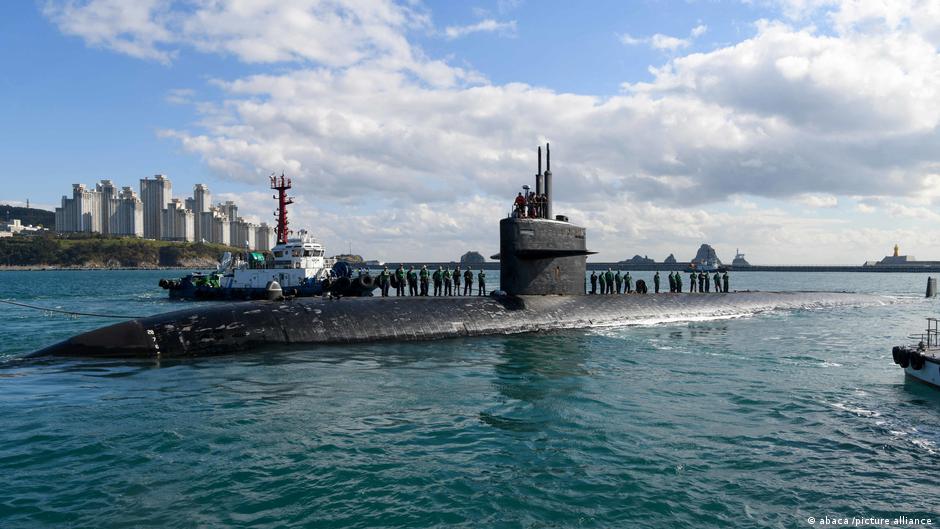
The South Korean government has announced plans to develop nuclear-powered attack submarines, with the first vessel becoming operational by the mid-2030s, in an effort to strengthen its naval capabilities.
When developments already underway or under consideration by China, North Korea and Japan are taken into account, it is clear that Northeast Asia is already strongly embroiled in an undersea arms race, analysts say.
Defense Minister Ahn Gyu-bak unveiled Seoul’s plan at a Tuesday meeting of the Future Defense Strategy Committee at the naval base in Jinhae, stressing the importance of developing a system to counter North Korea’s advances in submarine technology.
The plan – known as the Jangbogo-an Project, named after the South’s first submarine – emphasizes that nuclear-powered submarines have “dramatically increased operational capabilities compared to existing diesel submarines.”
According to the Defense Ministry, the submarines “will play a key role in responding to threats such as North Korean submarine-launched nuclear and missile threats.”
The ministry described the plan as a “national strategic project” that will utilize South Korea’s shipbuilding and nuclear power technologies, with what is expected to be a decade-long construction period and a 30-year operational period.
America is helping Asian ally in developing submarines
Seoul is pushing the plan after the United States supported South Korea’s pursuit of conventionally armed, nuclear-powered submarines, with Washington promising to help its Asian ally build the ships, including their propulsion systems.
It appears that there are some issues between the two countries that need to be resolved.
During talks with South Korean President Lee Jae-myung in October, US President Donald Trump said the submarines would be built in Philadelphia. However, a recent statement emphasizes that they will be manufactured in South Korea.
Nevertheless, the announcement marks a significant advance on South Korean ambitions that have been in place since the early 1990s.
“A combination of military, corporate and political actors in South Korea have long wanted to pursue nuclear-powered submarines, and Trump is the first US president to greenlight this effort with Seoul,” said Leif-Eric Easley, professor of international studies at Ewha Womans University in Seoul.
Still, “political will, diplomatic clearance and defense budgets are not the only obstacles that can be overcome,” he told DW, pointing to the need to address technology transfer and nonproliferation concerns as well as “significant and time-consuming” industrial challenges.
Chu Jae-woo, a foreign policy professor at Kyung Hee University in Seoul, said there were several strategic reasons behind the government’s decision.
“We need to strengthen our naval power to counter North Korea, but also to resist China’s increasing incursions into our territorial waters in the West Sea,” he said. “These submarines will also be useful in the East Sea and south of the peninsula.”
‘Strengthen security against North Korea’
“We need to strengthen our defenses against the nuclear threats posed by North Korea, which we know has developed a submarine capable of launching ballistic missiles,” Chu said.
Beyond the defense sector, the project will help expand South Korea’s nuclear industry, Chu said, allowing the enrichment of uranium and promoting the development of the technology needed to reprocess growing stockpiles of nuclear waste at civilian energy facilities.
South Korean lawmaker and defense expert Yoo Yong-wen said nuclear-powered submarines are faster and can stay underwater longer than their diesel-powered counterparts, meaning they would increase surveillance of North Korean submarines.
However, Mason Ritchie, a professor of politics and international relations at Hankuk University of Foreign Studies in Seoul, is less convinced about the South Korean military’s need for the ships.
“The North’s submarine fleet is very weak and their ballistic missile boats are based on old Soviet-era submarines which are very noisy, have limited capabilities and would be very easy to track when they leave port,” Ritchie said.
Kim Jong-un inspected the submarine
And while Pyongyang periodically releases photos of Kim Jong-un inspecting warships, including submarines, and claims to be expanding its navy, Ritchie points out that a significant leap forward would be difficult to achieve.
Ritchie also believes the Trump administration greenlighted Seoul’s plan in part because it expected U.S. allies in the Indo-Pacific region to commit forces if a crisis arose over the Taiwan Strait and that a new generation of South Korean submarines would be a valuable asset.
However, in reality, the current left-leaning government in Seoul has signaled that it has no desire to engage in any conflict with its powerful neighbor.
Another factor to consider, Ritchie said, would be whether South Korea is developing enough capability to make it a “marginal nuclear power,” which could be beneficial to Seoul and the U.S. should regional tensions escalate into full-scale hostilities.
But there is no doubt that Seoul’s move is an extension of an already developing desire by governments in the region for greater military capabilities.
Asked whether Seoul’s announcement was a harbinger of an underground arms race, Ritchie responded, “We’re already there.”
“China is clearly building up its capabilities, North Korea is clearly trying to add more and more capable boats and now South Korea is also taking this path,” he said.
In December, Japanese Defense Minister Shinjiro Koizumi acknowledged that adopting nuclear propulsion for the next generation of Japanese attack submarines was “an option”.
Edited by: Keith Walker