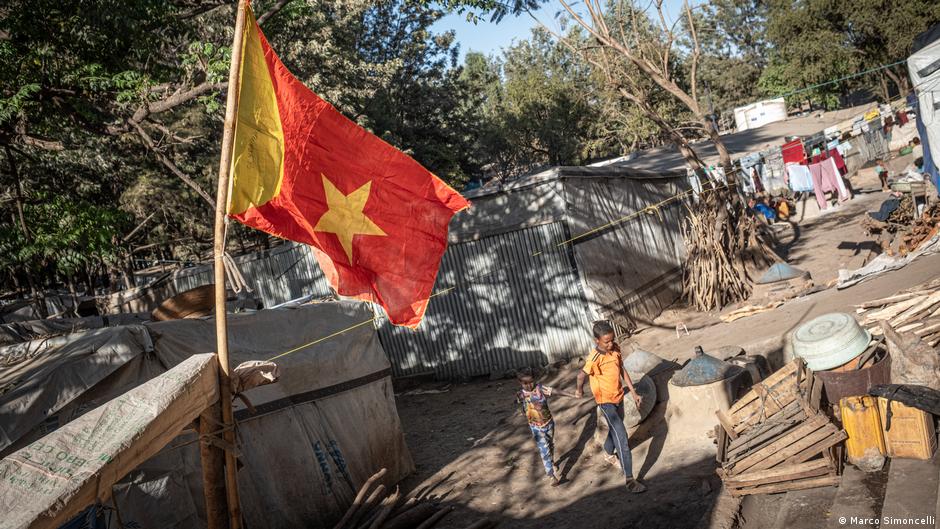
The outgoing lower house of the Ethiopian parliament, known as the House of People’s Representatives, does not have a single representative in the upper house – the House of Federation – currently representing the crisis-hit Tigray region.
Missing another election in 2026 would mark Tigray’s complete absence from the political arena in Addis Ababa for a full decade. Many wonder where the region is headed, as tensions appear to be flaring up again.
“Can we still say with certainty that ‘Tigray is part of Ethiopia?’ “I’m not sure,” says Alemayehu Fantaw, a fellow at the Center for Constitutional Democracy at Indiana University Maurer School of Law.
It appears that others share an equally bleak outlook on the situation – or worse.
TPLF: Half of Tigray ‘under enemy control’
According to the agreement signed after AU-led mediation in Pretoria in 2022, the Federal Government of Ethiopia is legally mandated to ensure and facilitate the representation of Tigray in its federal institutions, including the two Houses.
However, that agreement has repeatedly failed to live up to expectations, apart from being largely successful in quelling active fighting in the area; Above all, it has not helped bring democracy back to Tigray.
Many people still view the central government with suspicion and resentment.
“More than 40% of Tigray’s sovereign territory is under enemy control,” says Michael Asgedom, spokesman for the Tigray People’s Liberation Front (TPLF). He highlighted that the region is unable to “hold elections” after years of conflict.
Asgedom explains the millions of internally displaced people who fled Tigray reason for was a bloody citizen They have not returned home, in addition to countless others who originally sought asylum near Sudan; He told DW that any elections held in Tigray would not be representative of all Tigreans.
But there is more than uneven voter turnout that is making observers concerned about the fragile peace in the region, as the rest of the country prepares to go to the polls: 2020 to 2022 still casts its long shadow over Tigray.
Tigray: from constitutional crisis to civil war
In 2020, the Ethiopian government led by Prime Minister Abiy Ahmed had to postpone the country’s planned elections due to the COVID-19 pandemic.
The TPLF – the largest and most influential party in the country’s northern Tigray region – accused Abiy of unconstitutionally extending his government’s tenure in this manner, and arranged for its own local elections, which he won.
Later, the TPLF denied the federal government legal authority over the Tigray region; The standoff quickly escalated into military hostilities between the TPLF and the Ethiopian National Defense Forces (ENDF).
Between 2020 and 2022, an estimated 600,000 people were killed in the ensuing fighting, with both sides accusing the other of starting the conflict.
In November 2022, following the Pretoria Peace Agreement between the Ethiopian government and the TPLF, the results of the 2020 local elections in Tigray were finally annulled and an interim regional administration was established in Tigray, sidelining the TPLF’s wartime leaders.
In the three years that followed, disagreements between the region’s interim administration and the TPLF continued to grow.
Return to power: TPLF opposes peace deal
The TPLF was particularly opposed to Prime Minister Ahmed’s unilateral decision to extend the tenure of Lieutenant General Tadesse Werede as president of the Tigray interim administration for another year.
Last month, the TPLF decided to take unilateral action on its part and reinstated the Tigray State Council – which was dissolved as part of the peace deal.
On May 5, TPLF leader Debretson Gebremichael was elected as the new president of Tigray, setting the stage for another potential standoff.
The TPLF’s consolidation of power received a stern warning from Tadesse; However, the federal government has yet to comment on the restoration of the pre-war regional council, nor on Gebremichael’s return to the leadership.
all quiet on the northern front
Meanwhile, Major General Teshome Gemechu, a senior military leader of the Ethiopian Defense Forces, described the move as “anti-Ethiopia” and “a fantasy that poses a threat to Ethiopia’s sovereignty”.
DW contacted the Prime Minister’s Office and the Government Communications Service via email, WhatsApp and phone to get an official response to the development; Neither office responded to our requests for comment.
Legal scholar Alemayehu believes that the federal government’s inaction is as much to blame for the collapse of the cessation of hostilities as the TPLF’s return to leadership, emphasizing the fact that the Pretoria Peace Agreement serves as the only engagement mechanism between the federal government and Tigray.
Alemayehu accused the federal government of “turning Tigray into a buffer zone”, saying, “In my opinion, the federal government has a deliberate policy of retreat.”
Is Tigray about to witness another war?
As the political crisis continues, there are concerns of renewed war among Tigray residents.
“Our people are suffering under the federal government,” TPLF spokesman Michael told DW. “There are more than enough reasons for conflict on our side,” he said, adding that Tigrayans do not want another war.
But not wanting conflict does not mean that we will not resist an attack that is launched against us, or will not resist an attack that will be launched against us.” He said, ”The mood on the ground also reflects a similar sentiment.
soldiers are recruiting teenagers
Witnesses in Tigray told DW this week that TPLF-aligned Tigray Defense Forces (TDF) soldiers were seen forcibly recruiting former fighters as well as teenagers in towns and rural areas outside the regional capital Mekelle.
Tesfalem Berhe, director of the rights group “Human Rights First Ethiopia”, confirmed receiving similar reports.
Journalist and former correspondent for the Voice of America (VOA) Tigrinya service Mulugeta Atsebeha, meanwhile, told DW that on May 5 and 6, Ethiopian military jets were seen flying over Mekelle, the capital of Tigray.
Magnus Fahrer, an anthropologist and Horn of Africa expert at Ludwig Maximilian University in Munich, believes the fighter jets over Mekelle are more than just a “show of force.”
“And the Ethiopian National Defense Force […] Establishing themselves in the neighboring states of Amhara and Afar,” Fahrer explained, highlighting that defense installations are being expanded along northern access routes to the capital Addis Ababa.
Is Abi Ahmed trying to save face?
Looking at the reasons for another possible war, the Fuhrer believes that Prime Minister Ahmed is more than a loser in his own country. For the Fuhrer, Tigray represents the declining geopolitical clout of the Nobel Peace Prize winner:
“In fact, Ahmed has failed to dislodge the TPLF’s old guard and establish an opposition loyal to him in Tigray, either politically or militarily. The TPLF remains the biggest challenge to Abiy Ahmed, who is increasingly isolated internationally because of his alleged association with the United Arab Emirates (UAE) and the Sudanese Rapid Support Forces (RSF),” Fahrer told DW.
For constitutional law scholar and conflict analyst Alemayehu, the danger of another civil war may still be mitigated.[i]”F is the goodwill of the federal government.”
Referring to amendments to the Pretoria Agreement, he believes that to maintain peace, the government “must be able to restore the registration of the Tigray People’s Liberation Front and invite it to dialogue,” he said.
As Ethiopia faces multiple armed challenges, including from the TPLF in Tigray, Fano militias in Amhara, and the Oromo Liberation Army in Oromia, not to mention rising regional tensions with neighbors Eritrea and Sudan, the new government will undoubtedly have its work cut out after the June 1 elections.
Edited by: Serton Sanderson