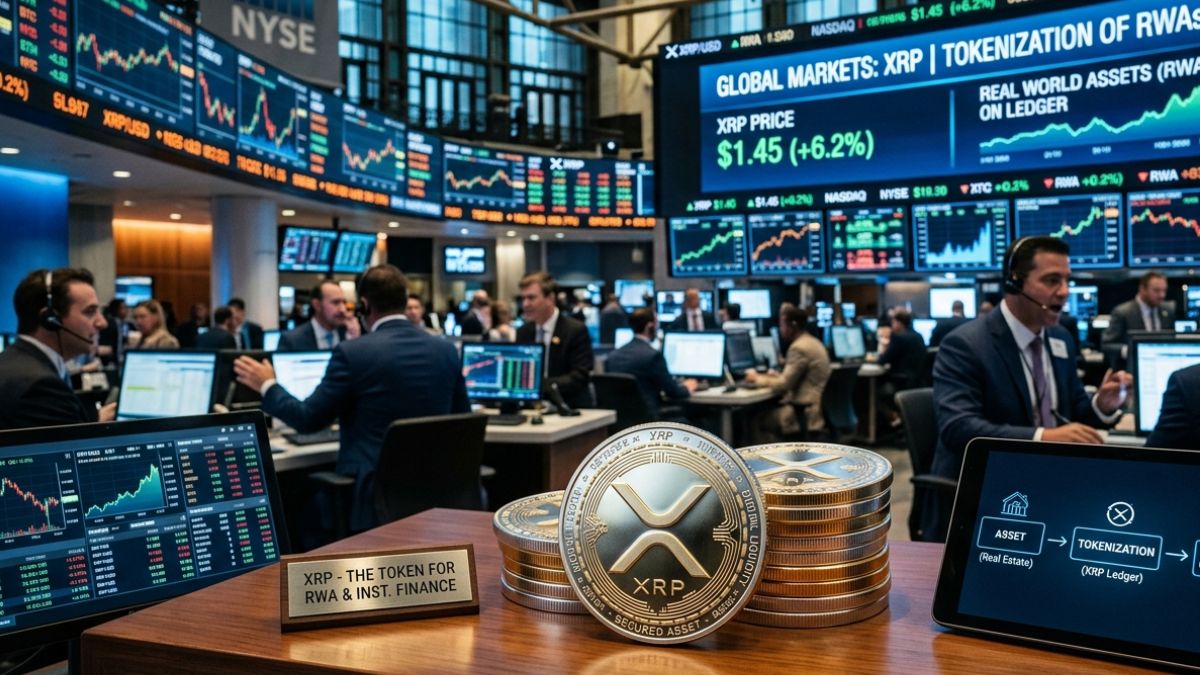
Ethereum leads the way in the RWA space, but the XRP Ledger is growing faster.
The company believes that there is redistribution of the new capital flow towards the XRP Ledger.
The XRP Ledger network shows strong dynamism in the real-world asset (RWA) tokenization sector, according to a report published on May 28, 2026 by digital asset management firm Evernorth.
This company, which has the largest corporate treasury based on XRP globally (with a total of 388 million XRP valued at approximately 500 million dollars) analyzed the dynamics of capital in the sector.
Although the Ethereum network maintains current hegemony by hosting around 55% of the total value of the RWA market, Evernorth highlights that XRP Ledger surpasses it in growth rate.
From the evaluation Four quantitative trends emerge that redefine competition in the ecosystem. The company claims that when considering growth rather than current size, “XRP Ledger ranks among the elite in almost all metrics.”
XRP Ledger grows faster than Ethereum
One of the central findings of the report is the superiority of XRP Ledger in expansion speed. Evernorth compared the time it took each network to go from 10 to 400 million dollars in tokenized assets.
“XRP Ledger covered the same ground in 15 months that Ethereum took 36 months to cover,” the document states. XRP Ledger reached that mark between January 2025 and April 2026, also surpassing Avalanche and Polygon, and placing it practically on par with Solana, Arbitrum and zkSync Era.

Evernorth clarifies that only two networks had faster growth (BNB Chain and Plume), but under special circumstances. BNB Chain was almost entirely powered by a single concentrated asset, and Plume launched in a market where the tokenization model was already established. “XRP had none of these advantages. It scaled at breakneck speed from scratch,” the report added.
This same superiority in speed is also observed in the growth of the year 2026. The report indicates that XRP Ledger is growing more than twice as fast (+78%) as Ethereum.
“Ethereum hosts more than half of all tokenized assets on the planet and is growing at a rate of +35% this year,” Evernorth shows.

Evernorth explains that the three networks growing faster than XRP (SEI, Plume, and zkSync) start from much smaller capital bases. When an ecosystem has little total value locked, growth percentages are mathematically easier to calculate upwards, so “the most useful comparison is with established networks: Stellar, Avalanche, BNB Chain and Solana. “XRP is right in that range.”
The entity’s analysts emphasize that “XRP is growing in the same time horizon as the networks that are currently considered the frontier of tokenization.”
XRP Ledger is receiving large injections of institutional capital
As a second finding, the report points out that unlike Ethereum, whose growth in tokenization is based on a constant flow of relatively small contributions, XRP Ledger advance mainly responds to large, one-time injections of institutional capital.
The report highlights that, of the last 365 days, only 20 days generated 96% of all new tokenization activity on XRP Ledger, while the other 345 days contributed only the remaining 4%. To graph this difference, Evernorth uses the following analogy: two restaurants can bill the same million dollars, but one does so with thousands of daily customers and the other with a few catering contracts from large companies. The total is the same, but the model and the future are very different.

Ethereum shows the first pattern (distributed and constant growth). The XRP Ledger shows the second: “The capital inflow pattern into XRP exhibits episodic behavior rather than a continuous retail flow,” the report states.
This concentration, according to Evernorth, “is consistent with a predominantly institutional issuer base.” That is to say, large entities that decide to add significant volumes to the network at specific times.
XRP Ledger Displaces Traditional Corporate Competitors
The third finding reveals how the XRP Ledger positions itself against its peer group. Historically, the network has been grouped with other networks aimed at enterprise and institutional tokenization, such as Algorand, Mantle and Aptos, which began their climb in a similar period, Evernorth explains.

A year ago, these three networks clearly outperformed XRP Ledger, with Algorand being 2.6 times larger. Today, all three are behind.
The report records 246% year-on-year growth for XRP Ledger in this segment. However, Evernorth avoids hasty conclusions and clarifies that it is not possible to claim that issuers withdrew assets from one network to XRP Ledger, as contractions on other chains may be due to redemptions, liquidations or valuation effects.
“What we can say from the data is that the type of issuer activity that once made Algorand a prominent tokenization platform has significantly reduced, while the same type of activity on the XRP Ledger has increased markedly,” the report notes.
Evernorth concludes that, regardless of whether there were direct capital movements, “the relative attractiveness of these networks for the tokenization business has clearly changed.” When new issues begin to systematically choose one network over another within the same category, it is often one of the first signs of where long-term institutional attention is headed.
XRP Ledger Sees Steeper Growth Trajectory Than Other Networks
The fourth finding shows that the first quantifiable RWA data on XRP Ledger was recorded on September 10, 2024, with just $3 million. Twenty months later, in May 2026, the value reached 404 million dollars, which represents an increase of 134 times in that period.

Evernorth points out that comparisons with much longer-running networks are not fair. While Ethereum began its tokenization activity in 2018 and Stellar in 2022, the XRP Ledger must be measured against those networks where institutional tokenization began to scale relevantly in a similar period (post-2023).
In that group—which includes Solana, Avalanche, Arbitrum, zkSync Era, and others that surpassed $10 million after 2023—XRP Ledger has seen the steepest absolute growth curve from a comparable starting point.
The report emphasizes the importance of how the figures are contextualized: $404 million may seem like a modest amount compared to Ethereum’s $18.7 billion. However, “it went from 3 million dollars to 404 million dollars in twenty months” tells a completely different story, and it’s that trajectory that best reflects—according to Evernorth—where the network is headed..
The sector evaluates the ideal infrastructure
This dynamism of XRP Ledger is part of a strong general expansion of the real-world asset sector. The active market capitalization of tokenized RWAs exceeded $17 billion for the first time on April 1, 2026, as CriptoNoticias reported at the time. Today, almost two months later, The value of this market is 26 billion dollars, which represents an increase of 52% in this short period.
The speed of this expansion raises different visions about the optimal technical architecture for the international financial sector. Evernorth’s conclusions about massive growth in public infrastructure like XRP coexist with alternative perspectives on designing systems suitable for institutional capital.
While Evernorth shows that many large issuers choose public infrastructure like XRP due to its speed of scalability, a study published on April 29 by Grayscale Research considers that institution-focused networks, like Canton, “could lead the market in the near term.” Compared to publicly accessible platforms, institution-focused networks “fit better with the current functioning of the financial system, which could facilitate a smoother transition for users and intermediaries. Additionally, institutional use cases often require privacy, something that Canton offers by default,” explains the research entity.
Nevertheless, This initial preference for closed and controlled environments faces the strong quantitative growth they are experiencing the open chain options described in the manager’s report. Regarding this point, public networks such as Ethereum, Solana and the XRP Ledger itself face different technical challenges. These open network platforms “are still developing privacy and identity tools, but offer a broader vision for reinventing capital markets and potentially greater long-term adoption, if they materialize.”
This argument validates Evernorth’s projection of XRP’s position among the sector’s elite in the long term. Despite the immediate regulatory advantages of private systems, Grayscale Research foresees trading in tokenized assets “migrating over time to decentralized and fully permission-free public networks.”
These findings serve as a useful guide for assessing portfolio risk and diversification in the real-world asset sector. While the velocity data favors the XRP Ledger infrastructure for large corporate issuances, It is prudent to remain cautious given the concentration observed in a few institutional issuers. This reliance on episodic events and high volume injections means that the network can experience prolonged periods of stagnation followed by abrupt spikes in activity, a critical factor to consider when managing liquidity tools.