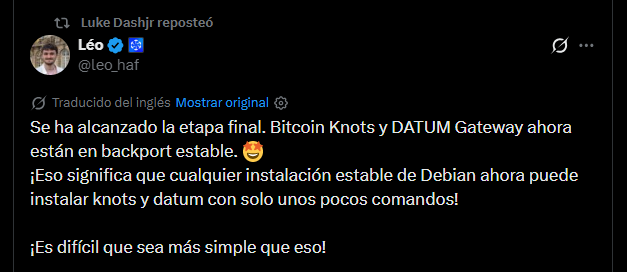
Until now, installing them required manually compiling code, a process that took hours, according to Haf.
The change applies to home miners all the way to industrial farms, Haf explained.
One of the clearest expressions of decentralization in Bitcoin mining, independently deciding which transactions to include in each block instead of delegating it to a pool, became more accessible today, May 29. Bitcoiner developer Léo Haf announced that two tools to achieve this, the Bitcoin Knots node software and the DATUM mining protocol, can now be installed with a few commands on Linux, the most used operating system on mining servers.
When a miner connects his equipment to a pool, they are These platforms decide which transactions to put together in the block. that the miners will try to solve. The miner provides computing power, but does not choose the content of the block. That delegation is convenient and provides frequent payments from the pools, but it concentrates the decision about which transactions Bitcoin processes in a few pools.
Bitcoin Knots, for its part, is a client that, unlike the Bitcoin Core reference software, allows you to filter transactions considered by the community as spam (Ordinals or Runes inscriptions, for example), before they enter the block.
DATUM, created by OCEAN pool developers, is the bridge between a node and its mining rigs. It takes instructions from the client used, such as Knots or Core, and sends them to the ASICs.
In this context, DATUM, unlike other similar systems that use pools, allows miners to select the transaction templates that they will include in the blocks. In this way, the pool, It is only responsible for distributing the rewards and no longer decides the content of the block.
How does the integration impact Bitcoin mining?
Both tools, Knots and DATUM, already existed, the change lies in the process to install them. Until now, doing so required downloading source code from repositories on GitHub, manually resolving software dependencies, compiling programs (a process that could take hours), and configuring system services by hand.
Haf, responsible for the Knots and DATUM communion, summarized it this way to CriptoNoticias: «Installing Knots and DATUM separately requires the user to have some knowledge of the Linux terminal in Debian. Thanks to this integration in Debian, Now just a few commands are enough. Future updates are also simplified: they are managed with the standard Debian system, without recompiling anything.
Regarding the scope, Haf was direct: “I made it sustainable for all mining scales,” he told CriptoNoticias, listing everything from Docker images and home servers, solo miners and even factory farms.
When asked by CriptoNoticias if the change implies any risk for those who adopt it, Haf noted that Debian “has secure infrastructure for building and distributing packages” and that the programs “can be independently verified with reproducible builds» (a mechanism that allows checking that the installed program corresponds exactly to the declared source code, without intermediate modifications).
Technical developments that can decentralize Bitcoin mining
Last May 7, as reported by CriptoNoticias, seven of the largest mining pools in the bitcoin ecosystem, including Foundry USA, AntPool and F2Pool, joined the working group that develops Stratum V2, the protocol that, among other functions, allows each miner to build their own block template instead of receiving a predefined one from the pool.
Although this adhesion to the group could imply progress towards decentralization, it would still remain those pools activate the Stratum V2 work negotiation function by default, which is what precisely offers the power to choose the transactions to the miners. Adhering to the standard and ceding control of the block to the miner are two different decisions.
In parallel, the developer skot, creator of the open source Bitaxe mini ASICs, warned that mining is the only layer of Bitcoin that does not have open source as a standard: «Bitcoin Core, node implementations, wallets… they simply do not question it. Why isn’t mining?
His projection was that development in the sector “is going to become absolutely vertical” as that changes. What Haf announced on May 29 could be read as a sign in that direction: an open source tool for mining that is installed with the same ease as any other standard program on Linux.
The integration of Knots and DATUM in Debian is part of that same movement: tools that already existed but whose entry barrier prevented their mass adoption. None of these initiatives solves the concentration in mining on its own, but each one modifies a different variable of the same problem.