Rand Hindi, founder of Zama, clarified that it was not a sanction against the platform.
The freeze affected 12.6 million USDC within the cUSDC contract.
The privacy platform Zama was involved on May 30, 2026 in a judicial dispute unrelated to its activity.
Everything happened after Circle will freeze 12.6 million USDC contained in its cUSDC contract by order of a US court, without prior notice to Zama.
The move is related to a class-action lawsuit filed on May 28 against Maxim Ermilov, founder of Overnight Finance, a decentralized finance (DeFi) protocol.
In the writing, it is highlighted that The plaintiffs accuse him of having transferred more than 15 million dollars from the project treasury ahead of a governance vote that sought to liquidate and distribute those funds among OVN token holders.
The measure ended up affecting cUSDC, a confidential version of USDC, the stablecoin issued by Circle and pegged to the US dollar. Unlike a conventional stablecoin, cUSDC allows balances and transferred amounts to be publicly hidden, although it keeps the addresses participating in the operations visible.
According to the lawsuit, on May 11 an address linked to Ermilov transferred approximately 12.5 million USDC to Zama’s cUSDC contract. Subsequently, the plaintiffs requested emergency injunctive measures to prevent these funds from being moved while the litigation unfolds.
On May 29, Federal Judge P. Casey Pitts ordered Circle to freeze the USDC involved and the company executed the measure a few hours later. The order ended up affecting Zama’s cUSDC contract on Ethereum, identified with the address 0xe978F22157048E5DB8E5d07971376e86671672B2, where the funds that were the subject of the dispute were deposited.
Due to the architecture of cUSDC, the freeze ended up affecting the entire pool and not just the assets in dispute.
Hindi spoke of a “hacker”, but the case is a civil lawsuit
One of the points that generated initial confusion was the explanation published by Rand Hindi. It is that the founder of Zama stated via his
However, court documentation shows that the origin of the freeze It is not a recent hack or an exploit against Overnight Financebut a civil lawsuit for alleged misappropriation of funds from the protocol treasury.
Ermilov spoke to The Block site and rejection the accusations and maintains that the funds did not belong to the community treasury, but to accounts controlled by the team and used to operate the protocol.
The debate about privacy and censorship
The controversy goes beyond Overnight Finance. On-chain researcher ZachXBT, who initially warned about the freeze, pointed out that the case establishes a “precedent” because the court order ended up blocking a contract used by multiple users and not just the funds under dispute.
“Overall, I feel sorry for the Zama users who have now been indirectly affected by this civil case imbroglio in the United States,” he wrote.
The situation revived a frequent debate within the ecosystem: to what extent a centralized stablecoin can affect decentralized protocols when there is a court order on a portion of the funds.
In a similar vein, the X user, known as CyberSatoshi, warned that the most delicate point was not the blocking of an individual wallet, but the blacklisting of “a live smart contract.” For him, the precedent is problematic because it shows that, if designated funds enter a shared infrastructure, the entire contract can end up affected. “Your stablecoins on a DEX router, lending markets, or yield farms are never safe,” he said.
And he closed with a direct criticism of the centralized stablecoin model within DeFi: “You can’t build permissionless finance on a centralized kill switch.”
From Zama they maintain that the problem reflects precisely that tension. “This is an example of collateral damage affecting a public smart contract due to the centralized architecture of the underlying asset,” the company said.
Another relevant element is that Hindi assured that Circle did not previously notify Zama about the freezing of the contract.
In this context, Hindi announced: “In the meantime, we will pause the cUSDC, cUSDT and cWETH contracts until we have completed our investigation, identified all addresses linked to this case and taken appropriate action.”
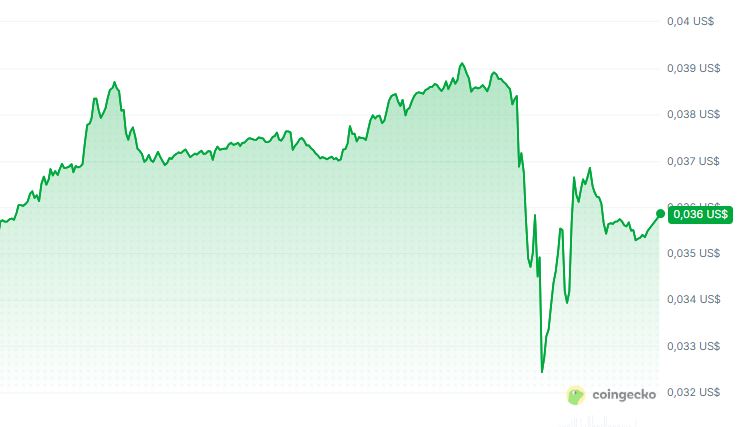
The news caused volatility in the ZAMA token. As can be seen in the graph, the asset fell from the $0.039 zone to a low near $0.032 after the freeze became known. It later recovered part of the losses after public clarifications from Circle and Rand Hindi, founder of Zama, and returned to trading around $0.036.
At the moment, Zama’s legal team is working with the various parties involved to isolate the affected addresses and restore access to users who have no relation to the judicial dispute.
The hearing on the temporary restraining order is scheduled for June 1, when the court will hear arguments from the parties involved before deciding the next steps in the case.