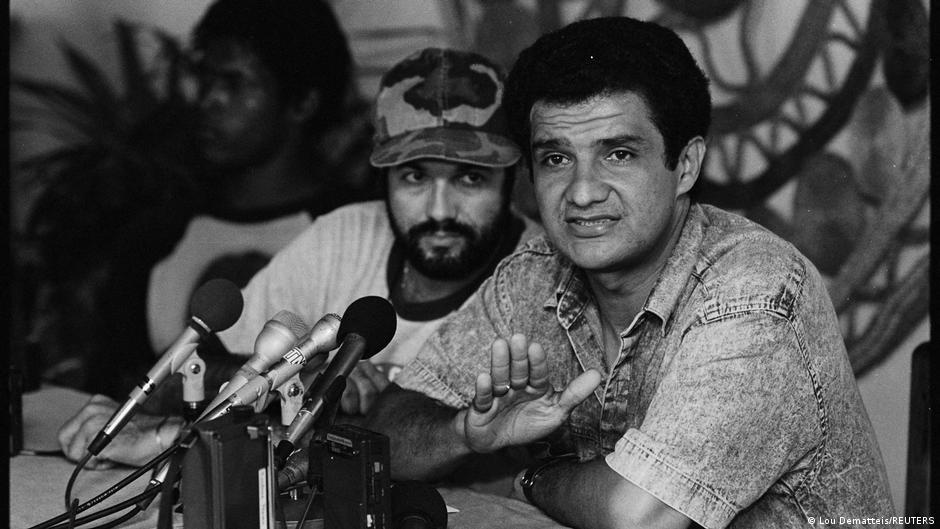
Nicaraguan indigenous leader and activist Brooklyn Rivera died of health complications after nearly three years in detention, the country’s health ministry said Sunday.
Last week, the Nicaraguan government confirmed that he had been detained since 2023. UN representatives, the US government, and Rivera’s family have demanded proof that he is still alive.
“We are saddened to confirm that he has tragically passed away,” the Health Ministry said in a statement on state media outlets.
Authorities said the leader’s “physical and neurological deterioration” was “the result of the bacterial infection caused by the COVID-19 virus,” adding that doctors had made “huge” efforts to save Rivera’s life.
On Wednesday, the government released photos of Rivera attached to a ventilator, acknowledging that his condition was critical.
The 73-year-old was a well-known leader of the Miskito people and a former member of the Nicaraguan Congress. He was arrested in 2023 leftist authoritarian government President Daniel Ortega on undisclosed charges.
According to news reports in 2024, the government informed the Office of the UN High Commissioner for Human Rights that Rivera’s parliamentary immunity had been revoked. Authorities were reportedly preparing to investigate serious crimes including treason.
Rivera’s exiled daughter Tinniska Rivera said she wanted the government to hand over her father’s body so he could be buried under Miskito traditions. He also refuted the government’s claim that Rivera’s family members were with him at the time of his death.
Activists condemn Rivera’s death
Human rights activists and groups around the world condemned the leader’s death.
“They took him alive, and after refusing to tell his family, his lawyers, anything about his fate to the world, they called him brother,” said Reed Brody, an American human rights lawyer and member of a group of UN experts on Nicaragua. Broidy cited an earlier statement where the Ortega government called Rivera a “brother” and said they were praying for him.
“It’s unconscious skepticism on the part of the government to make it seem like they were trying to help him,” Brody said.
Manuel Orozco, director of the Inter-American Dialogue, said Rivera’s death was the result of “complete neglect”. “His death reflects the horrors of repression,” he said.
The Argentina-based Inter-American Center for Legal Assistance in Human Rights also condemned Rivera’s death in a post on Twitter, and demanded that those responsible “be held criminally accountable.”
Albert R. Ramdin, Secretary General of the Organization of American States, said he was “deeply concerned” about reports of Rivera’s death.
“His death demands an immediate, independent and transparent investigation,” Ramdeen wrote on Sunday X. “The rights to life, personal integrity and due process must be guaranteed.”
Edited by: Darko Janjevic
Don’t let algorithms hide news. If you rely on our team for reliable reporting, please take a moment Choose us as your favorite source on GoogleThat’s why you’ll always see our verified news first.