
Bitcoin spot ETFs recorded their longest streak of outflows since their launch in January 2024, with ten consecutive days of outflows until May 29, 2026, in a context of correction in the asset’s price and changes in the behavior of institutional flows.
The movement intensified in the second half of May, when the price of bitcoin fell towards the $73,000 area, moving away from the maximum near $126,000 reached in October 2025. In this environment consecutive outputs began to accumulate in the listed productswhich led to the current negative sequence.
Ten consecutive days of outflows in bitcoin ETFs configured the longest period of selling pressure since its approval in the United States, with a more evident change in flows starting at the end of the second half of the month.
As reported by CriptoNoticias, the week ending May 24 registered more than 1.3 billion dollars in outflows, while on May 27 733 million were recorded and on May 18 another 649 million. In parallel, assets under management fell from more than $107 billion to around $94 billion in the same period.
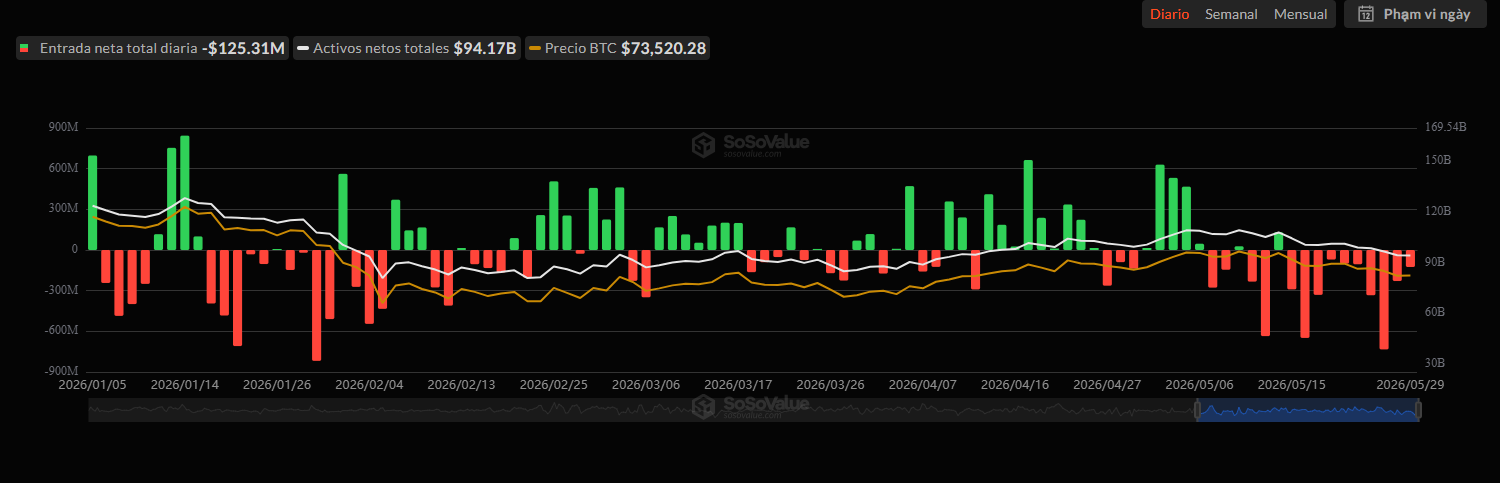
Selling pressure also extended to ether-linked ETFswhich accumulate between 10 and 14 consecutive days of departures depending on the data cut, with a total of 241 million dollars in net withdrawals, reinforcing the weakness in flows towards the main investment vehicles in digital assets.
It is worth highlighting that, despite the recent adjustment, accumulated net flows remain in positive territory and ETFs They continue to represent a relevant portion of the circulating supply of bitcoinwhich partially moderates the structural impact of the exits.
Likewise, the interpretation of the movement is not uniform. Analysis of ETF flows, such as those of SoSoValueCrypto, reflect a change in trend after several months of previous entries, what part of the market interpreted as a profit-taking phase.
In parallel, the behavior of the flows coincides with an environment of greater sensitivity to the macroeconomic cyclecharacterized by variations in interest rates, global liquidity and risk appetite, factors that have historically influenced these investment vehicles. For now, the episode reinforces a structural trend: the integration of bitcoin into traditional financial dynamics through ETFs has increased its sensitivity to global liquidity cycles. In this context, the evolution of the price depends increasingly on the behavior of institutional flows, which conditions the scenario for the next movements