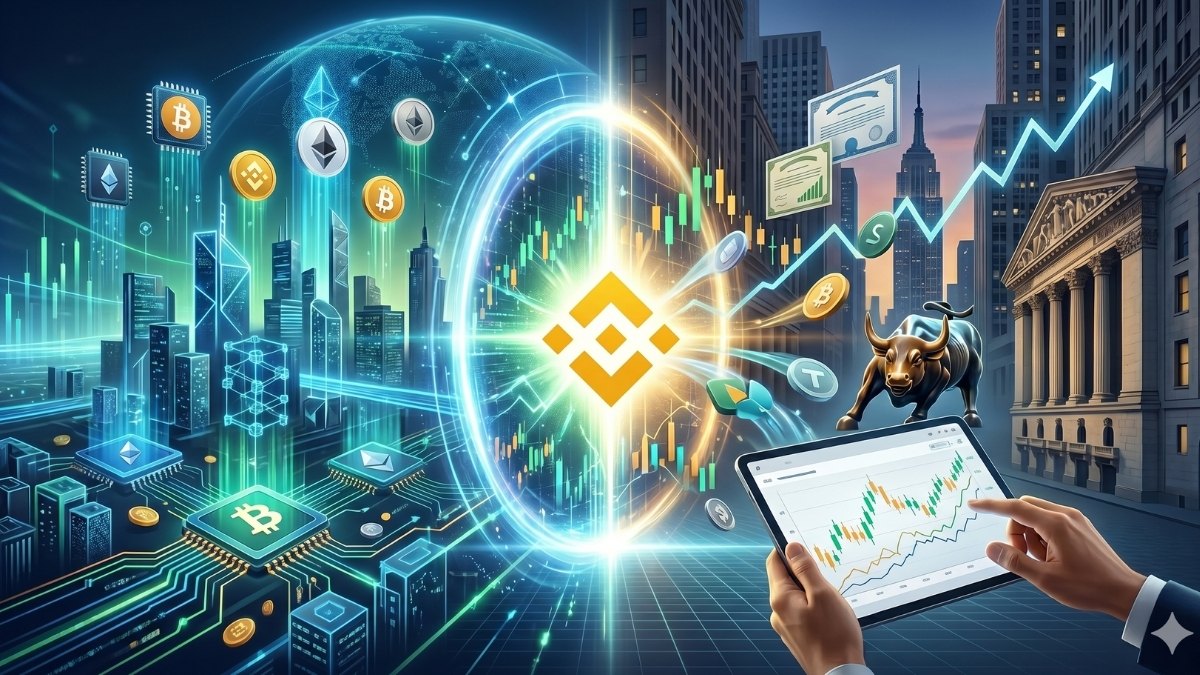
Shares on Binance include corporate rights: dividends, splits and warrants
The tokenized stock market exceeded USD 1.4 billion in capitalization in May 2026
As of June 1, 2026, Binance allows its users to buy and sell more than 7,000 US stocks and ETFs directly from its platform. The model is not tokenization: the exchange operates through Nest Trading Limited as introducing broker and Alpaca Securities LLC as executor, custodian and liquidator of the operations. The assets are real shares, with direct ownership of the securities.
The launch comes at a time when tokenized stocks are seeing all-time highs in activity. In March 2026, transfers of this type of assets grew by more than 80% in 30 days. For May,Daily trading volume in tokenized stocks reached $3.57 billionaccording to Mudrex data. It happened in the same week that the SEC published its innovation exemption for this segment.
The total market capitalization of tokenized stocks exceeded $1.4 billion in May 2026, spread across nearly 2,246 assets. However, that number represents just 0.001% of the global stock market, valued at USD 134 trillion. Platforms such as Robinhood, Kraken, Bybit and Gemini already compete in that segment with tokenized versions of Apple, Tesla or the S&P 500 shares.
Binance, on the other hand, took the opposite path: untokenized shares, with regulated custody and full ownership rights. The question is why.
One platform, two worlds
The exchange itself has an implicit answer. In its launch statement, Binance describes the product as a tool designed to attract both cryptocurrency investors who seek to diversify into stocks, as well as traditional stock market operators interested in digital assets. The proposal is coexistence: cryptocurrencies and stocks in a single account, without friction between markets.
The differences compared to a traditional broker are concrete. Users can trade 24 hours a day from Monday to Friday – compared to 6.5 hours during regular Wall Street hours – as well as finance their purchases with USDC, BNB, USDT or USD1, and invest from $5 in fractional shares. The platform does not charge commissions, although a spread or platform fee applies, which is waived for operations over USD 350.
Besides, Those who hold shares in Binance retain corporate rights. This includes the automatic collection of cash dividends, participation in splits (stock split) and mergers, and the possibility of exercising voluntary actions such as warrants or exchange offers within the deadlines stipulated by the issuer. This is an offer that tokenization, in its current state, does not replicate with the same regulatory strength.
The strategic context
The company’s move is also read from the vision of Binance CEO Richard Teng. In May 2026, Teng noted that the growth potential of exchanges It is not in the speculation of the ecosystem, but in the integration with large industries. The stock market is the largest of them.
That thesis has numerical support. Citi projects that the tokenized asset market could reach between $2.7 and $8.2 trillion by 2030, with a base case of $5.5 trillion. The total real assets tokenized on-chain already exceeded USD 29 billion in the first quarter of 2026. An increase of 263% year-on-year. Nasdaq, the NYSE, and the DTCC began integrating tokenized securities into their systems during the same period.
In that scenario, the offering of real shares in Binance can be interpreted as a dual-track strategy: capture users from traditional markets today, with infrastructure that could eventually lead to tokenization tomorrow. Other cryptocurrency platforms are already betting on IPOs like SpaceX from the blockchain ecosystem; Binance arrives through the regulated door.
What is at stake is not minor. The market for tokenized assets grew 245% according to Grayscale, and participation in exchanges in emerging markets – Binance’s natural audience – ranges between 5% and 15% of the adult population, compared to 55%-62% in the United States. Bridging that gap, with the cryptocurrency sector as a bridge, is the business.
With Citi projecting an exponentially growing tokenized asset market by 2030, Binance’s move can be read as a capture of users today, with the rails set for tokenization tomorrow.