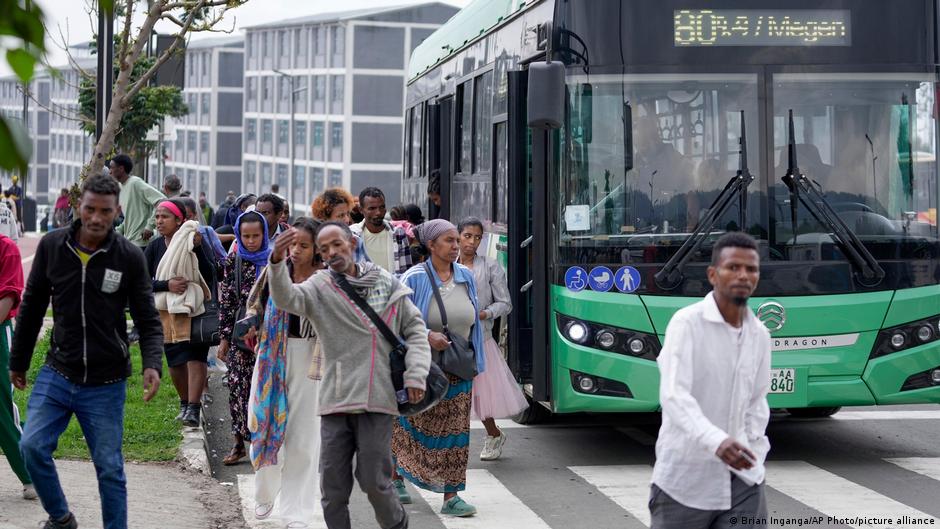
Shashe Asemare handles the large steering wheel with ease, steering the mint-green city bus through Addis Ababa’s notoriously congested streets. Ever since the Ethiopian capital added 100 new electric buses to its fleet by 2025, they have focused on the benefits.
“These electric buses are very different from gasoline buses,” he said, glancing at the cars overtaking on his left. “They don’t emit exhaust fumes or make annoying noises.”
The clean, quiet buses have also been popular with many of the 90,000 commuters who rely on new rapid transit lines like the Zeray Tekelu for their daily commute.
“It is very comfortable to travel in these. They are also better because they do not pollute the air,” he said, calling it “a step forward for our country.”
Ban on import of petrol and diesel vehicles
Addis Ababa, one of Africa’s fastest-growing cities, introduced climate-friendly buses last year Ethiopia bans import of gasoline and diesel cars.
Announcing the world’s first such ban as early as 2024, Transport Minister Alemu Sime declared Ethiopia’s support for “green growth”. This includes tax breaks for electric vehicles (EVs), 17 plants to make electric vehicles using parts from China, and a focus on climate-friendly public transportation, including fully electric light rail.
While the government has talked about Ethiopia’s green ambitions, there is another major reason for the move to go electric: the high cost of imported fossil fuels.
The East African country reportedly spent about €4 billion ($4.6 billion) on fuel imports in 2023 and 2024, a huge cost for one of the poorest countries on the continent. Conventional fuel prices are set to more than triple by 2022.
In March, the Ministry of Transport and Logistics said that global oil market instability caused by Iran shows that Ethiopia needs to accelerate its transformation and promote the use of electric vehicles along with other behavioral changes such as carpooling and walking or cycling.
Just two years after the ban was announced, more than 100,000 of Ethiopia’s 1.2 million registered vehicles are electric. The country is aiming to have 500,000 EV share by 2030.
Electric passenger cars represent more than 5% of the country’s total fleet, putting it on par with the European Union. This in a country where almost half the population of more than 110 million still lives without electricity.
Ethiopia’s EVs run on hydropower
While EVs eliminate tailpipe emissions, the electricity that powers the cars doesn’t always come from a non-polluting source. Many countries still rely on natural gas, coal or nuclear.
This is not the case in Ethiopia. Known as the “Water Tower of Africa” for its significant rainfall and numerous rivers, including the source of the Nile River, Ethiopia generates over 96% of its electricity from renewable hydropower. And the newly opened Grand Ethiopian Renaissance Dam, with a capacity of more than 5,000 MW of renewable energy, is expected to more than double the country’s electricity supply.
For many people in Ethiopia, where salaries are often less than €1000 a year, the starting price of a new electric car – €17,000 ($19,700/3.2 million Ethiopian birr) – is too high. But taxi driver Abdurrahman Ali is happy he made the change.
“For starters, EVs are more comfortable,” he said while behind the wheel of his mint-colored Changan hatchback, a Chinese brand.
“Before switching, I drove a Toyota Vitz – every month I would spend £40,000-50,000 on fuel. Since switching to electricity and charging at home, my monthly costs have fallen by at least £5,000. That’s a big difference.”
Need for more charging stations
But with more electric vehicles on the roads, Ethiopia is now facing a different problem: charging.
“The government should work harder on this area,” Abdurrahman said. He said charging service is only available in Addis Ababa, where “the number of charging stations is not sufficient.” There are about 500 in the country, mostly in the capital.
Private operators like Ezequias Duferra have noticed a gap in the market. Earlier this year, they opened a 24-hour charging station, which also includes an app they say provides customers with complete transparency on pricing. Despite the demand, they have faced some obstacles.
“Sometimes there are challenges in terms of power cuts,” he said, adding that the situation has improved. “But overall it’s been a really great opportunity.”
Ezekias will have no shortage of customers as Addis Ababa now plans to electrify the shared minibus taxi service. The backbone of the city’s public transportation, it consists of between 8,000 and 10,000 vehicles that carry more than two-thirds of the city’s passengers every day.
Reporting by Shewangizaw Wegayehu in Addis Ababa.
Edited by: Tamsin Walker