
Some rate the amount of BTC sold as “small” compared to total holdings,
Peter Schiff says there could be “much bigger” sales to come.
Between May 26 and 31, 2026, the company Strategy, founded by Michael Saylor, sold a total of 32 bitcoin (BTC) for an amount of $2.5 million, registering an average price of $77,135 per unit.
The operation was formally announced on June 1, through a company presentation before the United States Securities and Exchange Commission (SEC). This movement represents the first sale of the digital currency that the company has made since 2022.
The event generated an immediate division within the Bitcoin community, between those who justify the move as logical financial management and those who warn of possible bearish consequences. Despite the transaction, Strategy remains the publicly traded corporation with the largest amount of BTC in your possessionguarding a total of 843,706 bitcoin in its treasury.
The main trigger for this sale responds to an internal policy aimed at active management of the balance sheet and operating expenses, as they had already announced in 2023. The company evolved from a strict approach of passive accumulation to one that allows tactical executions.
As explains the investor known under the alias @CaesarJulius0, founder of the investment platform Stablejack, “the strategy has moved from a strict ‘never sell’ bitcoin policy to one that allows limited and tactical sales under specific conditions.” This turn had already been anticipated by CEO Phong Le and Michael Saylor himself. during the first quarter 2026 earnings call.
The root cause of the operation was the need to obtain institutional liquidity to comply with the obligations contracted with its investors. According to analyst @wyckoffweb, founder of the Web3 Original Work platform, the explanation It’s simple: “they needed cash to pay dividends/distribution obligations on their preferred shares.”
The analyst added that “these payments cannot be made with ‘conviction for bitcoin,'” so the firm had to opt for the liquidation of a fraction of its assets to obtain fiat money.
@CaesarJulius0 detailed that the determining financial factor is “funding the ~11.5% variable dividend on the large issuance of STRC perpetual preferred shares, which carries approximately $1.23 billion in annual obligations.” Sales were executed opportunistically looking for the highest cost currencies to minimize the fiscal impact.
Real dimension of the sale and market behavior
Despite the media hype on social networks, the amount of BTC traded is rated as insignificant by specialists compared to the total assets of the company.
The analyst known as @charttext highlighted that «32 BTC is 0.0038% of your 843,706 BTC. “It’s a rounding error.” In tune, @wyckoffweb emphasized that the volume “is very small compared to what they own,” arguing that public opinion reacts with panic “because of the image they built for years: ‘We don’t sell Bitcoin.'”
The announcement coincided with a correction in the market that took the price of bitcoin below $72,000 on the same day as the news, as CriptoNoticias reported earlier. However, analysts rule out that the fall was caused by organic sales pressure from the company.
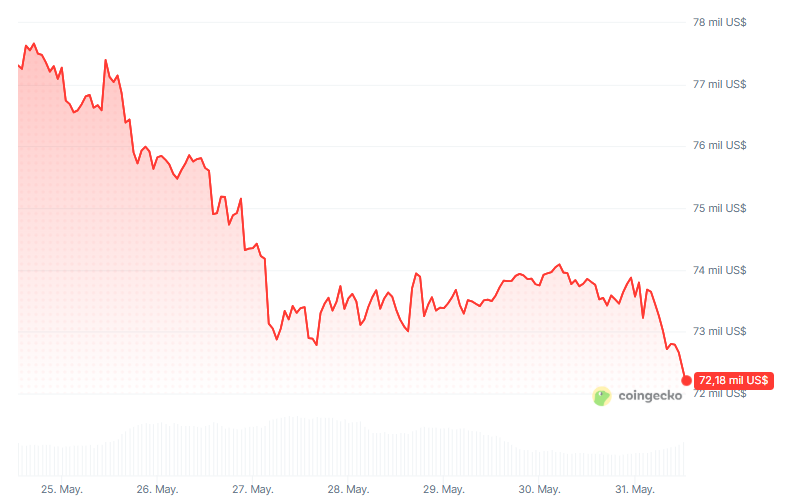
According to @charttext, the setback was emotional and enhanced by an adverse macroeconomic context: “the market was already bleeding: the MSTR fell 22% in a month, internal sellers, accumulation stopped and tension between Iran and the United States on the same day.”
The specialist defined the situation as “an increase in leverage disguised as bad news” where “90 million + dollars in long securities were liquidated”, using the headline of the sale as the psychological trigger. to hunt stall stalls.
There is also important precedent in the organization’s history. In 2022, Strategy sold 704 BTC for tax reasons, and then made purchases for a much higher volume. Therefore, these types of technical movements does not take the institutional market by surprise nor does it invalidate the company’s long-term accumulation thesis.
Debate and positions found in the community
The disclosure of the report to the SEC reactivated criticism from the most skeptical sectors of the traditional financial environment. Economist Peter Schiff questioned the future of the digital asset noting: “Since the largest buyer of bitcoin has now become a seller, where will the new demand come from to sustain the pyramid?”
In the opinion of the BTC detractor, Strategy’s move would be the prelude to big sales that, from his perspective, “could be to come.”
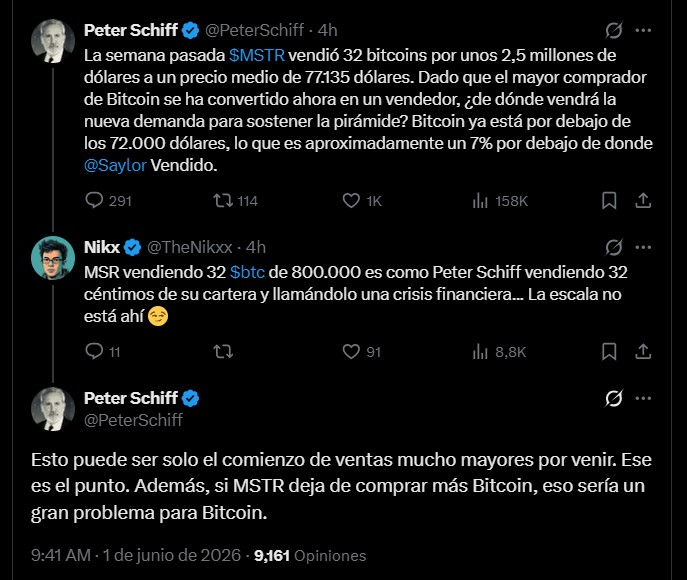
Likewise, journalist and television host Jim Crammer suggested that “maybe the pro-bitcoin stance needs to be rethought given how much Strategy has supported it.”
For his part, Carlos Moreno, business developer at Altura, reminded of the risks associated with corporate volatility and the financial past of the firm’s executive president: “Saylor became a billionaire during the dotcom bubble and lost everything afterwards, seeing his stock fall 99.9%.” Moreno closed his comment directly: “Michael, don’t screw up again.”
On the other hand, defenders of Saylor’s strategy see the move as a sign of business maturity. The financial advisor @ZynxBTC cataloged the reactions bearish such as “disinformation and FUD” (fear, uncertainty and doubt), ensuring that it remains “bullish by Strategy.”
The Argentine bitcoiner Nicolás Bourbón said something similar, who defended the logic of the operation explaining that “it makes no sense to assume that nothing will ever be sold under any conditions.”
“That, on the contrary, created a fear that they could go bankrupt, generating a worse explosion,” he said. Bourbón satirized the change in discourse by pointing out that “Saylor already made a statement about ‘never sell more than what you bought’…. so as long as he has 1 sat left, he complies.
Despite the initial psychological impact on retail investors and alarmist narratives from digital platforms, Strategy’s investment thesis in the digital asset remains intact.
The company maintains a 20:1 buy/sell commitment for each BTC settled, which means that the goal remains to be a net accumulator in the long term. It seems clear that the sale executed responds to a purely technical, fiscal and dividend distribution movement, and not to a loss of confidence in Bitcoin technology. Although anything can happen.