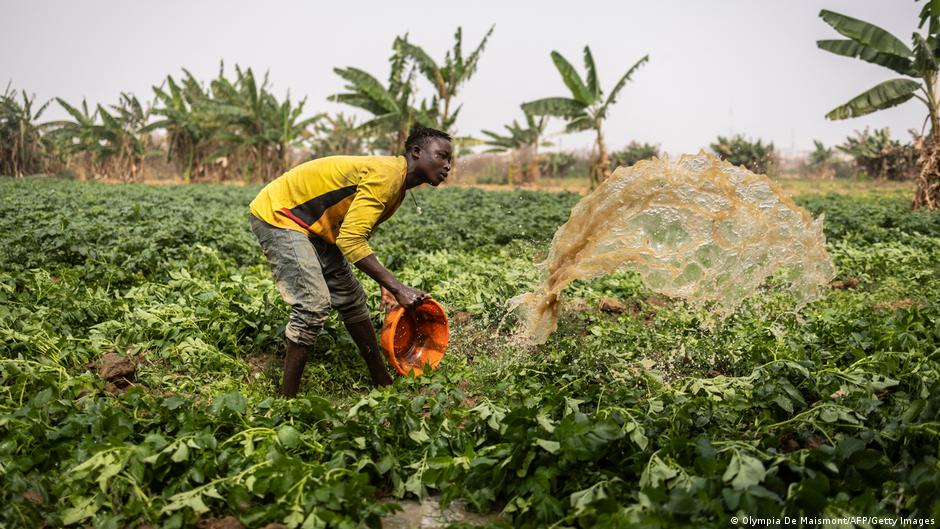
In the Sahel region, where many Fulani herders have historically lived, rising temperatures, drought and desertification have reduced grazing land. Now, pastoralists are increasingly moving their livestock beyond traditional boundaries and coming into conflict with sedentary farming communities.
wzb berlin The Center for Social Sciences used over two decades of data across Nigeria to examine the relationships between drought patterns, conflict events, and the religious structure of local communities.
Sociology professor Ruud Koopmans, a co-author of the study, said the data challenges the notion that climate change is the main driver of violence. Instead, he points to religious divisions as the deciding factor.
Religion influences violent conflict in the Sahel
“Where these Muslim herders meet farmers, who are majority Christian, that’s where we have the most violent confrontations,” says Koopmans, who works at Humboldt University in Berlin.
He adds: “Where there is this religious divide, conflict is exacerbated by drought.”
Researchers used a survey in Kaduna state, in north-western Nigeria, to establish that Christian respondents were more likely to attribute conflicts over grazing lands to religious reasons and to be more distrustful of Muslim Fulanis. Meanwhile, Muslim respondents were more likely to cite drought and competition for resources as causes of conflict.
Researchers say similar dynamics may apply outside Nigeria, including in parts of the Sahel where climate stress and social divisions overlap.
They also call for policies to address water and land management, as well as early warning systems and community-based conflict mediation in religiously mixed areas. They suggest that such measures could help prevent environmental pressures from escalating into violent conflict.
Religious tensions in northern Nigeria
According to Koopmans, religious tensions have intensified since the late 1990s. He cites the introduction of Sharia law in parts of northern Nigeria, resistance in mixed areas such as Nigeria’s Middle Belt, and the rise of Boko Haram as factors deepening mistrust between communities.
He argues that these developments have also revived old historical fears, especially among Christian communities.
Clashes are more likely in the middle belt, where Muslim herders and predominantly Christian farming communities interact. Conflict is less likely in northern areas where pastoral and sedentary communities are mostly Muslim.
According to the WZB study, shared religious identity can help limit conflict by appealing to religious authorities respected by both parties, making dispute resolution more likely and reducing the risk of violence.
According to the study, “When nomads and farmers are both Muslim, they are more likely to respect common religious norms related to property and the use of violence. There are clear spiritual benefits associated with harming people of the same faith.”
Fulani insurgency is fueling religious violence
The United States Commission on International Religious Freedom (USCIRF) identified armed Fulani groups as one of the most prominent non-state actors behind religious violence in Nigeria. It added that “an estimated 30,000 Fulani militants” are active across Nigeria.
“Although these militants do not share a centralized leadership, some cooperate in attacks,” According to USCIRF, It also said that violence linked to Fulani militants caused more deaths in religious communities last year than attacks by insurgent groups or criminal gangs.
While many attacks have focused on Christian communities, particularly in the Middle Belt and in southern Nigeria, Muslim communities have also faced raids, killings, and kidnappings.
The Washington-based US government commission says the militants have been described as carrying out coordinated attacks on rural communities, often at night, using motorcycles, firearms and machetes to drive residents off their lands.
The violence has contributed to mass displacement, with at least 1.3 million people forced into overcrowded and unsafe camps in the Middle Belt. Kidnapping for ransom has also become a prominent tactic, often targeting religious institutions.
Call for stronger security coordination in Nigeria
Legal expert and founder of the Abuja-based House of Justice, Gloria Mabeim Ballasan, says the scale of the threat remains to be independently verified due to the difficult lack of verifiable information presented by Nigerian authorities.
Bailason says these risk undermining public trust and warns that conflicting messages could fuel uncertainty and fear.
“These threats are real. This will help the government formulate a clear program and strategy to ensure that the next group of recruits to terrorism is prevented,” he told DW.
Retired Assistant Inspector General of Police Wilson Inalegwu says immediate efforts should be a combination of forces with better planning and coordination. He warned that attacks often spread across areas because authorities fail to anticipate patterns.
“The people of Kwara were not ready. They thought it was Niger’s problem. You went to Kwara, the people of Oyo thought it was Kwara’s problem. Now it is in Oyo. So, we should have very strong patrols in these areas,” he told DW.
Ben Adam Shemang in Abuja contributed to this article
Edited by Cai Nebe