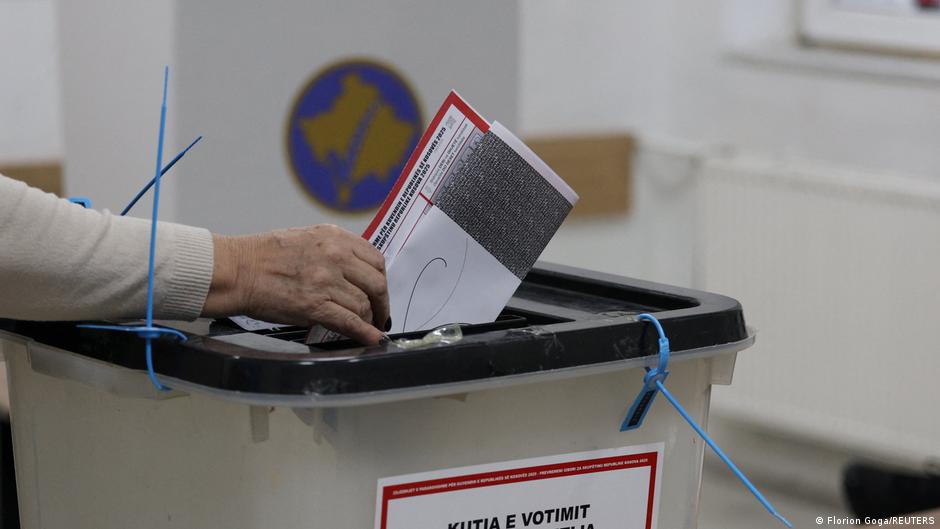
The current election campaign in Kosovo is marked not only by the usual competition between rival political parties, but also by the disintegration of one of the most important political coalitions in the country in recent years, namely that of Prime Minister Albin Kurti, who has led the government for the past six years, and former President Vjosa Osmani.
Osmani was already a political ally of Albin Kurti and had the support of the prime minister if he was elected president by the Parliament of Kosovo in 2021.
At the time, both were seen as drivers of change in Kosovo and the fight against corruption. Now, they are rivals.
no consensus in parliament
When Usmani’s term ended earlier this year, Kurti did not support him for a second term.
Kurti has said that “the President should be a unifying and representative figure,” and in his view, Osmani has political ambitions to join a political party and receive direct support from voters.
Instead, the Prime Minister put forward candidates from his own party, Vetevendosje. But the opposition MPs did not unite in favor of these candidates.
Sunday’s snap general election – Kosovo’s third in less than 16 months – was triggered after Kosovo’s parliament failed for a second time to elect a new president in April.
Osmani is now running for parliament as a candidate for her former party, the Democratic League of Kosovo (LDK).
Speaking at an election campaign rally, he told supporters, “You vote to decide whether Kosovo will be a state of its citizens or a one-man state.”
Why did the Kurti-Usmani alliance turn sour?
“Kurti and Osmani are politicians with opposite ideologies who were united at this time for a political rapprochement that citizens regard as hope for change, especially against corruption,” political analyst and journalism professor Arben Fetoshi told DW.
Fetoshi further said that although there were differences between the two on the subject of foreign policy and coordination with international partners, there were no major clashes between them during the four-year tenure of Kurti’s government.
He added, “Therefore, their rivalry in the current race stems primarily from the lack of support for Osmani’s second mandate, but does not exclude the personal dimension and ideological orientation of each.”
political hunter
For a country that is still trying to strengthen democratic institutions, move closer to the EU and pursue dialogue with neighboring Serbia, analysts say the endless cycle of elections in Kosovo highlights an even bigger problem, namely the inability of its political class to make institutional compromises.
Kurti’s Vetevendosje has won several elections since 2021, most recently in the last election on December 28, where it received 51% of the vote, almost 30 percentage points ahead of its nearest rival, the Democratic Party of Kosovo (PDK). This has given Kurti a significant advantage over his political rivals.
Political scientist Artan Muhaxhiri says the large electoral gap between Kurti’s Vetevendosje and the opposition parties has created a new political imbalance in which neither side is able to move forward with a solution.
He warned that if the results of this election do not bring major changes, the current impasse could continue.
impact on foreign relations
The consequences of the current situation are not limited to domestic politics.
Relations between Kurti’s government and Western partners have been difficult in recent years, particularly due to tensions in northern Kosovo, where more than 90% of the population are Kosovar Serbs, and the fact that Kurti’s government has taken unilateral steps there despite criticism from both Washington and Brussels.
These actions included the closure of parallel Serbian structures operating in Serb-inhabited areas of Kosovo, such as Serbian post offices, offices that issue various Serbian documents to Kosovar Serb citizens, and municipal facilities.
As a result, Kosovo has faced punitive measures from the EU and a significant deterioration in relations with some of its partners.
Kosova, Serbia and the European Union
Kosovo is the only Balkan country that still does not have EU candidate status.
EU officials have repeatedly stated that Kosovo’s European integration depends on the success of bilateral relations and negotiations with Serbia to improve the lives of citizens in both countries.
Artan Muhaxhiri confirmed this, saying, “Naively ignoring the situation has deepened the existing stagnation, leading to hundreds of millions of financial injections being wasted.” [of support from the EU] “And countless opportunities for political and economic reform.”
There have also been disagreements over how to manage negotiations with Serbia.
However, Arben Fetoshi says that the impasse in the negotiations with Serbia, which was mediated by the EU, cannot be understood without taking into account Serbia’s perspective on the process.
“There is another dimension to the impasse in the Brussels talks due to Serbia’s aggressive approach and expansionist goals. [Serbia’s] “The hybrid intervention in Kosovo – especially in the elections – aims to control the representation of the Serb community in order to continue using it as a tool against Kosovo,” he said, adding that the EU’s neutrality in the process of normalization between the two neighbors has not been successful.
increase in political rhetoric
Another feature of the June 7 election campaign is the hardening of political language – not only in election rallies but also on social media.
Alban Zanelli, a journalism professor at the University of Pristina, told DW that this shift toward harsher language is being used as an electoral tool.
“Politicians are using this language, which is extremely polarizing and includes insults, labeling and simplification, as a ‘divide and rule’ election strategy.” This way, they polarize and divide society to gain more support,” he told DW.
He said, “This language has serious consequences for society; it divides it even on issues that are not very political, such as the economy, security and education policies.”
Genelli further stated that after nearly two years of national and local election campaigns, the rhetoric has escalated, resulting in “physical clashes, threats and online violence against political opponents.”
What does Kosovo want from this election?
Analysts who spoke to DW agreed that despite the parties’ promises on economic development, wage increases or strategic investments, a key question in this election campaign is still whether Kosovo’s politicians are willing to build the culture of compromise they currently lack.
But even more important is the question of whether Sunday’s election will finally give Kosovo a political elite capable of governing, cooperating and putting the country back on the path of reform, dialogue and European integration.
Edited by: Angiel Flanagan