An ETH at USD 250,000 would imply a valuation of tens of billions of dollars.
Part of the value of tokenization is concentrated in applications, not ETH.
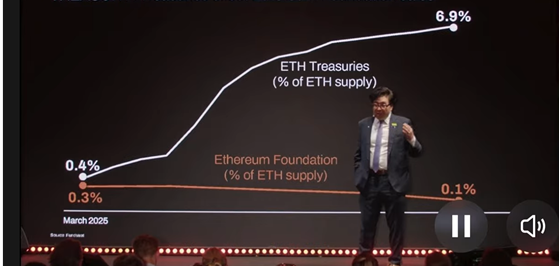
Tom Lee, co-founder of Fundstrat and president of Bitmine Immersion Technologies, projected on June 2, 2026 that ether (ETH) could reach $250,000 in the long term. The statement was made during the Proof of Talk conference, held in Paris, where he stated that ETH will first reach $5,000 before multiplying its price by 50.
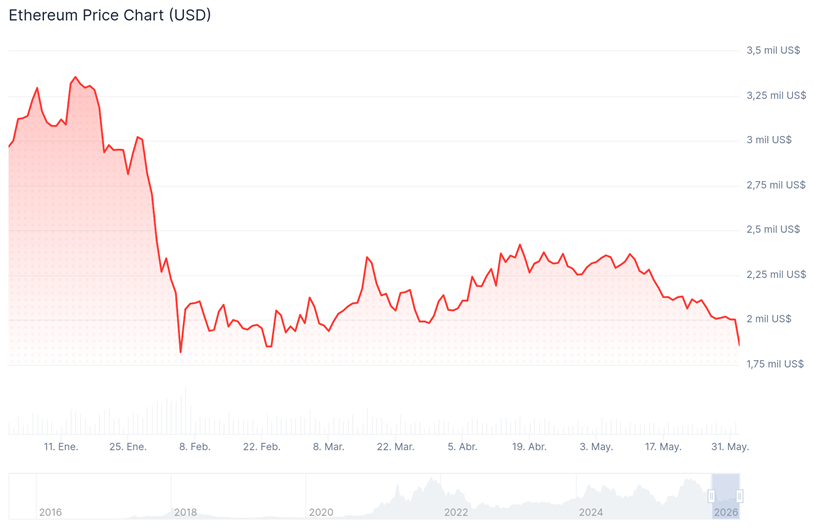
The prediction was made with the asset trading close to $1,900which It would imply a revaluation of more than 13,000% from current levels. Although he did not offer a date for that scenario, Lee argued that the expansion of asset tokenization, decentralized finance (DeFi), and artificial intelligence will drive a new stage growth for Ethereum.
During his presentation, the executive defended the idea that autonomous agents and artificial intelligence systems will need an infrastructure capable of executing payments, settlements and identity verifications automatically. In his vision, Ethereum is better positioned than traditional financial systems to become the base layer of that digital economy.
Lee also noted that network structure is changing. As explained, the Ethereum Foundation has significantly reduced its participation in the supply of ETH, while public companies and corporations accumulate more and more coins to allocate them to staking, increasing their influence within the ecosystem, as reported by CriptoNoticias.
It is worth noting that his thesis He has a direct relationship with Bitmine, the company he presides over. The company owns approximately 5.4 million ETHequivalent to more than 4% of the network’s circulating supply and valued at around $11 billion. Lee stated that if ETH were to hit $250,000, Bitmine shares could go from around $18 to around $5,000 per unit.
The contrast between the bullish view and the current state of Ethereum
However, Lee’s projection It comes at a particularly complex time for Ethereum. Over the past few years, the network has faced questions about its ability to capture economic value despite the growth of sectors such as stablecoins, tokenization and second-layer networks.
Added to this is that the performance of ether has been cause for debate within the market. Although the currency continues to be the second most valuable in the ecosystem, its relative behavior against bitcoin in recent years has disappointed some investorsfueling doubts about the strength of its value proposition.
The Ethereum community itself has also gone through internal tensions. In recent years There were departures of relevant figures linked to the Ethereum Foundationwhile different companies and projects have chosen to develop solutions outside the main network or on alternative infrastructures, reviving the debate on the competitiveness of the ecosystem.
Likewise, Lee’s prediction reactivated questions that have accompanied it in previous market cycles. One of the most frequent points to his bullish forecasts for bitcoin (BTC) and ether, which in some cases have not materialized within the initially proposed deadlines.
Another point of controversy is his position at the head of Bitmine. Because the company owns approximately 5.4 million ETH and bases part of its strategy on the accumulation and staking of the asset, it is considered that there is a direct economic incentive behind such an optimistic valuation for Ethereum.
Among the critical voices stands out Markus Thielenresearch director at 10x Research, who has questioned the idea that the growth of sectors such as stablecoins and tokenization necessarily translates into greater value capture for ETH. According to his analysis, a significant part of the value generated remains in the applications or in the issuers of the tokenized assetsinstead of accumulating in the native Ethereum currency.
Questions have also arisen from within the ecosystem itself. David Hoffmanco-founder of Bankless and one of the most recognized figures in the Ethereum community, recently argued that The “ETH as money” narrative has lost steam. According to Hoffman, the network is evolving towards a financial settlement layer rather than a form of ultra-solid money, a vision that contrasts with the theses that attribute massive value capture to ETH in the future.
Added to this is the magnitude of the objective set by Lee. A price of $250,000 per ETH would imply a market valuation of tens of trillions of dollars for the Ethereum network, a figure that is difficult to justify even under mass adoption scenarios of tokenization and artificial intelligence.
Regardless of whether Lee’s projection materializes, the debate once again puts tensions around Ethereum’s role within the market on the table. Between expectations of mass adoption and questions about its ability to capture value, the ecosystem moves between competing narratives that still do not show a clear consensus on its future evolution.