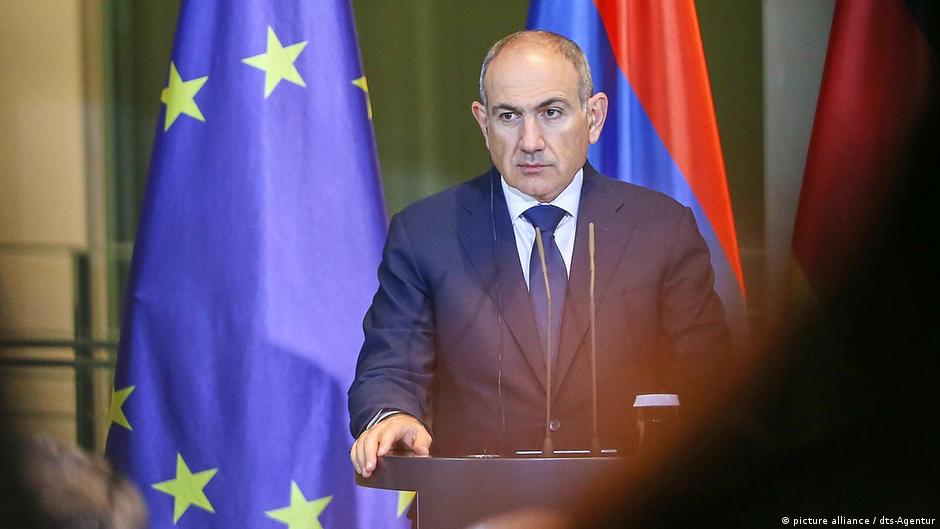
In the upcoming parliamentary elections in Armenia, citizens of the South Caucasian country will not only elect a new National Assembly but also decide the future geopolitical direction of their state. On the table is either rapid EU integration or a return to the Russian sphere of influence.
A pre-election survey conducted by Washington based NGO The International Republican Institute (IRI) ranks current pro-European Prime Minister Nikol Pashinyan’s “Civil Contract” party in first place, with 32% of respondents saying they would cast their vote in favor of the party.
According to the election results, the opposition traditionally has more pro-Russian views and is represented by three major forces that are currently far behind the ruling party. About 7% of voters said they would support the “Strong Armenia” bloc, run by Armenian-born Russian billionaire Samvel Karapetyan. He is currently under house arrest in Yerevan on charges of inciting a violent power grab because he publicly supported the Armenian Apostolic Church amid a bitter conflict between church leaders and Prime Minister Pashinyan.
The political group “Armenia Alliance”, led by former President Robert Kocharyan, who is reportedly a friend of Russian leader Vladimir Putin, is expected to get 4% of the vote. The “Prosperous Armenia” party, founded by business mogul Gagik Tsarukyan, can probably count on the support of 2% of Armenian citizens. Tsarukyan’s party officially partners with Russia’s ruling ‘United Russia’ party.
The remaining five political parties, including some new protest projects, are only polling around 1-2%.
Experts cautioned that these numbers should be considered with caution given the unprecedentedly low response rate, with only 16% of respondents agreeing to participate in the poll. This is 19 percentage points less than before the 2021 snap election. Whereas in 2021, 92% participants expressed their desire to vote compared to 72%. Nearly one in two respondents declined to name their preferred candidate or said they had not yet reached a final decision on how to vote.
However, other polls showed different results, even giving Pashinyan’s “Civil Contract” party about a third of the vote, suggesting he may have a smaller lead than anticipated against the opposition.
New political vector: Brussels or Moscow?
International affairs are an important issue in the election campaign. The ruling party has gradually moved closer to the EU while distancing itself from Russia and the Collective Security Treaty Organization (CSTO) – a military alliance overseen by the Kremlin.
In May 2025, the Armenian Parliament adopted a law to begin the process of joining the European Union. During the ongoing election campaign, Nikol Pashinyan promised to ensure a visa-free regime with Europe within the next two years.
In early May, Pashinyan hosted the European Political Community summit in the Armenian capital, Yerevan. At the press conference after the summit he told that his country is “not an ally of Russia” when it comes to war against Ukraine.
There was a sharp reaction to this rhetoric in Moscow. In late May, President Vladimir Putin threatened to impose tariffs on Armenia and create new legal barriers for its citizens wishing to work in Russia. He, along with other members of the Eurasian Economic Union (EAEU), suggested that Armenia hold a referendum on whether it wants to join the EU or remain part of the EAEU.
As Russia remains the largest market for Armenian agricultural produce, Moscow has sought to leverage its trade ties with Yerevan. Before the elections, Russia’s Federal Service for Veterinary and Phytosanitary Supervision imposed a number of restrictions on Armenian imported products, including vegetables, berries, wine, flowers and fish, under the pretext of alleged violations of sanitary norms.
Also, Moscow has informed Yerevan that their agreement on preferential supplies of gas and petroleum products to Armenia may be suspended.
Putin compared Armenia’s current political context to Ukraine’s political context in 2014, which he called a “crisis”. He warned that adopting European standards would lead Moscow to end its economic cooperation with Yerevan.
Russia is trying to influence the elections!
Moscow’s interference in the upcoming elections became a topic of heated discussion in Armenia long before the voting.
Tensions in the campaign rose sharply following a publication by Russian independent investigative media outlet The Insider about an alleged Russian espionage network in Armenia. According to the investigation, Russian billionaire and leader of the “Strong Armenia” party Samvel Karapetyan mentioned the Information Center of Russia’s Federal Security Service as his employer in his application for a passport issued in 1999.
Armenian security forces regularly initiate criminal cases against representatives of the pro-Russian opposition on charges of espionage. The opposition describes these cases, as well as The Insider’s article, as “political prosecutions”.
A new page in US-Armenian relations
In addition to changes in the EU, Pashinyan’s government is deepening its dialogue with Washington. Recently the two countries signed a charter on comprehensive strategic partnership and a memorandum on rare earths.
In August 2025, Armenia and Azerbaijan paved the way for an ambitious logistics project brokered by US President Donald Trump and informally called Trump’s Route. It aims to connect Azerbaijan with its exclave Nakhichevan through southern Armenia. The agreement is a significant step toward ending the blockade imposed on landlocked Armenia by neighboring Azerbaijan and Turkey amid a long-running dispute over the breakaway region of Nagorno-Karabakh.
Pashinyan’s party describes Armenia’s future relations with Russia as ‘transformational’ rather than friendly. According to the party, the reason for this is the diversification of foreign policy. This change does not go unanswered by Moscow. The crisis in relations between the two states began to escalate in late 2022, when the CSTO and Russia effectively failed to respond to Yerevan’s request for military assistance amid a border conflict with Azerbaijan.
In contrast, the main opposition forces act as ideological opponents of the current ruling regime. They insist on the restoration of a strategic alliance between Armenia and Russia, seeing it as a key security guarantor in the peace process with Azerbaijan.
Dispute around Nagorno-Karabakh
Nikol Pashinyan made the idea of a “real Armenia” central to his election campaign, rejecting revisionists’ calls to restore the country’s “historical borders”. These include the region of Nagorno-Karabakh, which was previously controlled by pro-Armenian separatists. Azerbaijan regained control of the breakaway region after the 2023 war, ending more than three decades of conflict.
The opposition criticizes this approach, insisting that Yerevan should advocate for the right of ethnic Armenians of Nagorno-Karabakh who had to flee as a result of the war to return to their homes. Officials accuse their opponents of pushing the country to the brink of war with Azerbaijan with their hostile rhetoric.
Despite the tensions, 71% of participants in the survey conducted by IRI believe the elections will be free and fair, while 61% of them said the country is moving in the right direction. 17% of the respondents consider border security as the main challenge for their country.
Edited by: Jess Smee