
Only bitcoin as a store of value and stablecoins as a means of payment would be the current narratives.
“Bitcoin is the only currency with a compelling long-term argument,” says the analyst.
The cryptocurrency market has lagged behind traditional markets. For example, while the price of bitcoin and most crypto assets is falling, the S&P500 index is trading near all-time highs. Such a situation raises questions about the real usefulness of most crypto assets.
Geneva Investor, a financial analyst, published a report on May 27, 2026 in which he warns that the narratives that fueled thousands of cryptocurrency projects have lost steam. According to the specialist, these assets are suffering severe wear and tear because they did not fulfill their initial promises of technological and financial advancement.
“What we are witnessing coincides with a bearish scenario,” he points out. He adds that the sector faces a “narrative problem” as cryptocurrencies generally did not act as a hedge against inflation in the short term.
It is worth clarifying that, unlike cryptocurrencies in general, bitcoin (BTC) has historically demonstrated be an asset capable of acting as a true refuge and hedge against inflation in the long term. This property is based on its programmed absolute shortage of a maximum of 21 million coins and its monetary policy regulated by halvings every four years.
The analyst gives as an example DeFi platforms that provide financial operations without intermediaries through smart contracts and attracted millions of users in previous years. However, the sector faces serious obstacles. DeFi is a still experimental technology that operates live, handling billions of dollars.
As CriptoNoticias reported, the DeFi industry faces incentives to be breached, composable code that spreads risk from one protocol to the next, and an attack surface that grows faster than the ability to audit it. This vulnerability was exposed after the wave of hacks, “corralitos” and freezes by decree that affected several protocols, especially between April and May of this year.
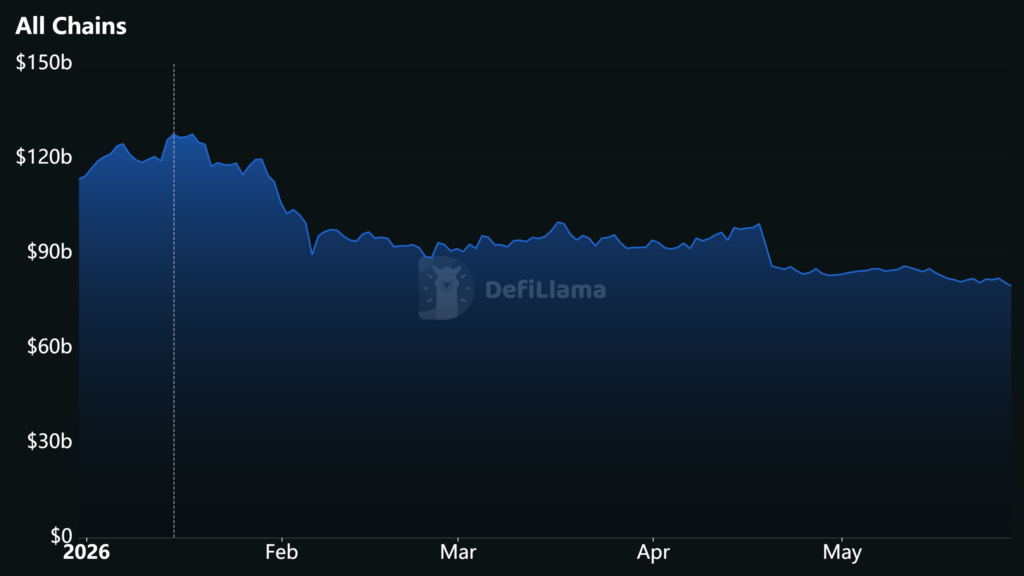
Reflecting this reality, the total value locked (TVL) in DeFi fell 36% from $127 billion at the beginning of the year to $78 billion today.
“Despite the lower euphoria for new projects, trading volume has remained practically stable over the last two years,” says the analyst. According to the report, the value is generated mainly in the fees charged by exchanges and custody platforms, and not in the networks or tokens themselves.
Project saturation — with tens of thousands of tokens launched in the last decade — diluted retail investors’ capital. As a consequence, many cryptocurrencies that previously dominated by market capitalization lost positions drastically, says the specialist.
“What is even more worrying is that many cryptocurrencies that were in the top 10 by market capitalization during the 2020-2021 BTC bull market have fallen off that list,” noted Geneva Investor. Among those projects, the analyst mentions, for example, cardano (ADA), polkadot (DOT) and litecoin (LTC) which now occupy the 13th, 37th, and 23rd positions respectively.
Currently, ADA is trading at $0.22, 92% below its all-time high of $3 reached in 2021. DOT is at $1.13, 98% away from its peak of $55, while LTC is trading at $49, 88% below its all-time high of $412 also recorded in 2021.
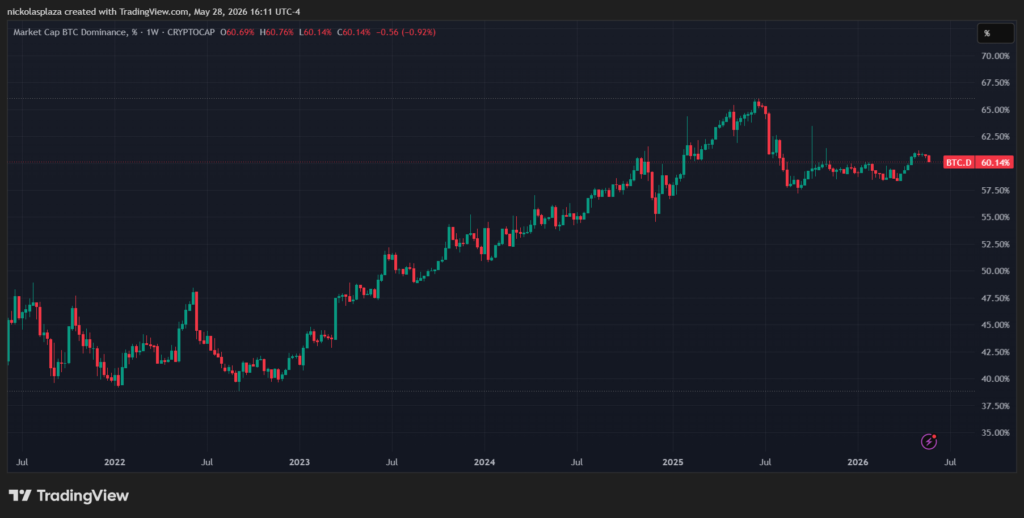
This loss of ground is also reflected in the dominance of bitcoin (BTC), which currently stands at around 60%, as seen in the chart. This level indicates that bitcoin has gained a greater relative market share against cryptocurrencies.
The music will continue to play for bitcoin
Geneva Investor states that bitcoin remains, by far, the digital currency that most justifies an investment.
I think bitcoin has established itself as an increasingly dominant currency. This shows that it is still the crypto asset with the strongest market narrative, and the one that has not been carried away by the logic of active trading instead of real value creation. In this sense, I continue to consider it the most interesting asymmetric bet in this area.
Geneva Investor, financial analyst.
Its consolidation as a global reserve asset would depend, according to Geneva Investorthat central banks, pension funds and governments adopt it on a large scalesomething that “remains to be seen,” he says.
The analyst also considers that ether (ETH), Ethereum’s cryptocurrency, could be an “interesting option, as it is the main network that supports stablecoins.”
In addition to the narrative of bitcoin as a store of value, the analyst also looks favorably on the stablecoins USDT and USDC, two tokens that have been favored by the advance of the Clarity Law in the United States. This legislative proposal seeks to create a clear federal regulatory framework for issuers of this type of cryptocurrency, requiring reserves backed one by one with liquid assets and prohibiting risky algorithmic variants.
«Of course, investing in a stablecoin does not make sense, since by definition it is pegged to the underlying currency. What could make sense is to invest in financial institutions and projects related to the use of stablecoins. Among these options are acquiring shares of companies such as Circle (issuer of USDC), custody infrastructure providers or institutional payment gateways that integrate stablecoins.
The current landscape forces ecosystem participants to abandon speculation based on promises and demand proven infrastructure and real value, the report notes. This transition redefines the risk map and points towards a more mature and professionalized market in the coming cycles.