
For BloFin analysts, the idea that Strategy would never sell bitcoin “was always a myth.”
Michael Saylor’s silence after the first bitcoin sale in 4 years is striking.
The analysis firm BloFin questioned the financial architecture of the company Strategy. A recent report from the consulting firm ensures that the myth of absolute retention of bitcoin (BTC) was debunked, after it was revealed that Strategy activated a surprise sale of funds in the market.
For BloFin, the capital engineering designed by the American company presents vulnerabilities. «The Strategy model with bitcoin suffers from a structural imbalance», the organization sentenced in a report published on June 2, 2026 when evaluating the operational sustainability of the company founded by Michael Saylor.
The break materialized between May 26 and 31, 2026, when Strategy sold 32 BTC for $2.5 million, thus registering its first BTC sale since 2022, as reported by CriptoNoticias.
BloFin argued that the company’s commercial obligations clash with the nature of the digital asset. The consulting firm explains that Strategy “finances the accumulation of an asset that does not generate returns and that fluctuates violently through capital and debt that carry rigid and recurring obligations, with interest and preferred dividends that mature regardless of the price.”
In addition to this, the sale of digital assets was carried out in the midst of a price correction in the bitcoin market that has already been going on for several weeks. This situation put even more pressure on the price of bitcoin, which at the time of writing is below $66,000 and is estimated to continue falling.
The trigger for BloFin criticism lies in the financing obligations of the company. The executive president of Strategy, Michael Saylor, had anticipated on May 5, during the presentation of results for the first quarter of 2026, the possibility of selling part of its funds.
“We will probably sell some BTC to fund the dividend,” Saylor stated at the time. The objective of the measure is to cover the returns on its preferred shares called STRC, a hybrid financial instrument that works similarly to a bond and pays a variable annual dividend of close to 11.50% in cash to investors.
It is worth clarifying that despite the sale, Strategy remains the listed corporation with the largest global reserves of the digital currency. At the moment, The company’s treasury accumulates a total of 843,706 BTC, a figure that preserves its status of institutional leadership.
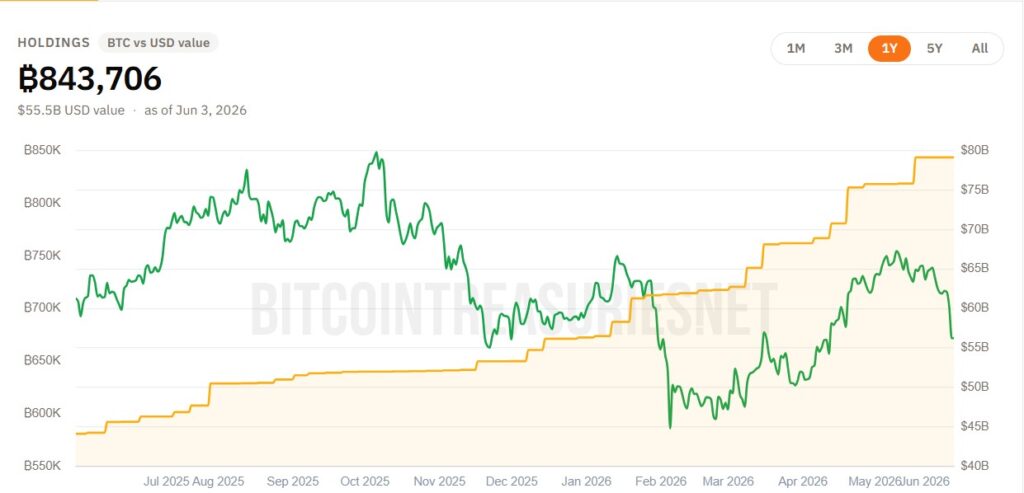
The transaction broke absolute retention promises
So far, Saylor has not directly explained the reasons for this sudden liquidation. Faced with this scenario, BloFin pointed out that “that is not like him. Normally, all your purchases are announced with great fanfare on social networks; This time, faced with a change of course, he did not say anything”, except for a message published today on the social network X that only says “back to work» (back to work).
For BloFin analysts, The transaction destroyed the credibility of the company’s long-term investment narrative. «What was broken was a promise, not a policy. For years, Michael Saylor preached ‘never sell’, thus becoming the main defender of that conviction,” highlighted the consultant.
From BloFin’s perspective, the volume of the operation takes a backseat to the change in precedents. «Therefore, size hardly matters. Even with 32 coins, what matters is that the line went from ‘never’ to ‘once’. “Zero versus non-zero is a difference of nature, not of degree,” the analysis company argued. This means that the true impact is not in the number of coins sold, but in the fact of having broken the rule of never selling.
Faced with BloFin’s negative reading, alternative valuations emerged within the corporate sector. Mason Foard, director of bitcoin strategy at Meliuz, a Brazilian company focused on bitcoin treasury, pointed out that The important context behind Strategy’s sale of 32 BTC is linked to risk rating agencies such as Standard & Poor’s (S&P).
“When S&P assigned Strategy a ‘B minus’ credit rating, it cited dependence on capital markets as a weakness, ‘particularly given that the company is reluctant to sell the bitcoin it holds as investments,'” Foard recalled to contextualize the institutional pressure on the company.
For the Meliuz executive, The transaction responds to a need for validation before traditional financial markets and not to a structural weakness. «This sale directly refutes that criticism. Far from showing a change in its treasury philosophy, Strategy demonstrated that BTC is not trapped on the balance sheet. “It is a liquid reserve asset that can be used when management considers it economically rational,” Foard said.
There is a possible institutional domino effect
For its part, BloFin’s vision remains that This move alters expectations of predictability of the cryptoasset market in general.. “When the most convinced preacher opens the door himself, the price reference point stops being a fixed value and becomes a variable that must be continually guessed at,” the analyst firm warned.
Researchers believe that breaking absolute retention introduces uncertainty for business operators. «Bad news is absorbed; “uncertainty silently reduces the valuation premium, and uncertainty is what markets hate the most,” they added.
Additionally, the firm warned of a potential domino effect on other companies with digital treasury (DAT) strategies. «Strategy is the largest DAT company in the world. Once the leader puts the option of ‘sell’ on the table, its smaller competitors with fewer resources selling under liquidity pressure begins to seem normal,” BloFin warned.