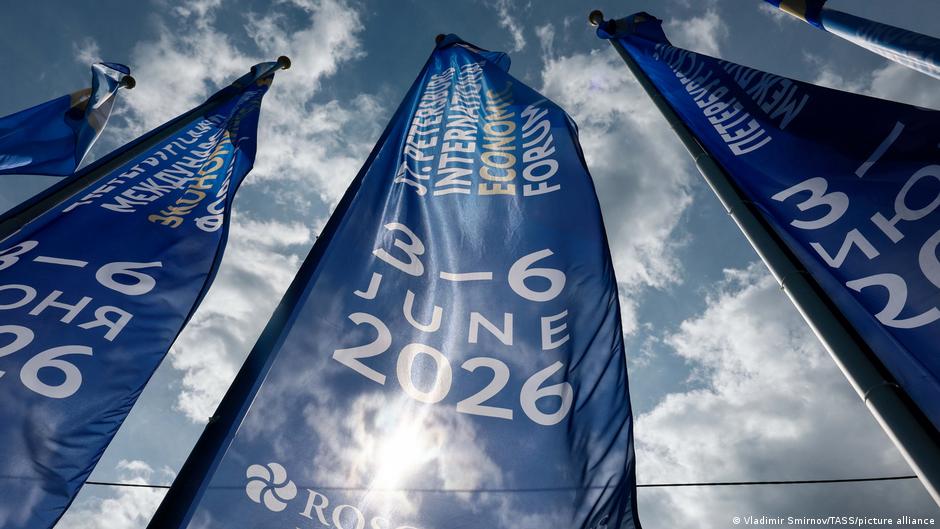
This year’s St. Petersburg International Economic Forum (SPIEF), which opened on June 3, is the fifth to be held since Russia launched a full-scale invasion of Ukraine in 2022.
Before the war, the forum served as a venue for the signing of major investment agreements with foreign companies. At the time, the EU was Russia’s major economic partner, and the forum attracted prominent Western politicians, business leaders and senior officials.
But after Russia invaded Ukraine, major Western economies withdrew ties and the forum’s highest-profile foreign participants increasingly came from countries that are no longer among Moscow’s major economic partners.
This year, the leaders of Uzbekistan and Tanzania, Shavkat Mirziyoyev and Samia Suluhu Hassan, are set to share the stage with Russian President Vladimir Putin in a joint panel.
Is there a German delegation in St. Petersburg?
Something that has made headlines in the Russian media in the days before the forum, however, is the alleged withdrawal of German businesses into SPIEF. However, the companies participating in this program have little connection with Germany.
According to Kirill Dmitriev, Putin’s special envoy for investment and economic cooperation with foreign countries, “Germany is sending an official trade delegation to St. Petersburg for the first time in many years”.
In reality there is no such delegation.
Hypermarket and Germany’s Globus Holding
According to the official programme, among the forum attendees is Thomas Bruch, shareholder of German retail chain operator Globus and one of Germany’s wealthiest businessmen. Bruch is ranked 2,386th on the 2026 Forbes Billionaires list, with an estimated net worth of $1.7 billion (€1.4 billion).
Bruch is not attending the forum on behalf of Germany’s Globus Holding, its spokesperson told DW. He also emphasized that from January 2025, the company’s Russian stores are not part of Globus Holding, which operates supermarkets in Germany and the Czech Republic.
In St. Petersburg, Bruch is representing Russian Hyperglobus, which operates hypermarkets solely in Russia, the spokeswoman said. He said the purpose of Bruch’s participation in SPIEF is to “maintain business contacts and exchange ideas with representatives of the business community and government agencies.”
Russian milk producer Econiva
The business path of another German participant, Stefan Dürr, is completely linked to Russia.
His Econiva Group is one of the largest milk producers in the country. In 1989, while a student at the University of Bayreuth, Dürr interned at an agricultural enterprise near Moscow and later began cultivating buckwheat and millet in Russia.
in an interview with financial Times Last year, Dürr said that Russia’s 2014 embargo on EU products in response to Western sanctions following its annexation of Crimea was one of the biggest drivers of his company’s growth.
Swiss newspaper businessman himself advised Putin to ban new zurich newspaper Reported in 2023. According to multiple reports, in addition to being German, Dürr has held Russian citizenship since 2013.
An Econiva spokesperson confirmed that Dürr was attending the St. Petersburg Forum. However, he did not answer DW’s questions about the purpose of his visit.
Industrial Equipment and Engineering
Another entrepreneur mentioned in the SPIEF program is Leo Eppinger. According to business verification platform Spark Interfax, he also holds both Russian and German citizenships.
According to his profiles on Facebook and Xing, in 2016, after graduating from a university in Moscow, Eppinger became head of the Russian office of the German-Swedish joint venture Metlock Engineering.
Following the beginning of the Russian invasion of Ukraine, Metlock Engineering ceased all cooperation with its Russian subsidiary and currently “has no business relations with Masterlock, the company founded by Mr. Eppinger,” a spokesperson for Metlock Engineering told DW.
The company he mentioned, Masterlock Engineering, is registered in the Moscow region. According to its website, it calls itself the “full successor” to Metlock Rus, the Russian branch of the German-Swedish Metlock and focuses on the repair of industrial equipment in Russia and the CIS countries.
According to their website, the Russian branch of Metlock Engineering was similarly transformed into Masterlock Engineering in 2024. Leo Eppinger did not answer DW’s questions.
Polina Sharova is another confirmed forum participant. She is the owner of Hermes-Ural, a Yekaterinburg-based industrial equipment manufacturer.
Sharova’s only connection to Germany is the acquisition of Russian assets of the German industrial group Viessmann Climate Solutions after the start of the war in Ukraine. Neither Hermes-Ural nor Viessmann responded to DW’s request for comment.
What remains of Russian-German trade?
The St. Petersburg Economic Forum is hosting several lawmakers from Germany’s far-right Alternative for Germany (AfD), who serve in the European Parliament, the German Bundestag and regional parliaments across Germany.
German daily newspaper owner berlin newspaper Holger Friedrich is also participating in the forum. Meanwhile, former German Chancellor Gerhard Schröder was spotted in Moscow on the eve of the forum, German broadcaster NTV reported. It is not clear whether he will attend the event in St. Petersburg.
The composition of what Russian officials and media describe as the “German delegation” accurately reflects the current state of economic relations between the two countries.
Sanctions, corporate exits and energy decoupling from Russia have taken their toll. In 2025, bilateral trade fell below €10 billion, down significantly from around €60 billion in 2021.
The Moscow-based lobby group German-Russian Chamber of Commerce, which has no ties to the German government, declined to comment on the German participants at the meeting, citing DW’s position in Russia.
Russia designated DW in December as an “undesirable” organization as part of its crackdown on independent media. According to Russian law, any cooperation with such an organization is a criminal offense.