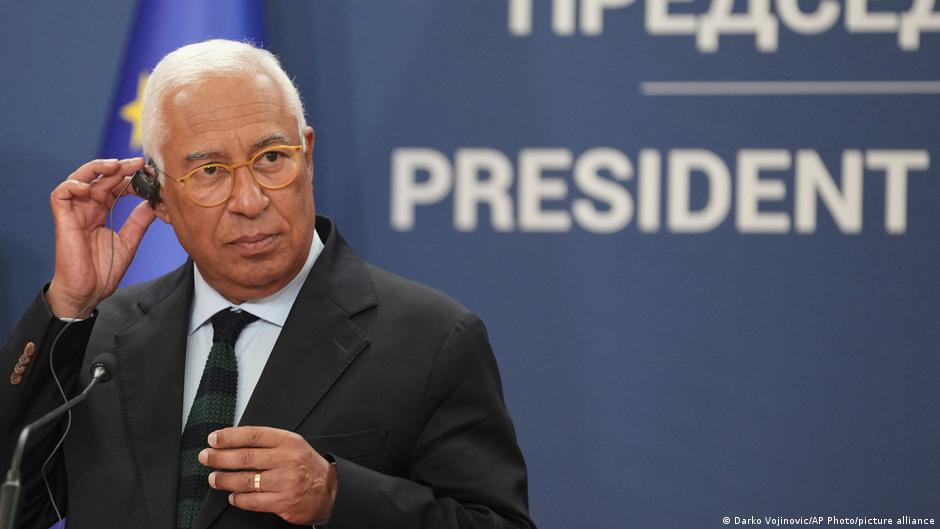
European Council President Antonio Costa said on Thursday the EU needs to find ways to speed up the membership process for the six Western Balkan candidate countries.
“For us, enlargement in the Western Balkans is the most important geopolitical investment the EU is making,” Costa said during a joint press conference with Serbian President Aleksandar Vucic in Belgrade.
Albania, Bosnia-Herzegovina, Kosovo, North Macedonia, Serbia and Montenegro have been seeking to join the group for some time, but have not yet completed the rigorous process.
EU leaders meet to find ways to make process ‘faster and better’
“Tomorrow European leaders will discuss with leaders from the Western Balkans how we can improve our approach to move forward faster and better,” Costa said. He emphasized that this is not meant to make the process “easy.”
Costa further said that “in order to promote trust between each other,” there should not be a sense of disappointment on the part of the countries involved and also on the part of the EU.
“Expansion is not a utopia but something that can become real in the coming years,” Costa stressed. “For this we need to work harder and faster.”
The EU-Western Balkans summit begins on Friday in Tivat, Montenegro and provides an opportunity for leaders to assess progress on the path to EU membership.
Costa is on a tour of Western Balkans candidate states ahead of the Tivat summit and on Thursday he told Serbia’s populist president that his administration needs to promote democratic reforms while aligning its foreign policy with the EU.
Belgrade has already been warned that it could lose about €1.5 billion ($1.8 billion) in EU funds if it does not stop the democratic backlash.
Tension between candidate states
Meanwhile, differences between candidate states threaten to overshadow the summit.
Host Montenegro on Wednesday banned 87 Serbs from entering the country, saying they are a security threat. The men had arrived in Tivat on an Air Serbia flight accompanied by security agencies and said they had communication equipment and banners reading “Serbia wins.”
Following the ban on Serbian citizens, Serbia’s security agency warned Vucic not to travel to Montenegro for Friday’s summit, citing security threats.
Serbia’s Security and Information Agency (BIA) said on Wednesday that a trip to Montenegro poses a high security risk for Vucic due to “hostile activities of foreign secret services and the presence of a criminal clan there.”
Twenty years after seceding from the state union with Serbia, Montenegro is seen as the Western Balkans’ frontrunner for EU membership, but continues to struggle with Belgrade’s political influence as well as corruption.
Edited by: Shawn Sinico