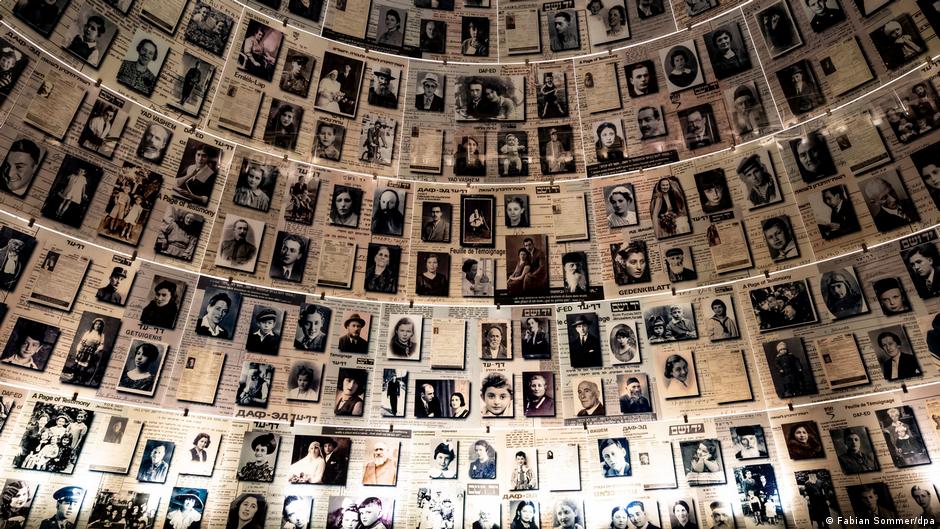
The memory of the Holocaust may be ubiquitous in Israel, but it is fading elsewhere, even in the country where it was planned and carried out.
Nearly 80 years after the end of World War II, a 2025 survey by the Jewish Claims Conference found that about 10 to 12% of young adults in Germany had never heard the word “Holocaust”. The same study found that nearly 40% of 18 to 29-year-olds in Germany did not know that six million Jews were murdered during the Nazi era.
That’s why Yad Vashem – the world’s largest Holocaust memorial located in Jerusalem – is setting up a branch in Germany. It is the first outside Israel. “We have not come to Germany to strengthen German democracy or to warn against the rise of a far-right party in Germany,” Yad Vashem President Dani Dayan told DW. “We have come to teach about the Holocaust. Educating is a tool in the fight against anti-Semitism. But I have no doubt that our work will strengthen German democracy and will be a weapon in warning against the rise of a political party that has its roots in Nazi ideology, and I will not hesitate to mention it clearly: the AfD.”
the poison of antisemitism
Jews have been stigmatized and persecuted for over 2,000 years. They were scapegoated by the Romans during political crises, stigmatized as “God’s murderers” by Christians, and targeted by the myth of Jewish “ritual murder” of Christian children in the Middle Ages, leading to show trials and bloody pogroms. Anti-Semitism as a racist ideology ultimately reached its peak in the Holocaust.
Dayan says, “I thought that after the Shoah and the devastation it caused in Europe – not only to the Jewish people, but in Germany and Europe – I thought that at least we would be, I don’t know, free from anti-Semitism for 100, 200 years. But yes, as we see, unfortunately that’s not the case.” “In a polarized world, as we see in many societies today, hatred of Jews and the Jewish state has become the language of all extremists in the world.”
Anti-Semitic attacks are also increasing in Germany. The decision to open the Yad Vashem Education Center in downtown Munich was partly motivated by the city’s high security standards. The historical importance of Munich as the birthplace of the Nazi movement was not the determining factor – yet the center would be housed in a building on central Carolinenlitz, the former headquarters of the Supreme Party Court of the Nazi Party.
There are also plans to open a second branch in Leipzig. As Dayan emphasizes, these spots are not just for Bavaria and Saxony – they are for audiences across Germany. He says, “It is very important to bring the Jewish perspective of the Holocaust, the perspective of the victims and survivors, to Germany, the land of the perpetrators.”
Germany already has no shortage of monuments, museums and memorials dedicated to the horrors of the Holocaust. So what will Yad Vashem in Munich do differently? “It is not intended as a museum containing exhibits and original artifacts related to the murdered Jews,” Dayen stressed, but as an interactive educational center.
Details about what this will look like in practice are scarce.
Meron Mendel, German-Israeli journalist and director of the Anne Frank Educational Center in Frankfurt, has questioned why German Yad Vashem branches were not integrated into existing institutions specializing in Holocaust education, such as the Nazi Documentation Center in Munich. After all, Dayan has praised Germany’s efforts to deal with Nazi crimes.
When entrepreneur and former US government representative Elon Musk said at the AfD party conference in January 2025 that Germany should leave behind its culture of remembrance, Dayan appealed. He said that these comments were not only an insult to the victims and survivors of the Shoah, but also a threat to German democracy.
Criticism of Yad Vashem: How political is the institution?
When news broke that Yad Vashem would open centers in Munich and Leipzig, German politicians reacted with equal enthusiasm – including politicians from the AfD.
However there was criticism from Meron Mandel. He argued in several news outlets that Yad Vashem is not independent: it answers to the Israeli government, which is currently dominated by far-right politicians who have a “clear interest” in defining anti-Semitism in a way that would allow criticism of Israel to fall under that label, Mandel said. In his view, there is a possibility that an institution under the authority of that government can easily reflect its agenda.
Dayan himself is not untouched by controversies. From 2007 to 2013, he chaired the Yesha Council, the umbrella organization for Jewish settlers in the occupied Palestinian territories – an organization the International Court of Justice has ruled in an advisory opinion saying the occupation violates international law. He later served as Israel’s Consul General in New York from 2016 to 2020.
When he was appointed president of Yad Vashem in 2021, many worried that the remembrance institution would be drawn into politics. Dayan vowed that he would not do so. He said at the time, “I have created a virtual firewall between myself and politics. The mission I have taken is sacred to me and I will never spoil it.”
Dayan told DW that allegations of Mandel’s politicization are absolutely false. “Yad Vashem is a state institution but not a government institution. Yad Vashem is completely independent. The idea that we are an instrument of a certain government – this government, any other government – is completely wrong.” He says he can point to several cases where Yad Vashem and the Israeli government have taken not only different but diametrically opposite positions.
He also noted that the Netanyahu government had already tried to push them out – a threat that was ultimately defeated in 2023 with the support of the broader scholarly community. “We are watching with great concern the recent attacks on Dani Dayan by the Israeli Education Minister,” 123 Holocaust researchers from around the world wrote in an open letter. He “serves the Institute in an excellent manner, helping Yad Vashem maintain its independent and non-partisan character.”
What will happen when there are no eyewitnesses?
For Dayan, the urgency of this moment depends on one thing: keeping the memory of the six million Jewish victims of the Holocaust alive at a time when the last survivors are dying. “The formative experience of hearing a survivor tell his or her story to us will not exist for children born today,” he says, expressing skepticism that artificial intelligence can fill that void.
Yad Vashem is experimenting with other ways to reach visitors emotionally – through theatrical presentations and immersive experiences that use music and large-scale projections to draw people into the vanished Jewish world destroyed by the Holocaust.
Dayan worries that once the last survivors are gone, it will be easier for Holocaust deniers to spread their lies. He says the world is not back to the 1930s – but it is moving in that direction.
He argues that what makes today different is that no one can claim ignorance any longer: “There is a difference between the generation of the 1930s and the contemporary generation. People in the 1930s had the privilege – indeed, the naivety – to say: They can burn books or set fire to synagogues, but they will never burn people. In 2026, we don’t have that privilege, because we know that It has happened once, it can happen again.”
This article was originally written in German.