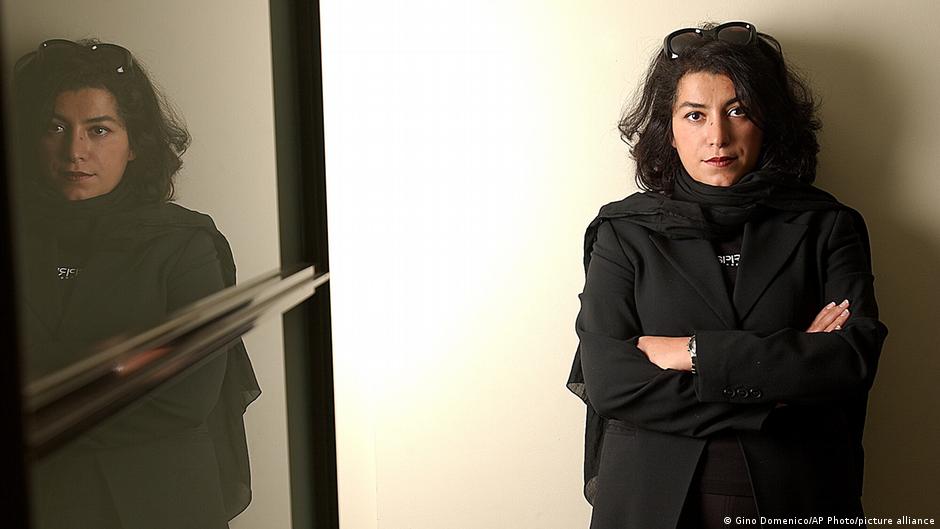
According to news agency AFP, Franco-Iranian artist Marjane Satrapi, who became famous worldwide through her graphic novel and film “Persepolis”, has died at the age of 56.
“Marjane Satrapi sadly died a little more than a year after the death of her husband and the love of her life, Mattias Ripa,” her family said in a statement sent to AFP.
Ripa, Swedish producer, actor and screenwriter, died on April 8, 2025.
After her husband’s death, Satrapi founded the Mattias and Marjane Ripa-Satrapi Cinema Foundation to support foreign students wishing to come to Paris to study filmmaking, and she expressed her grief by posting this message on Instagram: “Because I have lost the love of my life.”
‘Persepolis’ is a landmark work for the graphic novel genre
Iranian-born writer, painter and filmmaker best known for her landmark work of autobiographical literature, “Persepolis.”
The acclaimed graphic novel portrays Satrapi’s early life in Tehran. As a young teenager, she struggled under restrictions imposed by Iran’s new Islamic leadership after the 1979 revolution. His parents sent him to Europe where he began life in exile.
With its bold black-and-white imagery and frank, often satirical storytelling, “Persepolis” introduced many readers in the Western world to the political and social context of Iran. The work also demonstrated that graphic novels could serve as a medium for serious literary expression.
A rebellious teenager in Islamic Tehran
Born in Rasht, Iran, on November 22, 1969, and raised in the capital, Satrapi grew up in a politically engaged family, which shaped her early worldview. His childhood unfolded against the backdrop of the Islamic Revolution of 1979 and the subsequent establishment of the Islamic Republic, experiences that would later form the backbone of his most famous work.
Having been exposed to Western political ideas at a very young age, her parents encouraged her to be strong-willed and defend her rights. But as social restrictions tightened under Iran’s Islamic rule, her family became concerned for her safety, as she disregarded modesty codes and listened to banned music. They sent him to Vienna at the age of 14.
The dislocation and conflict he experienced abroad – the isolation, cultural confusion and his eventual return to Tehran – became the central theme in “Persepolis”.
First published as a series in French in 2000, “Persepolis” was later compiled into a single volume and translated into more than 30 languages. It won several prestigious literary and comedy awards.
Beyond “Persepolis”, her books include “Embroideries” and “Chicken with Plumes”, both of which explore personal and family history.
In “Woman, Life, Freedom” (2024), she collaborated with more than 20 activists, artists, journalists and academics to depict the fight for women’s rights in Iran, paying homage to the 2022 Iranian uprising following the murder of Zina Mahsa Amini, a 22-year-old Iranian Kurdish woman, while in custody for violating the dress code for women.
In addition to her graphic novels, Satrapi was also an award-winning filmmaker. In 2007, he co-directed an animated adaptation of “Persepolis” with Vincent Parronaud. The film premiered at the Cannes International Film Festival, where it won the Jury Prize, and received an Academy Award nomination for Best Animated Feature.
Satrapi also continued to work in film, directing the 2011 adaptation of “Chicken with Plums”, and later “The Voice” (2014), an English-language dark comedy starring Ryan Reynolds. His filmmaking displayed the same blend of visual inventiveness and emotional intensity that marked his literary work.
A voice for freedom of expression
Satrapi spent most of her adult life in Europe, arriving in France in 1994 and gaining French nationality in 2006. She often reflected on exile, identity, and the misunderstandings that arise between cultures.
Throughout her career, Satrapi has been a vocal supporter of freedom of expression and a sharp critic of authoritarianism.
His work resists simplistic political narratives. While sharply critical of the Iranian regime, he also challenged derogatory or stereotypical portrayals of Iranians in Western media. “I am Iranian,” she often suggested in interviews and in her work, “but that identity includes a lot of people.”
“The first thing I learned was that you can’t judge an entire country based on its government.”
She was also critical of the French government, refusing her the French Legion of Honor in 2025 over what she described as the country’s “hypocrisy” in its dealings with Iran.
With an intimate chronicle of her personal experience, Satrapi leaves behind a body of work that has reshaped how stories of revolution and exile can be told, and her stories will continue to inspire generations to come.
“We can be loudspeakers, that’s all,” he once said in an interview Guardian. “If we think we’re anything more than a loudspeaker we’d better not talk – it’s a matter of decency.”
Edited by: Martin Kuebler