
On July 1, EU exchanges must withdraw USDT, the market-leading stablecoin.
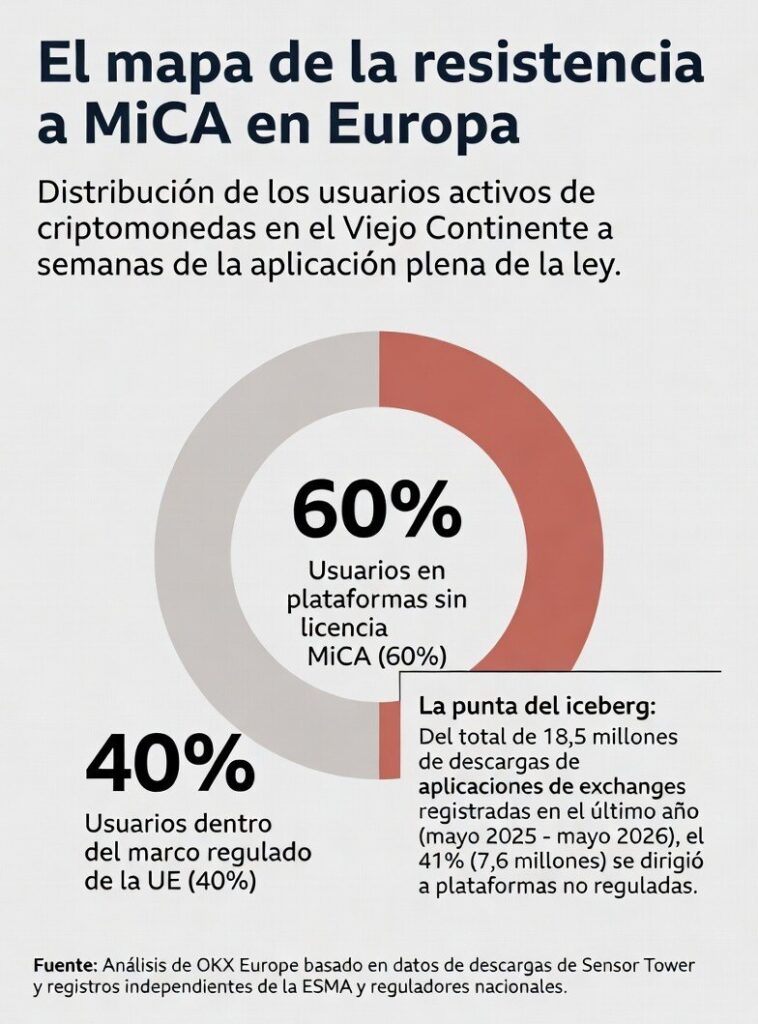
41% of digital asset app downloads correspond to unregulated exchanges.
There are just 26 days left for the European financial system to draw a new frontier. On July 1, the definitive entry into force of the Regulation on the Cryptoasset Market (MiCA) will force regulated platforms in Spain and the rest of the European Union to remove Tether (USDT), the most traded stablecoin on the planet, from their showcases. This regulatory train wreck is a geopolitical reconfiguration that threatens to isolate retail investors from the global liquidity engine of the digital asset ecosystem.
The paradox that surrounds this new regulatory corralito is profound. Designed under the premise of providing legal certainty and “protecting the investor”, MiCA requires that the issuers of stablecoins operate under traditional banking rulesguarding a large part of its reserves in regional entities and submitting to scrutiny of the European Securities and Markets Authority (ESMA).
However, Tether, which has expanded its international presence by establishing key operations in El Salvador for its global strategy, chose not to validate this state design. Paolo Ardoino himself, CEO of Tether, repeatedly warned that the requirements imposed by Europe are extremely “uphill”, pointing out that the obligation to maintain 60% of reserves in bank deposits not only limits operation, but also introduces systemic risks to the funds themselves.
By attempting to protect the user by forcing out USDT, the law risks pushing the user into a fragmented market, with fewer options and more costly trade executions. “MiCA creates a systemic risk that Europe is not prepared to manage,” warned Mike Belshe, CEO of BitGo.
Street resistance with USDT in Europe
Hard market data supports this contradiction and anticipates a tectonic impact in the region. A recent OKX Europe study reveals that 60% of cryptocurrency users in the Old Continent continue to operate in platforms that lack a valid license under the new legal framework.
The inertia towards unregulated circuits is so marked that, of the 18.5 million downloads of exchange applications registered between May 2025 and May 2026, some 7.6 million, that is, a resounding 41%, corresponded to platforms outside the official registry of the ESMA.
And in this scenario of regulatory resistance, USDT remains the backbone of daily trading. According to the DefiLlama control panel, the asset maintains an overwhelming global dominance of almost 60% of the capitalization of stablecoins, equivalent to about 187 billion dollars, consolidating itself as the true digital dollar of European investors despite pressure from Brussels to impose local alternatives, as reported by CriptoNoticias.
In fact, a recent Consensus report shows that the trading hours of the European market concentrate a highly active part of the global USDT volumes. Trade with the Tether currency in the Old Continent is so persistent that firms like Kaiko Research detected that continued to hold a dominant share of liquidity even in the midst of exclusion alerts, showing that European investors are reluctant to abandon their favorite digital dollar.
Effects of MiCA on European Union stablecoins
This disconnect between street preference and government mandate has become an obstacle course. To comply with ESMA guidelines, large authorized exchanges such as Binance, Coinbase and Crypto.com They have already delisted or severely restricted the token for its clients in the eurozone. The immediate consequence is that State protection is forcing operators to migrate towards alternatives with much less liquidity, making each routine transaction more expensive and complicated.
As a counterweight, the void left by USDT seeks to be taken advantage of by options that have aligned themselves with MiCA. The big beneficiary in digital dollars aims to be USD Coin (USDC), issued by Circle, which has been strategically positioned to absorb the continent’s legal liquidity. In parallel, Brussels has tried to promote the use of tokens anchored to the euro (such as EURC or EURT); However, these local options continue to face marginal adoption as investors prefer the global market depth offered by US dollar-pegged currencies.
In any case, the outcome of this countdown will measure the real force between the mandates of regulators and the true preferences of a mass of users that already operates largely outside the official umbrella.
Starting July 1, the European retail investor faces an immediate crossroads: accepting the restricted and more expensive options of licensed platforms, or migrate your funds to self-custody wallets and decentralized platforms to operate in the international circuit, assuming full responsibility for their private keys to preserve their freedom of choice against the protection of the law.