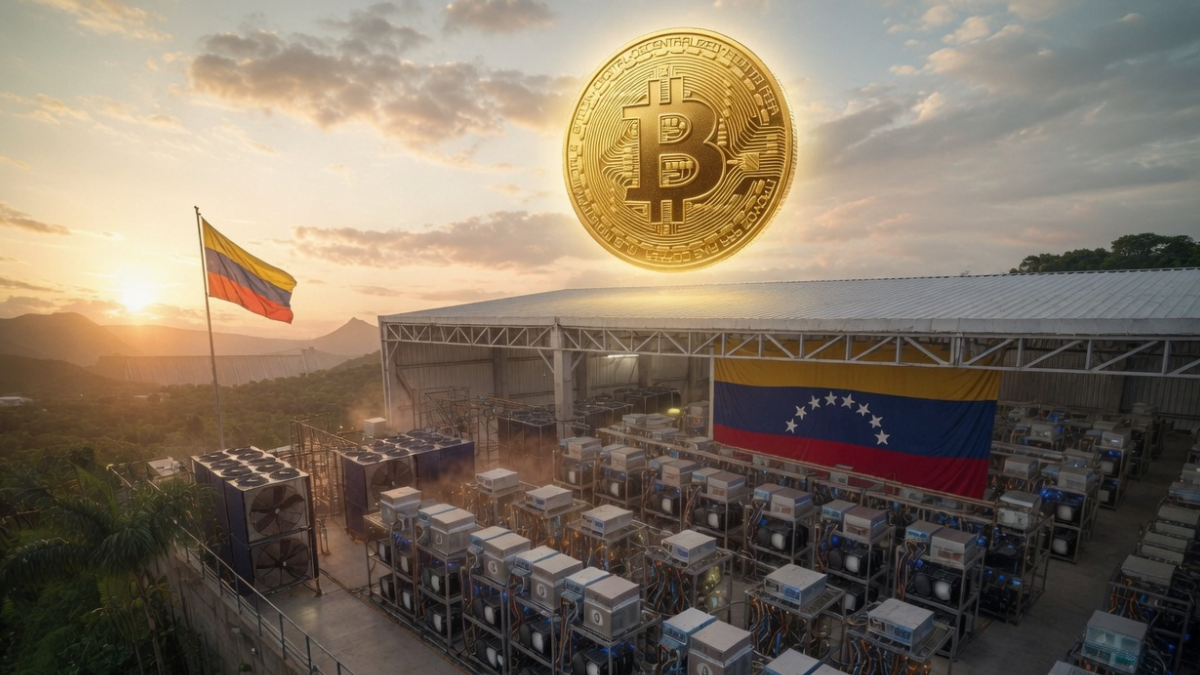
The reform would open an opportunity for Bitcoin miners to settle in the country.
Venezuela wastes up to 7,500 MW south of Bolívar state, according to Sultan Bitcoin.
Bitcoin mining in Venezuela could receive a strong boost and scale at an industrial level given that the National Assembly (the Venezuelan parliament) approved this June 2 in first discussion and unanimously a partial reform of the Organic Law of the Electrical System and Service that enables the participation of pure private capital in generation, transmission, distribution and commercialization of electricity for the first time since 2007, according to the official statement of the legislative body.
For Alessandro Cecere, known in X as El Sultán Bitcoin, Venezuelan economist and member of the Luxor Bitcoin mining pool team, The reform opens a direct opportunity for Bitcoin mining on an industrial scale.
The law that the reform seeks to dismantle, the LOSSE 2010reserved the entire electrical chain exclusively to the State, limited private self-generation to projects smaller than 2 megawatts (MW) without ministerial authorization and required that the State maintain no less than 60% of the capital in any joint venture.
The reform approved in the first discussion, explains Cecere, introduces four models of participation: state companies, mixed companies with a state majority, companies with a minority participation of the state and pure private companies. It also incorporates concessions of up to 25 years extendable for 15 more, and a tariff principle that for the first time recognizes that rates must cover real costs and allow reasonable profitability for the investoraccording to the Bitcoin Sultan.
However, the reform is not without obstacles. Engineer David Morán, whose analysis of the text Cecere cites as the most rigorous available, identified real barriers that should be corrected before final approval.
Among them, articles 33 and 34 establish the reversion of assets to the State at zero cost upon expiration of the concession; Article 38 enables the State’s discretionary preventive intervention over any operator; and articles 103 to 107 establish personalized criminal liability against directors of concessionaire companies.
Cecere recognizes these limitations, but frames them as a correctable starting point: the drafts are corrected before the second discussion, not after.
Bajo Caroní and the possibilities for Bitcoin miners
Beyond the reform, Cecere points out that Venezuela has a concrete opportunity in the energy it wastes today. Bajo Caroní, the southern region of Bolívar state where Venezuelan hydroelectric infrastructure is concentrated, including the Guri dam, It has up to 7,500 MW of capacity which, if reactivated, could not be distributed to the north of the country due to the limitations of the 765 kilovolt high voltage line. This energy has no viable local buyer.
In that context, a Bitcoin mining operator who installs 100 MW next to that dam with a BOT contract (Build, Operate and Transmit, a concession scheme in which a private party builds and operates infrastructure for an agreed period and then transfers it to the State) would not compete with any Venezuelan home for a wattaccording to Cecere, and would generate dollars that could finance local structures.
To gauge the potential benefits that Bitcoin mining would bring, the Sultan gave as an example what is happening in Paraguay. There, he explained that he visited the mining complex of the Canadian company HIVE Digital Technologies (HIVE), which has some 400 MW powered by the surplus hydroelectric power of the Itaipú dam. without consuming energy destined for homes or local industry.
For ANDE, the operator of the national electrical system of Paraguay, and which allocates 1 GW to mining, the money it receives from the miners represents 60% of its total income.
Venezuela wastes energy with which it would exceed the entire hashrate of Bolivia
Finally, and as reported by CriptoNoticias, Cecere had already highlighted a problem that the reform of the energy law does not solve on its own. This is the energy that is wasted in the Orinoco Belt region. There, gas is burned associated with its oil production equivalent to 344,000 barrels per day, according to the Venezuelan analyst.
That energy that is dissipated without use, converted into Bitcoin mining, would exceed all the computing power that Bolivian miners contribute to the network (2.5 exahashes per second), according to the Bitcoin Sultan analysis. Venezuelan miners currently add 5 EH/s, 0.469% of the global total.
The reform opens the legal framework, while the energy resource, according to Cecere, already exists and is being wasted. What persists, for now, is the mining ban in force throughout Venezuelan territory, which the Venezuelan government itself justifies by overloading a network that operates with 35% of homes suffering daily interruptions.