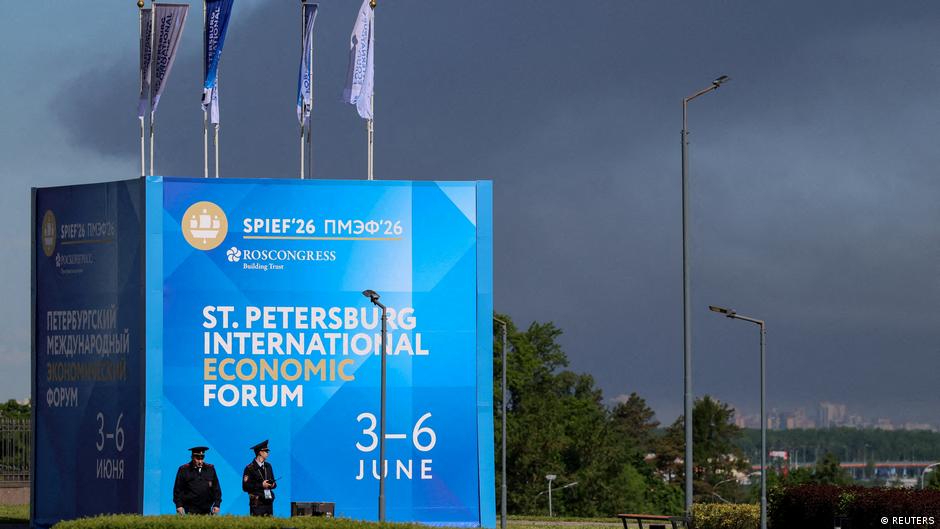
The Russian city of St. Petersburg was targeted by a fresh attack by a long-range Ukrainian drone on Saturday, as an international economic forum concluded in the city.
In the Leningrad region around Saint Petersburg (formerly known as Leningrad), local governor Alexander Drozdenko said air defenses shot down 141 drones in an “unprecedented attack”, while people within the city were warned to take shelter.
“In accordance with the recommendations of the emergency response team, I ask residents of St. Petersburg to stay in their homes and not go out on the streets,” city governor Alexander Beglov wrote on Telegram. There may be interruption in mobile internet.
The nearby island of Kronstadt in the Gulf of Finland, home to Russia’s Baltic Fleet, was also targeted, causing fires. The Ukrainian Security Service (SBU) claimed to have targeted missile and ammunition arsenals, saying “such special operations undermine the Baltic Fleet.”
Just south of Kronstadt on the Russian mainland, local media reported 600 people had to flee their homes in the coastal town of Bolshaya Ishora, while St. Petersburg’s Pulkovo airport, used by many of the economic forum’s international guests, temporarily halted flights.
The attacks on St. Petersburg and the surrounding area, about 1,000 kilometers north of Ukraine, were part of a wider wave of attacks in several Russian regions.
The Russian Defense Ministry said a total of 376 Ukrainian drones were “intercepted” over the Belgorod, Bryansk, Kaluga, Kursk, Leningrad, Novgorod, Oryol, Pskov, Rostov, Ryazan, Smolensk, Tver and Tula regions, the Moscow Region, the Republic of Crimea, the Republic of Abkhazia and the waters of the Azov and Black Seas – areas covering thousands of square kilometers of the vast Russian Federation.
Ukraine’s Zelensky describes ‘just reaction’
Ukrainian President Volodymyr Zelensky described the attacks as a “appropriate response” to continued Russian aggression against Ukraine, four years after Russia’s full-scale invasion.
The Ukrainian Air Force said on Saturday it had shot down 249 of the 272 Russian drones launched against Ukraine overnight.
One person was killed and three were injured in Ukraine’s eastern Dnepropetrovsk region as Russian forces attacked three districts about 30 times using drones and artillery.
“It’s time to end this war but Russia’s rulers want to keep fighting,” Zelensky wrote on social media. He claimed that “Ukrainian sanctions against this aggression are working.”
Saturday’s large-scale Ukrainian drone strike was the second in three days targeting the St. Petersburg International Economic Forum.
Speaking at an event in his hometown on Friday night, Russian President Vladimir Putin acknowledged that the attacks were causing “some damage” to the economy, admitting: “Nothing good comes naturally from these attacks.”
But it also came a day after Putin rejected an open letter from Zelensky proposing direct talks to end the war, saying he saw “no point” in a face-to-face meeting in a neutral country.
Responding to Putin’s rejection of the proposed meeting, Ukrainian Foreign Minister Andriy Sibiha said on Saturday that things would “only get worse” for Russia.
“[The] Failures will become more humiliating,” he wrote on social media, warning that “there is no safe place in Russia that would be free from long-range Ukrainian attacks,” and the intensity of those attacks “will continue to increase.”
London: Zelensky to meet Starmer, Macron, Merz
On Sunday, President Zelensky is due to travel to London for meetings with British Prime Minister Keir Starmer, French President Emmanuel Macron and German Chancellor Friedrich Merz.
The leaders are expected to discuss further support for Ukraine and the latest developments in the so-called “coalition of the willing” of 35 largely European countries working to support Kyiv.
Despite Putin’s rejection of Zelensky’s proposal, sources close to the German government told the dpa news agency, “Gradually, a window for dialogue is opening between the European side and Russia.”
NATO is increasing security in Sweden and Finland
Meanwhile, NATO forces this weekend launched operations aimed at boosting security in Sweden and Finland, Russia’s two Scandinavian neighbors that abandoned decades of military non-alignment to join the alliance after the invasion of Ukraine.
Both countries lie on the Baltic Sea, which is used by Russian warships heading towards St Petersburg or the Russian exclave of Kaliningrad, while Finland, which shares a border with Russia, fought two wars against the Soviet Union during World War II.
U.S. Gen. Alex Grinkevich, NATO’s supreme allied commander in Europe, said NATO’s northeast is “one of the most strategically important and environmentally challenged regions in the world.”
In 2024, NATO established a new multinational military presence in Finland called Forward Land Forces (FLF) Finland, designed to act as a rapid-reaction unit. NATO maintains similar land units in Bulgaria, Estonia, Hungary, Latvia, Lithuania, Poland, Romania and Slovakia.
Edited by: Jennifer Cimino Gonzalez