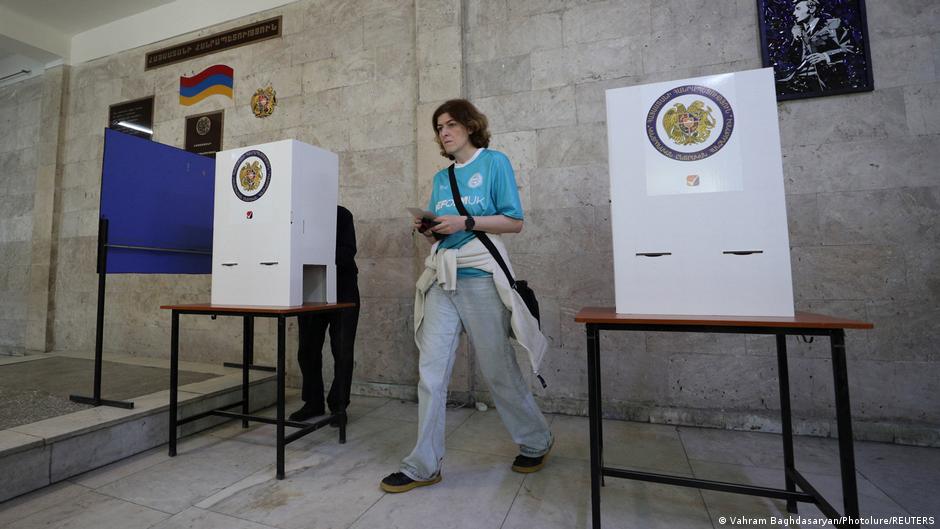
Armenians began voting in parliamentary elections on Sunday in a move likely to boost the country’s pro-EU trajectory, despite Russia’s anger over the government move.
Prime Minister Nikol Pashinyan’s ruling Civil Contract party has the pro-Russian Strong Armenia party as its nearest rival in the election, which is also seen as a referendum on Pashinyan’s peace efforts with Azerbaijan.
Polls have shown that Pashinyan and his party are in the lead with 32% support, while Strong Armenia has only 11% support.
This appears to indicate some support for Pashinyan’s efforts to move Armenia closer to the West since coming to power in 2018, although he would not be able to rule alone if the election results are confirmed.
In contrast, Strong Armenia, formed last year by Russian-Armenian billionaire Samvel Karapetyan, wants Armenia to remain close to Russia, a major trading partner and energy supplier.
What is Russia’s stance on Armenia’s elections?
Yerevan’s rapprochement with Europe has raised eyebrows over Armenia’s former Soviet master, Russia.
Last month, Russian President Vladimir Putin made a veiled threat about the negative economic impact of moving away from Moscow if Armenia continues on its path.
In the weeks before the election, Russia has made such theoretical economic threats more concrete by imposing new sanctions on Armenian produce, including flowers and vegetables.
Putin also suggested that Armenia may face the same crisis as Ukraine, saying that Kiev’s problems “began with its efforts to move towards joining the European Union.”
European Commission President Ursula von der Leyen called it a case of “Moscow weaponizing economic relations for political pressure”, which the EU has taken action against.
He promised €50 million ($57.6 million) to the country as well as more comfortable trade terms for goods targeted by Moscow.
Pashinyan’s peace deal with Azerbaijan is in focus
Despite still maintaining the lead in pre-election surveys, Pashinyan has come under attack from the opposition and some sectors of the public, who have accused him of capitulating to Azerbaijan.
Armenia and Azerbaijan have been locked in a long-running conflict since the 1980s, primarily over Nagorno-Karabakh, a breakaway region inhabited by ethnic Armenians that Azerbaijan took back in the 2023 war.
Critics say Pashinyan made too many concessions to Azerbaijan in the US-brokered deal signed last August.
He has also been accused of authoritarianism, with many of his opponents landing behind bars in recent years.
The government has defended its actions, saying that those imprisoned were attempting a coup.
Polls opened at 8 a.m. local time (0400 GMT) and closed at 8 p.m., with about 2.48 million people registered to vote. 3 million.
Edited by: Dmytro Lyubenko
Don’t let algorithms hide news. If you rely on our team for reliable reporting, please take a moment Select us as your favorite source on Google by clicking here and pressing the “Star” or “Favorite” buttonThat’s why you’ll always see our verified news first.