Many countries are increasing their military capabilities – and nuclear weapons are again on the agenda.
According to the Stockholm International Peace Research Institute (SIPRI), all nine nuclear-armed countries modernized and expanded their arsenals in 2025. In addition to new nuclear weapons, additional delivery systems have been introduced that can be equipped with both conventional and nuclear warheads. These include missiles or cruise missiles.
For the 2026 annual report, SIPRI researchers identified a general trend: more governments are once again relying on nuclear weapons for national defense. Tytti Erastow, a scientist at SIPRI’s Weapons of Mass Destruction program, told DW that Finland and Sweden are examples of countries that have changed nuclear policy following Russia’s invasion of Ukraine and joining NATO in 2022.
“These states, historically known as non-aligned supporters of nuclear disarmament, are now actively involved in NATO nuclear policy, for example by participating in exercises that simulate nuclear weapon use,” Erasto said.
According to SIPRI, there were approximately 12,200 nuclear weapons worldwide in 2025. Although this is a slight decrease compared to 2024, it is not an indicator of disarmament. Currently, more old warheads are being removed than new ones are being added.
The researchers found that change would likely occur. “This trend is likely to reverse in the coming years, as the pace of dismantling continues to slow, while the deployment of new nuclear weapons accelerates,” they wrote.
Governments are ‘increasing their nuclear powers’
In 2009, US President Barack Obama was celebrated for his vision of a world free of nuclear weapons. Current developments show that the world is moving in the opposite direction. In February, the last remaining international agreement limiting the number of nuclear weapons expired – the New START treaty between the United States and Russia.
Hans M. Christensen, a nuclear weapons expert at SIPRI’s Weapons of Mass Destruction Program and the Federation of American Scientists, said, “There is increasing evidence that nuclear-weapon states are sidestepping, and even walking away from, their disarmament commitments and using their nuclear forces instead.” “By reaching nuclear solutions, states are creating new risks and fueling the dynamics of an arms race.”
According to SIPRI, nine states possess nuclear weapons: the United States, Russia, the United Kingdom, France, China, India, Pakistan, North Korea, and Israel, which has not officially confirmed that it has nuclear weapons. SIPRI data shows that Russia and the United States account for about 83% of all deployable nuclear weapons.
Like many other governments, North Korea continues to expand its nuclear capabilities. SIPRI estimates that the country may already have about 60 assembled warheads and enough fissile material to produce at least 30 more.
In 2025, the regime in Pyongyang introduced and tested new missile systems, including the Hwasong-20 solid-fuel intercontinental ballistic missile.
China builds additional nuclear missile silos
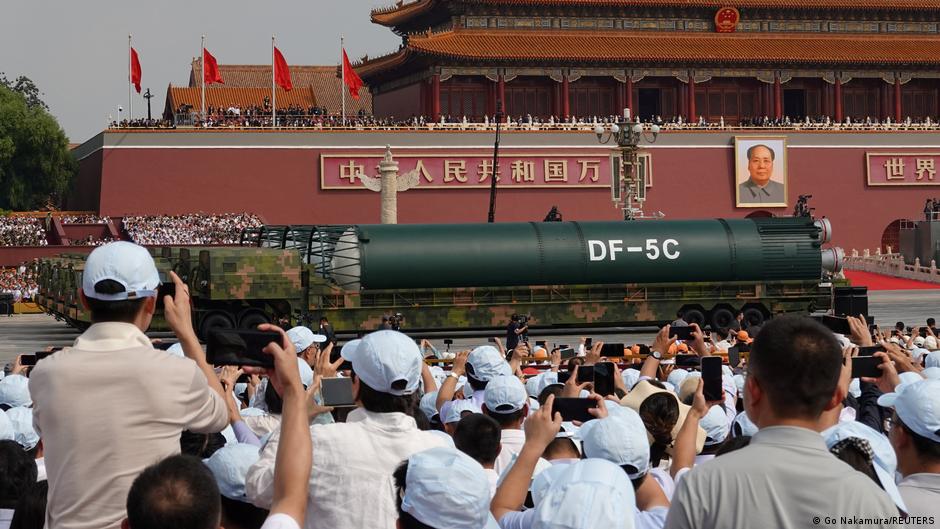
China is modernizing its nuclear forces faster than any other country. According to SIPRI estimates, China has about 620 nuclear weapons, increasing from 600 in 2024. At a military parade in September 2025, China presented a full nuclear triad – or weapons deployable from land, sea and air – for the first time.
According to SIPRI, China has deployed hundreds of nuclear-capable missiles in three large silo areas in the north. Work is underway on 30 additional silos in three mountainous areas in the east.
“Depending on how it structures its military, China could potentially have at least as many ICBMs as Russia or the US by the end of this decade,” the SIPRI report said.
Nevertheless, the number of nuclear weapons is far less than those possessed by Russia or the United States. However, China’s message appears to be clear: the government intends to credibly deter other countries from a potential nuclear attack.
In Europe, France provides nuclear security
In Western Europe, only the United Kingdom and France have nuclear weapons. France has 290 nuclear weapons, which can be launched from nuclear submarines or Rafale fighter planes. The government is constantly developing its nuclear forces and offers the possibility for other European countries to benefit from its nuclear umbrella.
Germany is not allowed to possess nuclear weapons of its own. This is set out in the 1990 Two Plus Four treaty on German reunification. Germany is therefore dependent on American patronage, with an estimated 20 American nuclear bombs deployed within the country.
“Nuclear sharing” is what NATO calls jointly organized deterrence involving US weapons. Germany recently began talks with France on closer cooperation in nuclear deterrence, after President Donald Trump repeatedly cast doubt on America’s commitment to NATO.
This article was originally written in German.