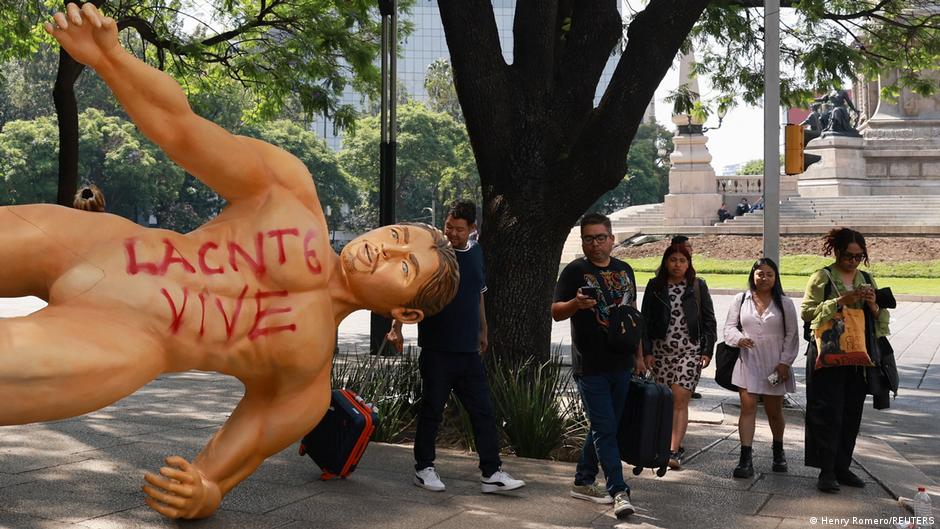
As Mexico City prepares to host the World Cup opening match on Thursday, teachers have promised to continue their protest for increased wages and better labor conditions in the area around the capital’s famous Estadio Azteca (Aztec Stadium) as part of a national strike announced on June 1 by the CNTE education workers union, which is demanding a 100% pay rise.
Over the past week, thousands of teachers have occupied the iconic Zocalo, or main square, blocking intersections and marching through the streets of the capital. Media reports said security forces fired tear gas against teachers who were attempting to take over the Education Ministry.
On the Paseo de la Reforma (Promenade of Reform), teachers tore down meter-tall statues of football stars built before the World Cup, tore plastic players’ jerseys and burned them. “Without solutions, the ball won’t roll,” teachers wrote on some of the toppled statues.
Teachers are protesting the education and pension policies of Claudia Sheinbaum, who was elected president with broad labor support to succeed Andrés Manuel López-Obrador, founder of the anti-neoliberal National Regeneration Movement (MURRENA) party. In May 2025, Sheinbaum’s government announced a 10% raise for teachers by September 2026 – which unions rejected as completely inadequate.
Salaries vary widely by region and education level. Early-career teachers in public schools in Mexico earn 8,000–14,000 pesos (€390–690/$460–800) per month.
The rival SNTE teachers union, which has long had close ties to Mexico’s various ruling parties, has called for a 13% raise in 2026 to cover rising inflation costs.
Protests in international headlines
With its protest at the World Cup venue, the CNTE is attempting to use the national and global focus on Mexico City to leverage. As one of three co-hosts of the tournament, along with the United States and Canada, Mexico is expected to receive approximately 5 million international tourists in June and July.
According to Mexico City’s administration, the Zocalo can hold up to 55,000 people for public viewing – although thousands may try to attend when the national team plays. The teachers’ protest camp threatens to disrupt those plans. FIFA, the global soccer governing body, has already stopped training for World Cup volunteers on the square.
At his daily press conference, Sheinbaum accused teachers of trying to provoke the government while the international spotlight is on Mexico, but he also ruled out tougher action. “We’re not going to give in to provocations,” Sheinbaum said.
Instead his government is talking to teachers. The 100% increase has been rejected as “inconsistent with the federal budget.” The most likely agreement between the government and teachers would be a package combined with a pension increase.
Historic center filled with protesters
Mexico City’s Chamber of Commerce claimed that the disruption to business in the area around the Zocalo and the blocking of traffic on main roads and to and from the airport caused losses to the private sector of approximately €20 million. Some Mexico City residents who opposed the protests wrote on social media that they felt as if teachers were holding them hostage.
The government has not blamed the union or most teachers for the damage and destruction caused by affiliated groups. “There was a lot of provocation yesterday,” Sheinbaum said after the march. “The truth is that I do not believe that teachers were behind the provocation.”
Many media outlets in Mexico have defended the protests as a legitimate form of social expression. On the other hand, the right-wing press has criticized teachers. In his column for the newspaper Milenio, journalist Héctor Aguilar Camín accused teachers of a “pedagogy of violence”. He said the Morena party was partly at fault because it had empowered the CNTE union in its efforts to win the teachers’ vote.
This article was originally published in German.