HTX processed more than $1.5 billion linked to sanctioned networks, according to the United Kingdom.
ByBit, Bitget and OKX also activated compliance alerts following the HTX case.
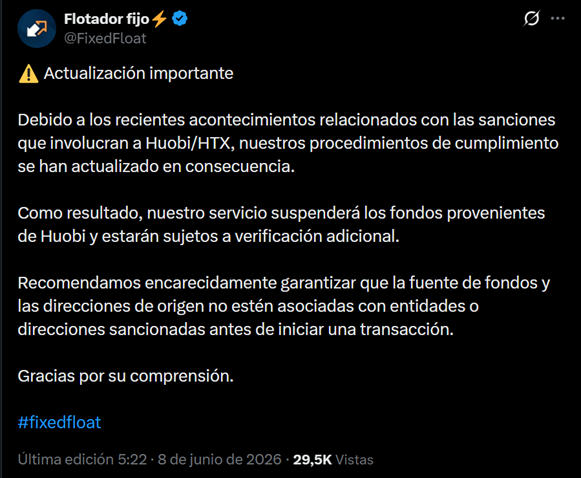
The FixedFloat exchange announced that it will subject funds from the HTX platform to additional verifications, a measure adopted after the sanctions imposed by the United Kingdom. The notice was published on June 8, 2026 and adds to other visible effects of the sanctions outside the platform itself.
“Due to recent developments related to the Huobi/HTX sanctions, we have updated our compliance procedures,” it noted. FixedFloat in a statement.
The company indicated that funds originated in HTX may be temporarily suspended and be subject to additional checks before processing transactions. Likewise, it recommended its users verify that the funds and source addresses are not associated with sanctioned entities or addresses before initiating a transaction.
The decision comes weeks after the United Kingdom sanctioned Huobi Global SA, a Panamanian entity associated with HTX, within a package of measures directed against the so-called A7 network, a financial infrastructure used by Russia. to evade Western restrictions and finance their war in Ukraineas reported by CriptoNoticias.
According to the british authoritiesHTX would have facilitated more than $1.5 billion in financial flows related to Russiamainly through operations connected with previously sanctioned entities such as Garantex and Grinex. It should be noted that it is the first occasion in which the United Kingdom directly sanctions a global cryptocurrency exchange.
It is important to highlight that The scope of the sanctions is already beginning to extend beyond the exchange. FixedFloat’s decision reflects how cryptocurrency service providers are adjusting their compliance policies to reduce regulatory risks, even as they operate under traditionally more flexible models and with lower identification requirements. This trend was also observed on other exchanges such as ByBit, Bitget, and OKX, which have issued warnings or implemented additional controls on HTX-linked transactions.
For its part, HTX and its global advisor, Justin Sunthey rejected the accusations. The company stated that the sanctioned entity is different from the main operation of the exchangeassured that it did not receive prior evidence or the opportunity to respond to the accusations and maintained that user funds are not affected by the measures.
This scenario has generated criticism within the community. The researcher on-chain ZachXBTfor example, questioned the sanctions against HTX and warned that they are causing massive address contamination, as many compliance tools flag wallets that simply interacted with the exchange before the sanctions as risky. According to the analyst, This is affecting legitimate users and reducing the usefulness of risk assessment systems.
On the other hand, the commentator Tonys Tucker held a more positive view on the HTX situation. According to him, the type of crisis facing the exchange would have meant a “catastrophic disaster” for smaller platforms, while HTX’s response would demonstrate its status as one of the main global exchanges. Tucker further noted that the platform’s operations continue to function normally — including deposits, withdrawals, trading and OTC operations — and that user funds remain under its control.
Beyond the debate, the sanctions against HTX are generating a knock-on effect in the ecosystem, where exchanges and exchange services are beginning to apply preventive controls on funds with indirect exposure to sanctions. This reinforces a paradigm shift: the historical origin of funds gains relevance in compliance systems, even above the current balance or activity.