
Many think that each publication on Saylor’s X was designed to make the price fall or rise.
For now, these speculations are not supported by concrete and decisive evidence.
The purchase of 1,550 bitcoin (BTC) that Strategy announced today, Monday, June 8, 2026, came wrapped in a controversy that is growing on social networks.
It turns out that the pattern that preceded the trade—a sale of 32 BTC announced on June 1, the subsequent price collapse, cryptic posts from Saylor, and then a purchase at lower prices—was enough for a Part of the community will begin to ask itself an uncomfortable question: was it all deliberate?
The thread is woven like this. Between May 26 and 31, Strategy sold 32 BTC at an average price of $77,135, its first sale since December 2022.
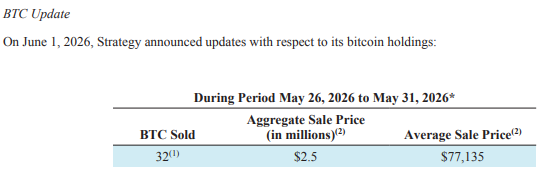
The operationeven though it is insignificant in terms of the company’s total volume—barely 0.004% of its more than 843,000 BTC in treasury— had a huge symbolic impactas detailed by CriptoNoticias last week.
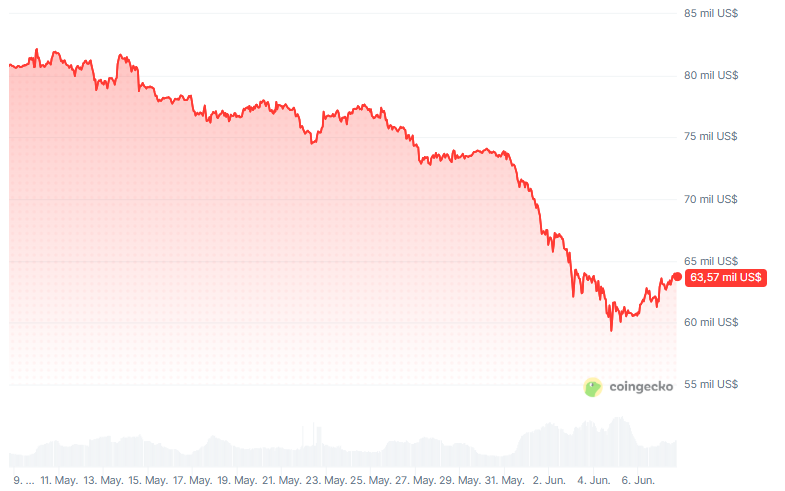
Saylor had publicly promised for years that he would never sell bitcoin, and that pact was broken. BTC price fell below $70,000 in hours. Then it continued down, touching lows close to $59,000.
That’s when Saylor posted on
Hours later, Michael Saylor added another one-word message: “32?”, an apparent reference to the sale of 32 BTC carried out days before. The combination of both publications triggered the debate.
Everything would have been a great plan, according to speculation
A sector of the community interpreted the sequence as a calculated operation. The reading circulates strongly in
The user @Crypto_Zh0u raised directly: according to him, Saylor sold bitcoin to sink the market and buy back cheaper, and he wondered if that does not constitute market manipulation.
Along the same lines, @0xStorm summed it up in a few words: I couldn’t believe that Saylor had been doing FUD to get in at a better price, qualifying it of “diabolical.”
Who writes in X with the username @Jordan1Nv pointed out Let Saylor first convinced the market of the idea of a bearish scenario by selling the 32 BTC, and then bought the bitcoins that left them scared.
A slightly more elaborate analysis was offered by @ZeremFinance, who pointed out that Saylor already has enough capacity to move the market like any whale, with the difference that his room for maneuver is different: he cannot sell by pressing a button.
But if you want to accumulate, the mechanics, according to this user, would be to sell a little, let prices go down, let fear spread and then buy hard.
Arguments in defense of Michael Saylor
It is worth clarifying that these readings are not supported by concrete and decisive evidence.beyond speculation and personal assumptions.
There is no evidence that the sale of the 32 BTC was designed to depress the price, nor that Strategy coordinated communications with the aim of generating panic selling.
The price drop, as CriptoNoticias has shown, had multiple concurrent factors: massive outflows from bitcoin ETFs for more than $4 billion, geopolitical tensions in the Middle East and an adverse macro context.
YouTuber David Battaglia appeared on Saylor defense with numbers. He explained that Strategy’s source of financing is not bitcoin sales but the issuance of shares: The company is authorized to sell up to $25.956 million in shares, which is equivalent to about $103 million per day for a year of trading.
Using execution algorithms that fragment orders into thousands of micro-trades distributed throughout the trading day, Strategy can convert stock market liquidity into bitcoin continuously and without generating visible downward pressure on its own chart, Battaglia maintains.
The conclusion of the Venezuelan influencer is that Saylor is solvent and that criticism about the ability to pay dividends or continue buying bitcoin They have no numerical basis.
Battaglia also questioned those who accused Monday’s purchase of generating dilution, pointing out that the $100 million added to the cash reserve is equivalent to about 1,575 BTC, which will not have to be sold in the future. With this, the net position of the shareholders would improve.
However, assuming that everything Battaglia explains is true, is it worth asking if bitcoin Could you finance the payment of dividends in other ways?
Peter Schiff, the eternal anti-bitcoiner, sees “the beginning of the end”
Peter Schiff doesn’t see it that way. The gold-fanatic economist reacted to this Monday’s purchase rating it of “damage control” and warning that if Strategy issued common shares at a discount to finance it, that diluted the bitcoin per share. Which constitutes, in his reading, the beginning of the end.
Schiff argues that the company’s model — continuous purchasing of BTC with instruments that generate periodic obligations — is fragile when the price of bitcoin falls.
In response to Schiff, analyst @QTRResearch acknowledged that few will understand the argument, but that — in his opinion — it is correct. He added that if bitcoin falls to $40,000 from current buying levels, the situation will become seriously complicated.
What becomes clear at the close of this episode is that the operation, however modest in origin, eroded the narrative of permanent accumulation on which much of Saylor’s narrative rested.
And when that story fractures, even for 32 BTC, Questions about his motivations become harder to ignore.
The episode once again highlights the enormous weight that corporate whales like Strategy have on price and market sentiment. Although there is no evidence of manipulation, the sequence of sale followed by repurchase raises reasonable doubts in the community.
In an increasingly mature market, transparency and consistency in accumulation strategies will be key to maintaining the confidence of retail investors.