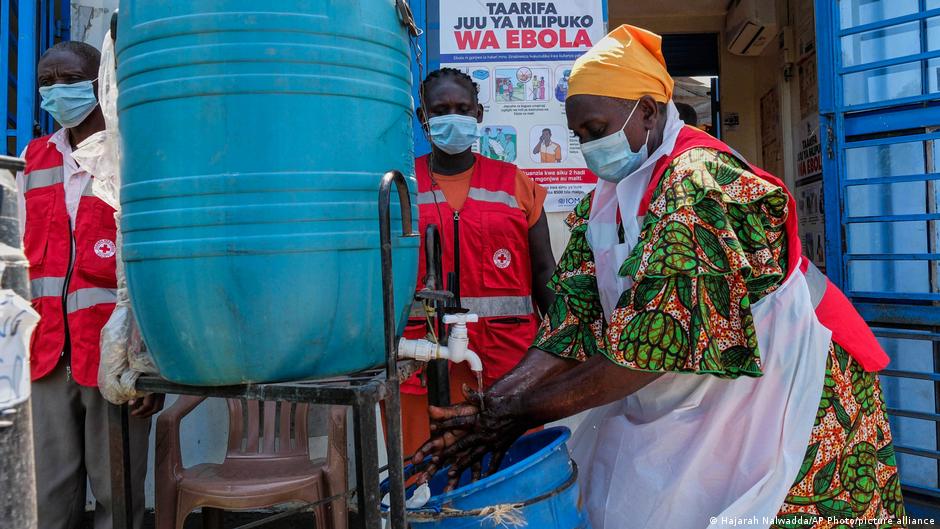
The director-general of the UN’s World Health Organization (WHO), Tedros Adhanom Ghebreyesus, on Monday visited Uganda, which borders the epicenter of the latest Ebola outbreak in Ituri province in the eastern Democratic Republic of Congo (DRC).
WHO has declared a public health emergency over the current outbreak, which was announced on 15 May in northeastern DRC.
Tedros was in the DRC last week, in the gold-mining center of Ituri province that has been the epicenter of the latest outbreak, which includes more than 500 confirmed cases.
What did Tedros say on his Uganda tour?
Tedros praised local authorities and their success in largely containing the few cases that arrived from across the border.
“I am in Uganda, where the government has responded quickly and competently to the Ebola outbreak,” he wrote.
“Screening at the borders helped detect cases coming from neighboring DRC, and the country’s surveillance, testing and case management systems are continuing to operate,” he said.
Tedros said there were 19 confirmed cases in Uganda, 14 of which were among people entering from the DRC and five were Ugandan citizens. Two have died and he expressed condolences to their loved ones, he said. He pledged to continue supporting WHO in responding to and controlling the outbreak, together with Africa CDC.
Asked by a Reuters reporter about Uganda’s decision in late May to close its border with the DRC, he said that blanket travel restrictions would not work, “so I hope they [Ugandan authorities] Reconsider.”
Dr. Diana Attwin, Permanent Secretary of the Ministry of Health in Uganda, also commented after the talks.
“[Tedros] “He is in the country to assess Uganda’s readiness to respond to the ongoing Ebola outbreak and to support efforts to prevent further export of Ebola cases from Congo and strengthen cross-border coordination to end the outbreak,” she said.
Africa CDC update confirms caseload, mostly for Ituri province
Also on Monday, the Africa Centers for Disease Control, or Africa CDC, released updated lab-confirmed case numbers for the current outbreak.
Africa’s top public health agency said a total of 544 cases of Ebola have been confirmed and 88 deaths have been reported. Of the cases, 515 were from DRC’s Ituri province. These figures differ slightly from those presented by the DRC a day earlier.
Due to difficulties in testing and confirming cases in a remote war-torn area, the confirmed caseload will certainly be small compared to the actual and suspected total.
This is the 17th outbreak in the DRC since 1976, involving the comparatively rare Bundibugyo strain of Ebolavirus for which there is no recognized vaccine.
Although it has complicated treatment, current case and death numbers also show that it is not among the deadliest forms of Ebola – the mortality rate among confirmed cases is less than 20%, whereas in previous outbreaks the rate was often more than 50%. Better treatment, prevention, and testing methods may also play a role in these figures.
WHO and the African CDC on Friday launched a $518 million (about €450 million) plan to fight the outbreak over the next six months.
American doctor and family discharged from Berlin hospital, now showing no symptoms
Meanwhile, an American doctor and his family in Berlin were discharged from specialist Charite hospital over the weekend.
The doctor was working as a medical missionary in the DRC with his family when he contracted the virus. At the request of the US government, he was taken to a specialist wing of a Berlin hospital for treatment.
The charity said no virus has been found in the patient since May 30. He was admitted on 20 May.
The hospital said his symptoms largely subsided after treatment, which included “combined antiviral therapy and additional supportive medical measures.”
Five of his family members were classified as high-risk contacts and isolated as a precaution, but none showed symptoms of infection, the hospital said.
Don’t let algorithms hide news. If you trust our team for reliable reporting, please take a moment to select us as your preferred source on Google By clicking here and pressing the “Star” or “Favorite” buttonThat’s why you’ll always see our verified news first.
Edited by: Jennifer Cimino Gonzalez