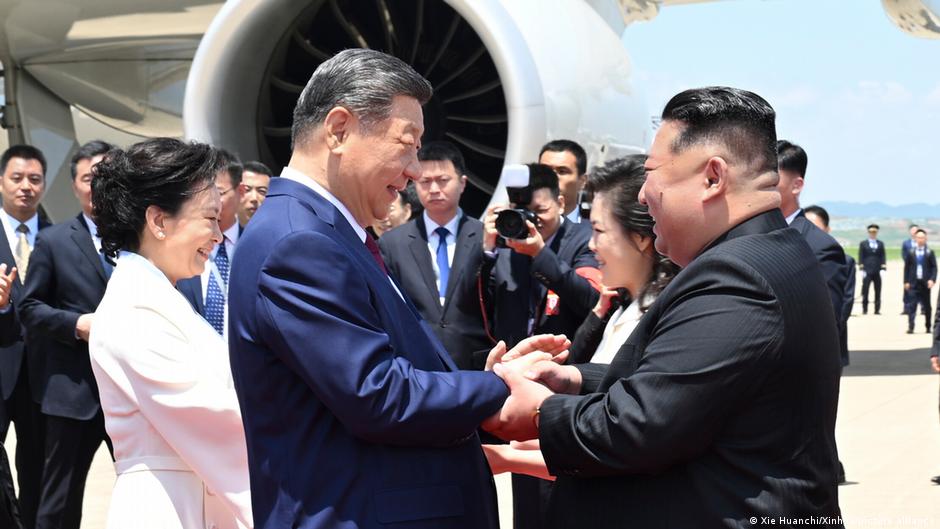
Chinese President Xi Jinping arrived in Pyongyang on Monday for his first visit to North Korea since 2019, at a time when Kim Jong Un has expanded his regime’s trade and military ties with Russia.
“No matter how the times change or how the international situation evolves, the traditional friendship between China and North Korea remains unbreakable, enduring and constantly provides vitality,” Xi wrote in a letter published in North Korea’s state-run Rodong Sinmun newspaper ahead of his visit.
Ever since the North Korean dictatorship emerged from the ashes of the Korean War, China has been Pyongyang’s primary geopolitical and financial beneficiary.
However, since North Korea provides military aid to Russia’s war in Ukraine, Xi would be motivated to “consolidate and reaffirm ties with the North,” said Chu Jae-woo, a foreign policy professor at the department of Chinese studies at South Korea’s Kyung Hee University.
Kim and Xi last met at a military parade in Beijing in September 2025.
North Korea has come closer to Russia
“Kim has been very active in improving his relations with Russia over the past few years, and China clearly feels it is lagging behind,” Chu told DW.
Chu said it is significant that Xi’s visit comes ahead of the 65th anniversary of the signing of the China-North Korea “Treaty of Friendship, Cooperation and Mutual Assistance.”
Chu said, “The hope was that Xi could visit Pyongyang on the anniversary, but I think it is significant that he went a month early.”
“It would have been more appropriate for him to go on the July 11 anniversary, but going early shows that Xi is concerned about North Korea getting too close to Russia,” he said.
Chu also points out that China has, in recent months, allowed large-scale cross-border exports into North Korea, while many of Kim’s tourist resort projects are drawing large numbers of big-spending Chinese tourists.
Kim is likely to trumpet bilateral ties and seek greater ties with economic powerhouse China to bolster North Korea’s economy, which has already posted a respectable 3% GDP growth over the past two years.
North Korea’s desire to become a ‘normal state’
Chu said the Chinese leader’s visit also provides Kim an opportunity to boost North Korea’s legitimacy and international respect on the global stage.
“Kim wants the North to be seen as a ‘normal state’ and to use the visit to expand the scope and reach of his diplomatic efforts, such as becoming part of the Shanghai Cooperation Organization or the BRICS alliance,” he said.
Established by China in 2001, the Shanghai Cooperation Organization (SCO) brings together 10 full member countries in Central and East Asia to promote security and economic cooperation. BRICS is similarly made up of 11 major emerging markets and developing countries from around the world, serving as a political and economic coordination platform for the “Global South”.
“Kim wants to lean on China and Russia to get North Korea to be a part of these multilateral programs that both countries have set up, giving them status and a place as a full member of international society,” Chu said.
Xi and Kim in the headlines
Kim Sang-woo, a former politician in the leftist South Korean Congress for New Politics and now a board member of the Kim Dae-jung Peace Foundation, said Xi’s visit was aimed at “emphasizing that China is now one of the two leading countries in the world along with the United States.”
“He wants to demonstrate that China is the hegemon of the Indo-Pacific region and to show that America’s commitment and credibility to the region is waning,” he told DW.
“This is a message to countries in the region that are increasingly uniting – including South Korea, Japan, India, the Philippines, Australia and beyond,” Kim said.
Pyongyang “wants to show that North Korea is a country that others need to pay attention to,” he said, an ambition that is aided by showing that China is providing “100% support and renewed recognition of the alliance.”
Kim Sang-woo said Xi was probably making the move at an opportune time as Russia appeared to be failing in its efforts to capture more land in Ukraine and defeat Kiev.
Edited by: Wesley Rahn