
The average production cost of bitcoin (BTC) currently stands at USD 62,650.
According to this model, bitcoin could still fall to the $50,000 area.
Bitcoin (BTC) returned to an area that Charles Edwards, CEO of Capriole Investments, considers historically attractive to long-term investors.
Through a post on his X account, Edwards stated: “Miners are now barely covering their costs on average. The best long-term value opportunities have historically been between here and the cost of electricity, currently at $50,000.
At the time of this publication, June 9, 2026, bitcoin is trading near $62,890, just above the average production cost estimated by Capriole’s model, currently at $62,650.
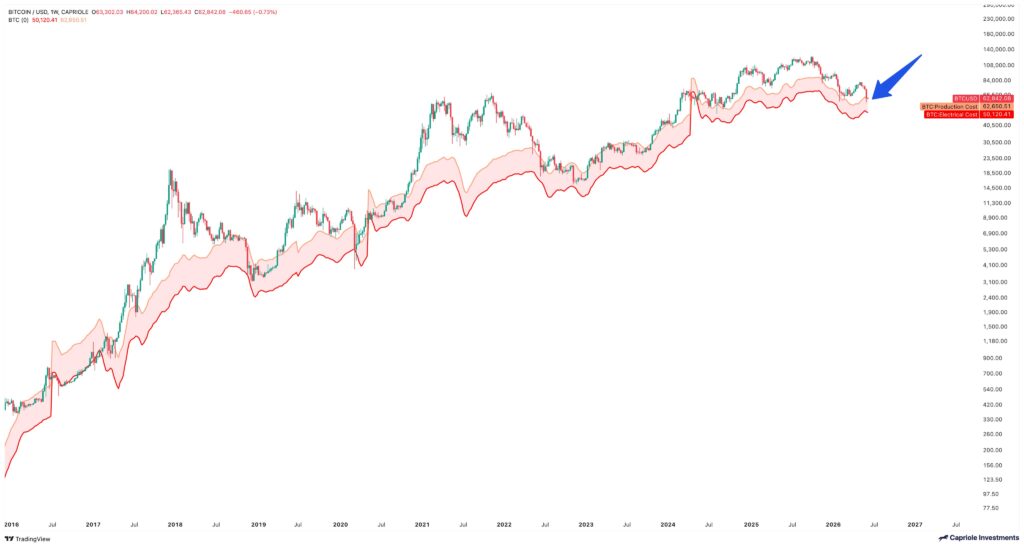
In the graph above, the upper orange line indicates the average production cost of miners, while the lower red line reflects the so-called “electrical cost.”
The estimated production cost how much does it cost to generate new units of bitcoin through miningconsidering variables such as network difficulty, equipment efficiency and energy expenditure. When the price approaches that level, the profit margin of the miners is considerably reduced.
For its part, the electrical cost seeks to estimate the minimum value associated with the energy expenditure necessary to produce bitcoin. In previous cycles, bitcoin entered the area between the cost of production and the cost of electricity during bearish phases such as those of 2015, 2018 and 2022.
These areas coincided with areas close to market floors, before bitcoin began new bullish cycles, although they did not necessarily mark an immediate rebound.
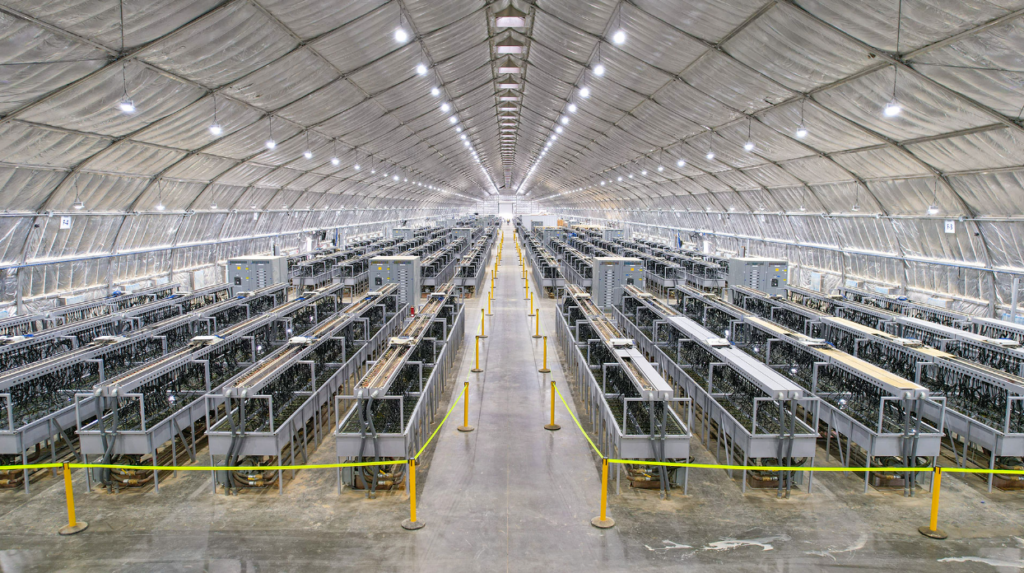
Other analysts also observe signs of possible bearish exhaustion, although with nuances. Willy Woo, financial markets analyst, noted that bitcoin could be “in the process of recovery” after a decline that, according to his reading, extended too long. In turn, he indicated that, if capital flows deteriorate again, BTC could still face new declines before forming a more solid floor.
For his part, Spanish trader Pablo Gil projects deeper falls for bitcoin. According to their analysis, if BTC repeats correction patterns observed in previous cycles.
“Taking into account the correction patterns that each crypto winter has had after halvings throughout the life of bitcoin, we could see prices of 38,000 or 40,000 per BTC,” Gil stated.
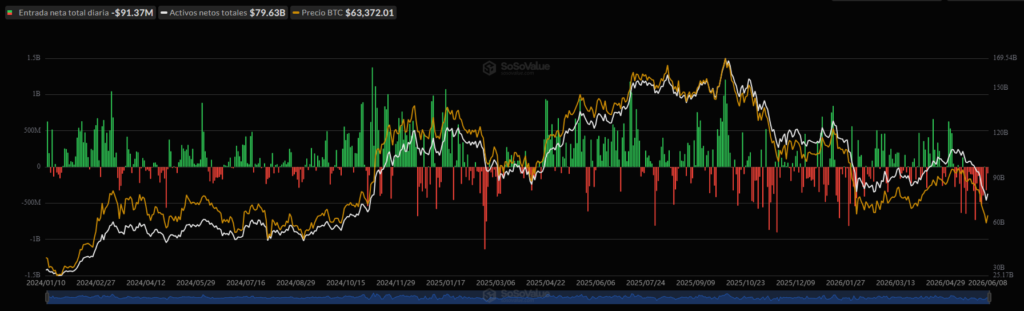
Along these lines, researcher CryptoVizArt warned that the 30-day moving average of net flows of BTC exchange-traded funds (ETFs) in the United States fell to 2,450 BTC per day, the fastest pace of exits since the launch of these financial instruments, as reported by CriptoNoticias.
According to their analysis, this dynamic reflects a persistent deterioration in institutional demand and not simply a temporary market reaction. As long as that trend does not reverse, ETFs will continue to act as a pressure factor for the BTC price.
Therefore, the Capriole indicator should not be interpreted as a prediction of immediate recovery. Rather, it functions as a valuation benchmark at a time when bitcoin is once again approaching the economic cost of producing new currency.
Meanwhile, the market continues to pay attention to possible signals coming from the macroeconomic and geopolitical front, including the evolution of tensions in the Middle East, the behavior of traditional markets and the eventual return of institutional liquidity towards bitcoin ETFs.