
Debt rose 168% faster than the economy in a year and a half, putting pressure on future budgets.
The intergenerational transfer is clear: taxpayers of today and tomorrow pay more taxes.
Mexico’s public debt, measured by the Historical Balance of Financial Requirements of the Public Sector (SHRFSP), reached 18.68 trillion pesos at the end of April 2026 (1.07 trillion dollars), equivalent to 50% of the Gross Domestic Product (GDP).
When dividing this figure by the population, around 133-134 million inhabitants, it is a theoretical burden of 151,000 pesos per Mexican, that is, about 8,000 dollars per person.
This debt grew more than a billion pesos ($57.3 billion) in just one year. The increase has clear triggers: persistent fiscal deficits caused because the public spending on pensions, subsidies, salaries and debt service has consistently exceeded tax and oil revenues.
To cover that gap, the government issues new bonds and takes out loans that largely refinance previous obligations, accumulating liabilities that carry into the future.
The SHRFSP represents the broadest measurement of debt and includes not only the Federal Government, but also the oil company Pemex, parastatal entities and development banks.
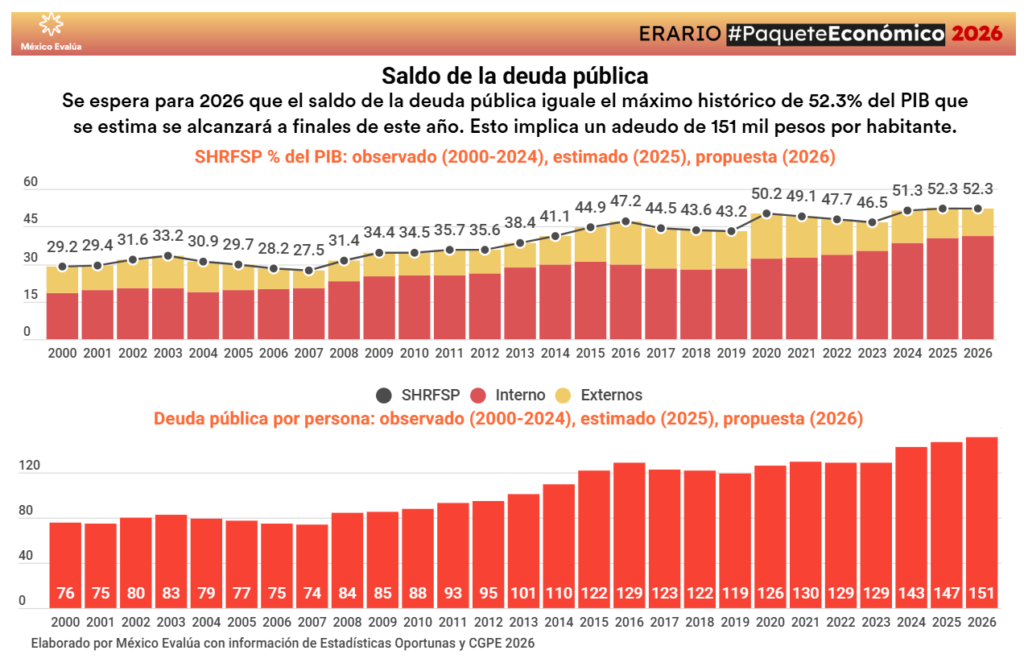
This is not an individual bill, but rather the total obligations incurred by the State, which are ultimately paid with present and future taxes, through inflation or by reducing spending in other areas.
Currently, the interest payments already exceed 3.7% of GDP —more than double that in 2008— and competes directly with areas such as productive investment, education or health.
Although the debt/GDP ratio remains at moderate levels compared to other countries in the region, rapid per capita growth and the fact that liabilities are increasing faster than the economy raise concerns.
Between October 2024 and the first quarter of 2026, the debt grew 12.4% nominallywhile GDP only advanced 4.6%. This panorama opens an intense debate.
The government and the Ministry of Finance They defend that the 50% of GDP is a manageable burdenwith debt mostly in pesos, at a fixed rate and long terms, which reduces exchange risks.
However, independent analysts such as CIEP, Mexico Evaluates and IMCO They warn that the indicator underestimates the real pressure, debt service displaces productive investment, debt grows unbalanced and the per capita burden especially affects those who save in pesos, through inflation and less future fiscal space.
«To measure the increase in the rate of indebtedness, in 2026 the Government will contract debt for 4,349 million pesos every day, which is equivalent to buying about 2,175 houses daily with an approximate value of 2 million pesos. This rate of indebtedness is even higher than the 4,274 million daily estimated for 2025,” highlights the México Evalúa report.
It is questioned whether this is responsible management or a mechanism that functions as deferred taxation on generations that did not directly approve those expenses.
Each Mexican today carries a public debt of approximately $8,000 that he never requested. Although he Debt is a legitimate and common tax tool around the worldits sustained use above economic growth converts today’s deficits into taxes or lower well-being tomorrow.
For citizens, especially peso savers, this translates into silent erosion of purchasing power and lost opportunities in infrastructure and growth, as CriptoNoticias has explained in the educational section, Criptopedia.
The sustainability of this debt will depend on greater discipline in spending, collection efficiency and, above all, robust economic growth that expands the base on which this burden is sustained. Meanwhile, that invisible bill continues to weigh on Mexican families.