
Hayes estimates that AI has attracted $1.5 trillion in funding since 2022.
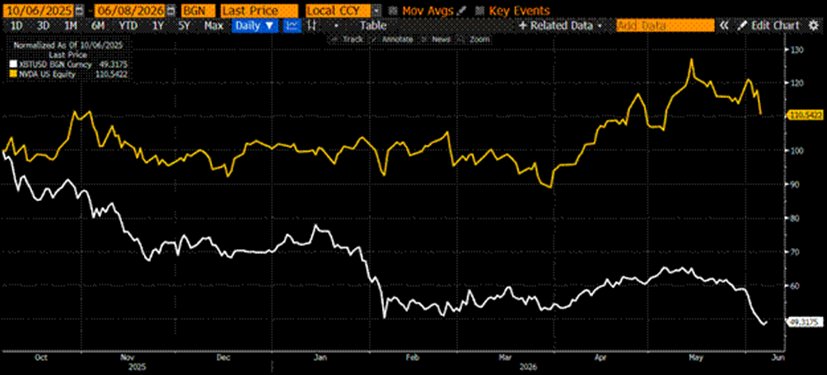
Bitcoin rose from $15,000 to $125,000, but was overtaken by Nvidia.
Artificial intelligence could become a pressure factor for bitcoin (BTC) and other risk assets if market enthusiasm for the sector begins to deflate. That is the thesis put forward by Arthur Hayes, co-founder of BitMEX, in an essay published on June 8, 2026, where he argues that an eventual correction of companies linked to AI would have repercussions on cryptocurrencies.
In the text, titled Reality TestHayes maintains that Much of the liquidity created in recent years was absorbed by the rise of artificial intelligenceespecially through investments in infrastructure, data centers and technology companies. According to their estimates, the sector raised around USD 1.5 trillion in financing since the launch of ChatGPT at the end of 2022.
The investor remembers that bitcoin went from approximately USD 15,000 after the collapse of FTX in November 2022 to USD 125,000 in October 2025, as reported by CriptoNoticias. However, he points out that several AI-linked stocks posted outperformance over the same period. Among them, Nvidia stands out, whose valuation far exceeded that of the digital currency.
The risks that Hayes identifies
Arthur Hayes’ analysis revolves around three factors that, according to his vision, could affect artificial intelligence companies and trigger a correction in the sector.
The first is the increase in energy prices. The businessman maintains that the expansion of artificial intelligence depends on large amounts of electricity to power data centers and train models. A sustained increase in energy costs, he says, would reduce companies’ margins and call into question the growth expectations that currently underpin their valuations.
The second factor is the future public stock offerings of companies such as OpenAI, Anthropic and SpaceX. Hayes believes that the market could have difficulty simultaneously absorbing emissions worth hundreds of billions of dollars.
The third element is political. According to the co-founder of BitMEX, rising energy prices and the impact of artificial intelligence on employment could make the industry an electoral target in the United States in the coming months.
«The only path to victory is turn against AI tech giants. If energy prices continue to rise and jobs continue to be displaced by automation, the industry could become a political target,” said Hayes, referring to the US electoral scenario.
Artificial intelligence absorbed all the dollars created. Since the launch of ChatGPT, capital has been massively directed towards building data centers, energy infrastructure, and AI-related companies.
Arthur Hayes.
Bitcoin could also be affected
Although Hayes maintains a favorable view on bitcoin in the long term, he believes that a severe correction in stocks linked to artificial intelligence would cause a general reduction in liquidity and risk appetite.
According to their approach, a sharp decline in the sector would affect the credit used to finance technological infrastructure projects, generating tensions in financial markets and temporarily reducing the flow of capital to cryptocurrencies.
For this reason, the businessman reported that recently sold positions in several digital assetsincluding HYPE, NEAR, WLD and ZEC, with the aim of prioritizing capital preservation while awaiting greater clarity on market developments.
Nevertheless, Hayes acknowledged that his scenario might not materialize.. In the essay he admits that there is a possibility that he is wrong and that the rise of artificial intelligence will continue to boost both technology stocks and other risk assets for longer than expected.
It is worth noting that the sales announced by Hayes coincided with public criticism of the researcher on-chain ZachXBTwho accused him of using his followers as “exit liquidity.”
The researcher maintained that Hayes publicly promoted several tokens before liquidating his positions days or hours later. Among the cases noted are HYPE and NEAR, included by Hayes in his so-called “Holy Trinity” on May 22 and sold on June 4; ZEC, purchased on the same day and liquidated on June 5 after reports of a vulnerability in the network; and WLD, presented as a bet linked to the rise of artificial intelligence and SpaceX, but sold on June 6.
According to ZachXBT, this pattern allowed Hayes to benefit from the demand generated among his followers before closing his positions. The co-founder of BitMEX He did not directly respond to those accusations in his essay.
For now, regardless of whether Hayes’ thesis ends up materializing or not, his analysis reflects a change that is beginning to gain weight among investors and analysts: the growing connection between the cryptocurrency market and the artificial intelligence sector.
In recent years, both competed to attract speculative capital and financing. If that relationship holds, the performance of large AI companies could become an increasingly relevant factor in understanding the future cycles of bitcoin and the cryptocurrency market in general.