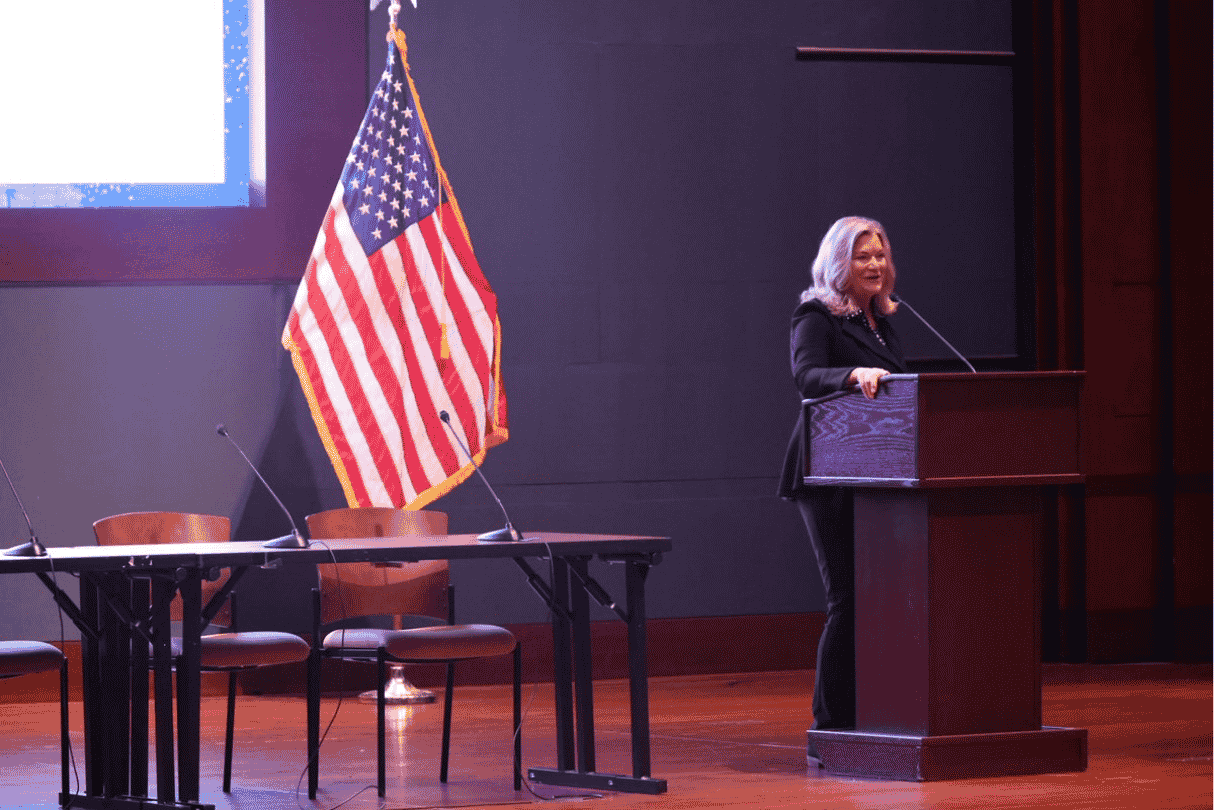
Lummis has criticized the lack of regulatory clarity between the SEC and CFTC in the sector
The senator seeks to prevent financial innovation from moving to other centers of economic power
US Senator Cynthia Lummis stated on June 9, 2026 that digital assets represent the latest expression of financial freedom and argued that the United States should lead in its regulatory protection.
The message, published in the social networkcomes at a time when the CLARITY law, one of the main cryptocurrency legislative projects in the country, It remains awaiting a vote in the Senate.
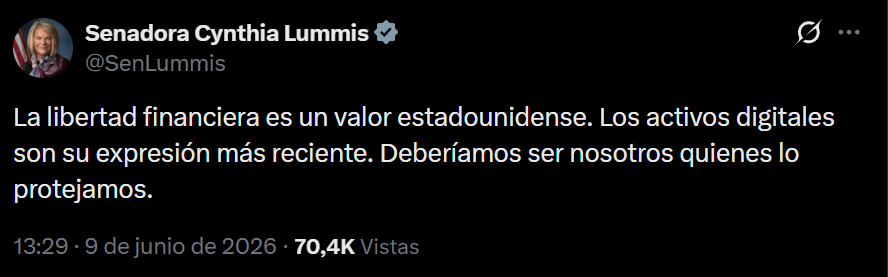
Although brief, the publication joins a series of recent interventions in which Lummis has defended the need to establish clear rules for the cryptocurrency market in the United States. The senator is one of the main promoters of the CLARITY law and currently chairs the Digital Assets Subcommittee of the Senate Banking Committee.
The legislative proposal seeks to resolve one of the largest regulatory disputes in the sector: determine when a digital asset should be considered a financial security under supervision of the Securities and Exchange Commission (SEC) and when it can be treated as a digital commodity regulated by the Commodity Futures Trading Commission (CFTC).
The initiative was approved by the House of Representatives in 2025 with a bipartisan support of 294 votes in favor and 134 against. Subsequently, the Senate Banking Committee approved a revised version by 15 votes in favor and 9 against on May 14, 2026. The project was referred to the plenary session on June 1 and incorporated into the legislative calendar, although as of June 9 it had not yet been debated or voted on.
For Lummis, The discussion transcends the strictly regulatory sphere. The senator has argued on several occasions that legal uncertainty has pushed companies, developers and investments linked to cryptocurrencies towards jurisdictions with more defined regulatory frameworks.
That vision was reflected days ago, when he warned that China could end up “writing the rules” of digital money if the United States does not approve the CLARITY law and does not establish its own regulatory standard for digital assets, as reported by CriptoNoticias. According to his approach, competition is no longer limited to the cryptocurrency market, but rather involves leadership over the digital financial infrastructure of the coming decades.
It is worth noting that The initiative has faced resistance. Legislators like the senator Elizabeth Warren have expressed concerns that some provisions could reduce the SEC’s oversight ability.
Debates also persist regarding investor protection, prevention of money laundering, regulatory treatment of certain decentralized finance (DeFi) protocols, and aspects related to stablecoin returns and protections for developers. These differences led to the Banking Committee indefinitely postpone a vote scheduled for January 15, 2026which opened several months of negotiations before the project could move forward.
For now, Lummis’ statements reflect a vision increasingly present in Washington: the regulation of digital assets is no longer discussed solely as a market issue, but as an element of economic competitiveness, technological and geopolitical leadership. While the Senate decides the future of the CLARITY law, the debate is taking place in parallel to a global race to define digital money standards, an area in which the United States seeks to maintain influence.