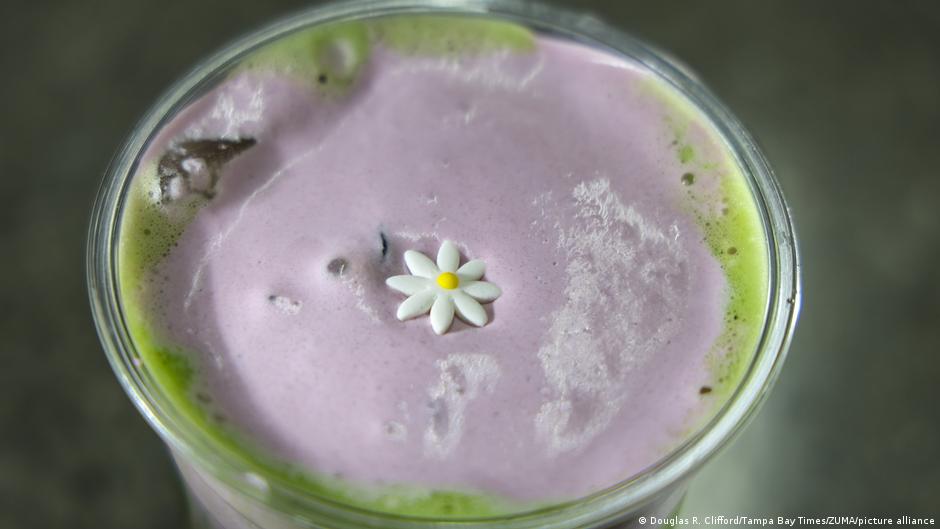
During a recent road trip to Germany, café owner April Schöngen spotted purple pastries at a gas station bakery.
Surprised to find a Filipino-flavored dessert at a European gas station, she said, “As I suspected, it was ube.”
Schöngen sells ube-flavored cakes and drinks at her Filipino-themed café, “Ube de Oro”, in Bonn. When it opened two years ago, the café had a mostly Filipino clientele.
Now, she’s seeing more and more people from different backgrounds drawn to lilac-colored cuisine.
What is ube?
When unfamiliar diners ask about ube, she shows them a poster summarizing the crop’s origins and cultural significance.
Ube (pronounced oo-beh), also known as purple yam, is a naturally occurring vibrant purple root crop native to the Philippines.
Subtly sweet and nutritious, ube is commonly served with jam, ice cream or as a dessert during festivities in the Philippines.
For many indigenous communities, tubers are a staple food and a major source of protein, carbohydrates and antioxidants, according to Cheryl Marie Natividad-Caballero, Philippine Agriculture Undersecretary for High-Value Crops.
Elsewhere, Ube Café offers purple cold foam sitting atop an icy macchiato. It is also the ingredient that makes pancakes and waffles on Instagram more vibrant and beautiful.
Like the ubiquitous matcha powder, ube is now found in cafes, bakeries, and restaurants around the world.
Ube exports from the Philippines are slowing down
The crop has been so popular that it has been dubbed a “Star Export” by the Philippines’ Department of Trade.
In 2025, the Philippines shipped 1.7 metric tons or $2.9 million (€2.57 million) worth of ube products (extracts, powders) abroad, the majority of which went to the United States. This figure is 20% more than last year.
Despite its rise in popularity, ube production in the Philippines has steadily slowed. From a total harvest of more than 30,000 metric tons in 2006, the Philippine Statistics Authority noted that only 12,400 metric tons of ube were produced in 2025.
According to Grace Bakian, director of the Northern Philippine Root Crops Research and Training Center, one of the obstacles farmers face when it comes to ube production is the lack of planting material.
The research institute, located in Benguet, north of Manila, is dedicated to renewing agricultural practices for root crops through research and training of farmers.
“Since foreign demand for ube has increased, the center has received more requests for seedlings to expand farmland for ube,” Baikian told DW.
Among those seeking seedlings are indigenous farmers from Pampanga and Tarlac provinces in Central Luzon.
Global glut puts pressure on Uber producers
Christopher Gomez, who works with farmers in the processing and distribution of ube, said growers were able to keep a portion of their crop to replant for the next season.
However, the global craving for ube has led farmers to sell all their produce and instead seek plants from other suppliers and the local government.
“The potential agricultural land here is vast, but we barely have any plants. We have tried asking from the government but we got nothing and now we are getting some material from an NGO,” Gomez said.
The farmer group also received requests from growers in other regions and even Indonesia for planting material.
“We don’t want to export the raw material, only processed ube like powder and extracts because we want to maintain farming here,” Gomez told DW.
Before the ube craze, farmers would harvest the root crop from their fields in the mountains and sell the crop in local markets, typically at a loss of 20 pesos ($0.33/€0.28) per kilogram.
Gomez is buying ube directly from farmers at the standard farmgate price of 80 pesos per kilogram. Orders have also increased from 300 kg to 30 tonnes.
Can Ube farmers meet the demand?
To meet the demands of ube while keeping production sustainable, Bakian stressed the need for local greenhouses where farmers can nurture quality plants and maintain supplies within the area. Growers also need to receive training to learn innovative methods of planting tubers.
“The government should provide funding for these greenhouses and also for training,” Bakian said. He said farmers would be discouraged from growing ube if they did not have the supplies.
Philippine Undersecretary Natividad-Caballero said the department is working to maintain the availability of ube planting material through distribution from regional research stations to local governments.
While ube is not a sensitive crop that can grow in a variety of terrains, Bakian said the crop thrives on rolling areas where the soil dries out.
This means that farming is labor-intensive, as plowing has to be done manually. Growing ube also requires patience, as it takes about nine months for the crop to yield, provided it survives the typhoons that frequent the tropical country.
Bakian observed that ube remains a secondary crop, as farmers prefer to grow a cash crop such as corn, which takes only three months to mature, and provides farmers with immediate income.
“That’s also one of the challenges in production. It’s very difficult to cultivate the upland. But farmers are very resilient. As long as they see the benefit of going into that venture, they will continue planting,” Bakian said.
Edited by: Wesley Rahn