
The Tim Payne case raises a reflection on the economy of attention.
As a society, we continue to buy whatever someone with reach sells us.
Tim Payne didn’t do anything wrong. That should be said from the beginning. This is not intended as an attack on good old Tim. The New Zealand footballer did not throw a coin, he did not promise returns, he did not sell smoke, he did not organize a pyramid scheme or go on social networks saying “to the moon.” He didn’t even promote himself.
Payne, as far as we know, was just there: playing his career, being another professional within an ecosystem where not everyone is Messi, Neymar, Mbappé or Cristiano. A footballer by trade, one of those who exist in thousands, with more work than epic and more discipline than headlines. And yet, suddenly, Tim Payne became famous. Very famous.
The story has something of a global joke. An Argentine influencer decides to point him out as the least known player in the World Cup and calls on his audience to follow him, comment on him, celebrate him, turn him into a character. In a matter of days, what started as an internet joke became a viral phenomenon. One of over 5.5 million followers right now.

Even the specialized media joined the wave of footballer Tim Payne. Not for an impossible goal. Not for a memorable performance. Not because I raised a glass. But because someone with enough distribution decided that he would be the one.
Welcome to the attention economy, where a well-packaged narrative can outweigh a solid track record..
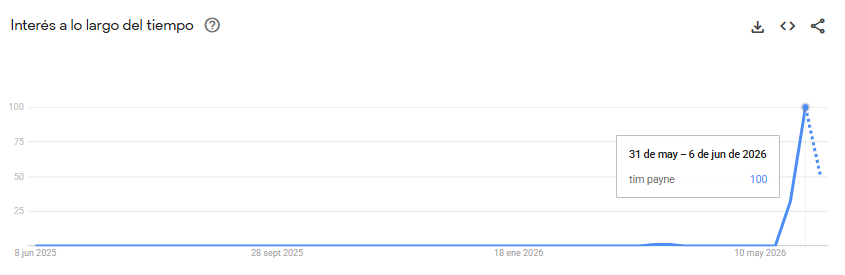
Vertical graph, without fundamentals
The Tim Payne case is fascinating because he is innocent. It has the charm of collective jokes that don’t hurt anyone. An ordinary man receives unexpected affection from half the planet, and he takes it with grace, which makes us empathize with the normal guy to whom fame came without seeking it. There is humor, tenderness, absurdity and even a small rebellion against the logic of the stars. In a World Cup where everything is usually dominated by brands, contracts, celebrities and million-dollar campaigns, there is something nice about the crowd choosing the least glamorous player.
But there is also another reading, less romantic and more useful: that of incentives.
From a bitcoiner perspective, the Tim Payne phenomenon is too similar to those assets that suddenly rise not because they have demonstrated value, but because they were blessed by a viral narrative. A trendy shitcoin needs no fundamentals at the beginning. It needs attention, the well-worn word “community”, memes. Then comes the price. Or, in this case, the followers.
The mechanics are familiar: someone with influence points at an object, mass rushes toward it, numbers go up. Those same numbers justify further attention and the cycle ends with the definitive statistical explosion. It’s a self-fulfilling prophecy where no one wants to be left out.. The phenomenon feeds on itself. Not for fundamental value, but for the speed of its viral spread.
That doesn’t make Tim Payne a scam by any means. But yes in a mirror. Because the important question is not whether Payne deserves that love. He probably deserves it like anyone else. The question is another: What does it say about us that we can inflate someone’s relevance overnight just because a powerful figure told us where to look?
Promotion without substance
In the crypto market, this happens every day. A currency without clear utility, without real innovation, without economic foundations or genuine previous community can climb positions with a mixture of influence, liquidity, anxiety and meme. The graph goes up and becomes an argument. “If it is going up, there must be something.” “If everyone talks about it, it will be for a reason.” “If so many people came in, it can’t be smoke.” Until the smoke clears and we see clearly: there was nothing there.
The attention economy works in a similar way. We have learned to confuse visibility with value, metrics with merit, and reach with substance. We even established a relationship in which followers equal authority.
But the problem is not virality itself, but what we do with it. When it stops being entertainment and begins to operate as a certificate of legitimacy, the criteria are buried and the door is open for bad decisions.
Just as in the financial world, where money is at stake, before giving our attention (where we give our time), it is always worth asking ourselves: what supports this? Does it stand the test of time or does it depend on us all continuing to applaud?
Applied to the Tim Payne case, these questions do not seek to destroy fun but to train judgment. It can be a nice phenomenon (and it is very good as entertainment and even as a way of connecting the world through a non-polarizing figure, a rare bird currently). But the logic that catapulted him is the same that can turn anything into an object of emotional speculation. Today he is a New Zealand footballer. Tomorrow is a coin with a dog, a frog, a politician, a dead celebrity or an incomprehensible technological promise. The structure repeats: attention first, justification later.

The times we live in
When attention becomes a substitute for value, we live in a market permanently vulnerable to deception. So much so, that in New Zealand’s first match after the viral explosion, there were many disappointments. Those who expected a football spectacle from their new figure left with a 4-0 loss against a fairly small rival: Haiti.
I repeat: this text is not against Tim Payne, but rather it is a reminder that we live in a time in which we were taught to react before thinking and buying without understanding what we are buying. Payne, in fact, seems the least guilty of all. He is just the accidental asset of a campaign that found itself in the right place at the right time.
The responsibility lies with those who observe, because we are the ones who must know how to enjoy the meme without losing our senses and understand that a wave can be fun and, at the same time, artificial. In this case, there appears to be no harm, but when the stakes are higher and the actors are dangerous, then the fire can become real. That is precisely the complexity of the case.
Tim Payne is not a lie. But his sudden fame is not proof of extraordinary sporting prowess either. It is rather a vertical graph, one of those to which instead of reacting you must first ask yourself, as if doing fundamental analysis: what is behind it?
The New Zealand defender is less a football revelation than a cultural reminder. A perfect example of how relevance is manufactured in the age of infinite distribution. A kind story that, read carefully, shows a much harder truth: As a society, we continue to buy whatever someone with enough influence manages to sell us as an event..
Disclaimer: The views and opinions expressed in this article belong to its author and do not necessarily reflect those of CriptoNoticias. The author’s opinion is for informational purposes and under no circumstances constitutes an investment recommendation or financial advice.