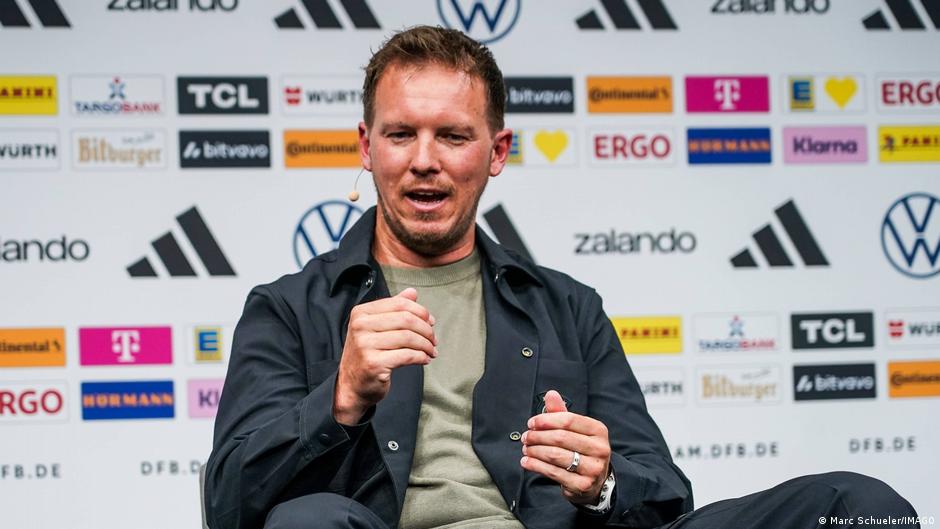
Julian Nagelsmann is entering this World Cup in a very different environment to Germany’s home Euros two years ago. The 38-year-old head coach has lost some of his luster as his communication skills are being questioned.
Most concern centered on the dramatic recall of retired goalkeeper Manuel Neuer to the Germany squad just weeks before the tournament began, while Oliver Baumann had taken a year to cement himself as the number one. His delivery also took place in March There was very public criticism of striker Deniz Undav, saying that the player had performed poorly after a game in which Undav had scored the winner. He later revealed that he had spoken to his wife on the matter. He apologized for his comments, saying he had made a mistake. For a coach whose early rise was fueled by a strong psychological antenna and who has been Keen to develop the group’s strengths, the months leading up to the World Cup have been far from ideal.
“Please understand that every detail of my conversations with the players cannot be made public,” Nagelsmann said during Germany’s squad announcement last month. “I try to explain things well and keep people informed. Sometimes I’m not as successful as I’d like to be, and sometimes I am.”
Nagelsmann’s indecision a reflection of German society?
“soccer Symbolizes the essence of social communication. In a highly diverse and fragmented society, it has the rare potential to bring together different social groups and groups.” Jürgen Mittag, professor of sports politics and sociology at the German Sports University Cologne, told DW.
“The national team coach thus becomes the focal point of this fragmented public sphere and the broader social discourse associated with it,”
Perhaps Nagelsmann’s indecision is an extension of the mood of the country. After all, many famous parallels have been drawn between Germany’s head coach and the Chancellor. Although these similarities should not be given too much importance, they have become part of the social history of both the national team and the country.
Former Germany coach Joachim Löw and former German Chancellor Angela Merkel are perhaps the most famous examples. The pair remained deeply connected during the 15 years they shared their respective roles. The pair shared a unified and cohesive vision, but perhaps lacked the will to pursue necessary reforms. Coincidentally, both of them left their jobs in 2021.
“On the other hand, Julian Nagelsmann can be compared with Friedrich Merz with all caution: someone who strives to pursue more far-reaching structural reforms, but in doing so he also polarizes more strongly and does not always show the most tactful tone in his communications,” Mittag said.
Why would a head coach make this decision?
For many, the question about Neuer makes sense from a sporting perspective, but is it worth the risk given his injuries? And why now? And what does the team think about the decision?
“In the public sphere, especially in the media, a lot of coaches get themselves into trouble by trying to be too clever,” Cody Royal, a coaching mentor who has worked with teams in the NBA, MLB, NHL and Premier League, told DW.
“It can be easy to try to look intelligent and over-interpret to show that you are worthy of that level. But my view is the opposite. To paraphrase American investor Charlie Munger, trainers should spend less time trying to look smart and more time trying to be less stupid.”
Royal believed Nagelsmann’s comments on Undav were a sign that the head coach was under stress, but his decision on Neuer was indicative of a commanding coach and linked to his approach.
“I thought he dealt with the goalkeeper situation quite beautifully. He showed a quiet confidence, and was thoughtful and intelligent in his explanation of why he included Neuer. He’s been hired to make such big decisions, and I was glad to see him stick to his guns and not panic when it became clear it would be an unpopular decision,” Royal said.
As far as the players are concerned, Pascal Gross said, “kicker” That “Nagelsmann’s credibility has not been harmed in the slightest.”
Can Nagelsmann bring Germany back together for one summer?
After Euro 2024, Julian Nagelsmann gave a speech that was about much more than his team’s success or happiness at the tournament. Some thought this was more appropriate for a president than a head coach, but most were positively surprised and impressed by his public display of emotion.
“After the tournament, Nagelsmann gave a remarkably emotional speech in which he emphasized a return to community, solidarity and shared experiences. He talked about the connection between fans and the national team, as well as social cohesion in the broader sense, highlighting issues of integration in the process. This intervention was in stark contrast to many current social developments,” Mittag said.
But Nagelsmann’s view then was not the same as now. In the two years since then, not only has Germany changed, but so has the feeling towards this team and its coach. The good feelings of a domestic tournament have faded and been replaced by global political turmoil, a bloated World Cup and a head coach who appears just weeks before the tournament, and still doesn’t know his best 11. It also can’t help that so many leaks about the team surfaced before the official announcement.
Still, with legacy and reputation at stake, Nagelsmann remains optimistic.
Nagelsmann said, “I don’t think the situation before the domestic Euros is much different from the situation now. We are prepared. I don’t know if it’s my job to create excitement before the tournament. My job is to create moments that lead to that excitement.”
The summer of 2026 will see how many moments he and this team can create.
Edited by: Chuck Penfold