Will it one day be possible for climate-neutral planes to fly without leaving conflicts behind? What does the rover that will be used to drill a two-meter-deep hole in Phobos, one of the moons orbiting Mars, look like? These are just two questions being explored at ILA in the German capital, one of Europe’s largest air shows.
There is little evidence about the current crisis facing civil aviation due to the Iran war, and little talk about complaints around the world about high oil prices and fuel shortages, rising ticket prices and canceled flights. At the inauguration, Michael Schallhorn, CEO of Airbus Defense & Space and President of the German Aerospace Industry Association (BDLI), spoke of “a record-breaking ILA”.
In 2024, 600 exhibitors from 31 countries participated in the trade show, while this year there are more than 750 exhibitors from 37 countries. “All the halls have been fully booked since November and 300 political delegations from all over the world are in Berlin,” Schallhorn said.
Defense industry is the main focus
The main focus is on the defense industry, which is growing rapidly as conflicts continue to increase around the world. The major names are present apart from the German Army, the Bundeswehr, which is the largest exhibitor.
These include aircraft manufacturer Airbus and German defense giant Rheinmetall to Hensoldt, which specializes in highly complex sensor systems and radar technology, as well as European defense group MBDA, whose most sought-after products include complex guided missile systems. Unmanned systems in the spotlight
Unmanned systems, especially unmanned aerial vehicles (UAVs) or drones, are in the spotlight at ILA this year. What started as a toy for tech enthusiasts has become a billion-dollar industry.
A Bundeswehr soldier displays a Black Hornet 4 in a “drone cage”, a net-like structure spanning multiple beams. Nano-UAVs are used for military reconnaissance, and can detect heat sources and provide sharp images to the operator. The drone is so small that it’s barely visible, and after the display, it disappears into a box that the drone pilot can put on a strap around his neck.
A larger drone offered by the German-Ukrainian joint venture Quantum Frontline Industries (QFI) is already ready for use on the front. It can fly up to 20 kilometers (12.5 mi) and weigh up to four kilograms (8.8 lb). Operators demonstrate how it can drop explosives. Munich-based Quantum Systems, which was founded in 2015, has played a key role in supporting the Ukrainian military.
Most of the companies presenting drone technology and AI applications at trade shows are relatively new but already successful. Helsing and Stark Defense, for example, are two start-ups that have won major contracts with the Bundeswehr. They both make disposable combat drones, also known as stray munitions. In Berlin, they are also presenting other autonomous unmanned systems expected to play an increasing role in future conflicts and wars.
Germany’s defense budget will reach €108 billion in 2026
There is a gold rush atmosphere in Berlin, and not just because Germany’s defense budget has been increased to €108 billion ($125 billion) this year. Even companies from other sectors are trying to get a piece of the pie.
For example, Heidelberger Druck, a precision mechanical engineering company that makes printing presses but has now entered the drone defense systems market through a joint venture. “We are looking for another source of revenue because the traditional printing press business is subject to economic fluctuations,” Matthias Rosling, a manager at the company, told DW. “We need something to keep growing. And that’s where the defense market comes in, which in many cases is still untapped.”
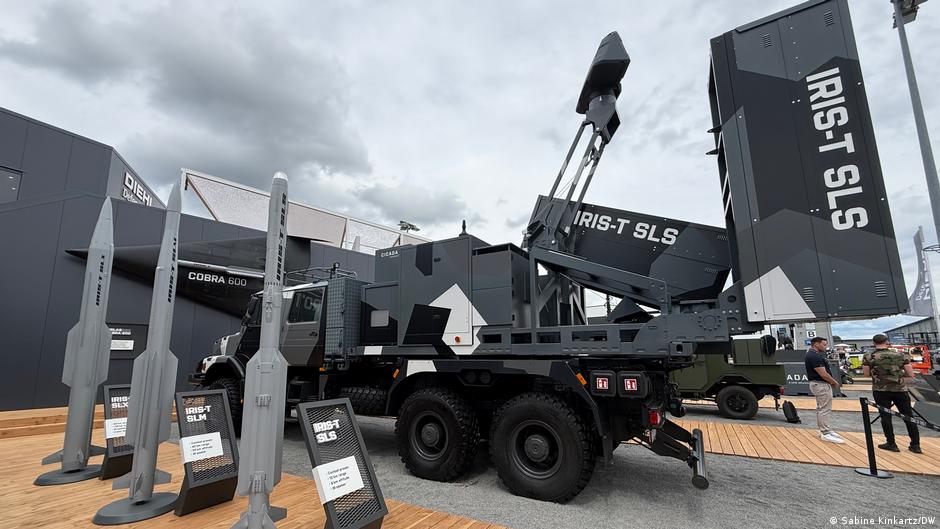
There is also a crowd at the Diehl Defense display, which is showcasing a new version of its Iris T, a short-range infrared homing air-to-air missile used by the Bundeswehr and other militaries. “We have got a lot of orders for the next few years,” said Chief Program Officer Harald Buschek, adding that the company planned to invest about €1.5 billion in new facilities, buildings and equipment.
He said there is strong interest from potential new customers on top of the 10 countries the company already works with. “Of course, the Iran war is having an impact. We have already received calls to start negotiations.”
Given the current global situation, military air defense has once again assumed importance to protect territory, civilians and critical infrastructure.
Chancellor Merz says aerospace industry is a ‘key strategic sector’
German Chancellor Friedrich Merz (CDU) also appeared impressed by the strong performance of German companies in the aviation industry, which was an exception amid the economic crisis. According to the German Economy Ministry, employment in the sector is expected to grow by 19% in 2025 and reach 130,000 workers.
“The aerospace industry is a key strategic sector,” Merz said as he presented the government’s new aviation strategy, which includes the military aviation sector for the first time. “Competitiveness and innovation are at the heart of our strategy in one of the key growth sectors of our country,” he said, adding that civil aviation, aviation industry and military aviation come together.
Over the next few years, €35 billion is earmarked for defense purposes. And Merz said he expects start-up ISAR Aerospace to successfully launch a rocket before the end of the month.
The government’s new strategy is also clearly designed to boost civil aviation as air traffic is expected to double by 2050. “Over the next 20 years, more than 40,000 new aircraft will be needed worldwide,” the Chancellor said.
European plane maker Airbus, headquartered in France, is expected to profit but Merz says German investment should be reflected in production sites. He stressed, “The next generation of short- and medium-range aircraft must again be built in Germany, with program management in Hamburg.”
Environmental groups criticize aviation strategy
Environmental groups have criticized the German government’s new aviation strategy for focusing too much on economic growth and not enough attention to the environment. In theory, Airbus could create climate-neutral aircraft that leave no contradictions, but in practice key conditions still need to be met.
“The infrastructure for hydrogen-powered aircraft is not yet ready,” said Thomas Toepfer, Airbus CFO at ILA. He said the required amount of green hydrogen is not yet available and planes cannot yet refuel at airports. He said such aircraft would become a reality by the mid-2030s at the earliest.
This article was originally published in German.