
On June 14, the Bitcoin network registered a downward difficulty adjustment of 10.09% in block 953,568, the second largest reduction observed so far in 2026.
As can be seen in the graph, The difficulty fell from levels close to 139 billion (T) to 124.93 T, its lowest level in recent months.
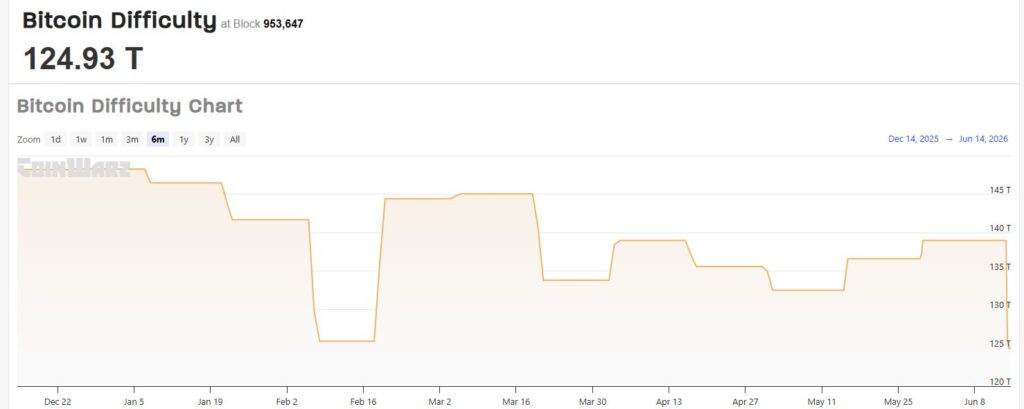
The difficulty is a parameter that Bitcoin automatically adjusts every 2,016 blocks (approximately every two weeks) to maintain a production rate close to one block every 10 minutes.
When the total computing power of the network decreases, also known as hashratethe protocol reduces the difficulty of balancing the system. As a result, Active miners need to do less computational work to find blocks and obtain rewards.
Bitcoin crash hit mining profitability
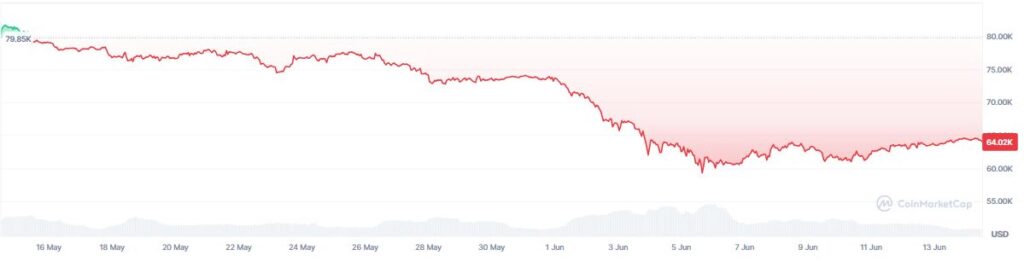
The reduction in difficulty usually occurs when some of the miners temporarily abandon the activity. This movement comes after the strong correction that bitcoin (BTC) suffered in recent weeks.
In the last month, The asset went from trading around $79,850 to the $64,000 areaa fall that deteriorated the profitability margins of numerous miners.
Among the most affected are usually older ASICs, which are devices designed exclusively for mining BTC. Newer models consume less electricity per processing unit, while older equipment becomes less profitable when the price drops or energy costs rise.
The output of these equipment reduces the hashrate network aggregate and ends up triggering difficulty adjustments like the one recorded this week.
AI competes for miners’ energy
However, The reduction in difficulty does not respond solely to factors linked to the price of BTC.
A report published by the investment bank Bernstein on May 19, 2026 indicates that mining companies are gaining prominence in the construction of infrastructure for artificial intelligence (AI), as explained by CriptoNoticias.
According to the entity, miners control more than 27 gigawatts (GW) of planned energy capacity in the United States and They have signed AI-related agreements worth more than $90 billion.
Bernstein estimates that approximately 3.7 GW already committed for high-performance computing services and data centers destined for AI. The bank’s thesis is that the main bottleneck of the technology industry is no longer chips or financing, but access to electricity connected to the grid.
In this context, mining companies start with a significant advantage: they already operate energy-intensive data centers and have installed electrical infrastructure.
Among the cases cited by Bernstein are IREN, which signed agreements linked to Nvidia for 3.4 billion dollars; Riot Platforms, which reached agreements with AMD; and companies such as Core Scientific and Hut 8, which expanded their exposure to computing and digital infrastructure businesses.
If a growing share of energy capacity migrates to artificial intelligence projects, Bitcoin mining could face increasing competition for one of its most valuable resources: electricity.
For now, the drop in difficulty represents a relief for miners who remain active. However, the future evolution of hashrate It will also depend on how this dispute over energy infrastructure between mining and AI progresses.