
While Nadella talks about greater human value, companies lay off staff when adopting AI.
The CEO of Microsoft warned about the concentration of AI on a few platforms.
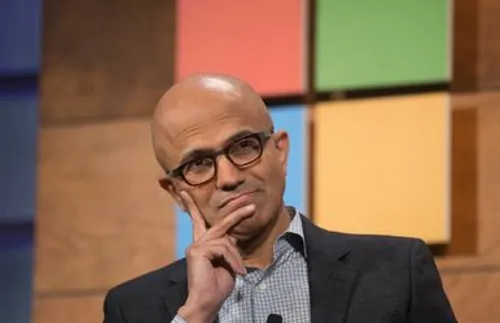
Satya Nadella, CEO of Microsoft, published an essay on his X account on June 14 in which he argues that companies’ human capital becomes more valuable as their own artificial intelligence (AI) systems grow, what he calls “token capital.”
According to Nadella, the human capital of a company (the knowledge, judgment and relationships of its people) does not lose value as your “token capital” growsThat is, the company’s own artificial intelligence systems that train on its workflows and internal data. On the contrary, he maintains that this human capital becomes more relevant the more the second is developed.
In this context, “token” refers to the basic unit with which language models such as GPT, Claude, Gemini, among others, process text.
For the relationship between human capital and token capital to work, according to Nadella, institutions must transform the knowledge accumulated by their people into artificial intelligence systems that improve with each use. For that, proposes two mechanisms:
- «Private evaluations» (private evaluations): internal metrics to measure whether a model improves on the results that matter to the business, and not just on public deadlines or goals.
- “Private reinforcement learning environments”: a space where a model is trained with data and real cases from the organization itself.
Meanwhile, companies reduce staff as they adopt AI
Nadella’s premise that human capital becomes more valuable as token capital grows, contrasts with what has been happening in practice.
Block, the financial technology company of bitcoiner Jack Dorsey, announced in early March the dismissal of 4,000 workers, as reported by CriptoNoticias, a decision that lThe company framed the adoption of AI agents for tasks that previously required extensive human structures.
MARA Holdings (MARA), public Bitcoin miner, carried out layoffs in April that affected around 15% of its workforce (about 40 positions out of 266 full-time employees), a cut as part of its transition from Bitcoin mining to artificial intelligence infrastructure. “The organization needed to scale a Bitcoin mining rig is not the same organization needed to build a digital infrastructure company,” MARA CEO Fred Thiel justified in that letter.
As CriptoNoticias also reported, similar cases are repeated in other companies in the sector: Gemini reduced up to 30% of its workforce and Crypto.com cut about 12%both in the midst of pivots towards artificial intelligence.
In this way, the pattern of companies that adopt AI and, at the same time, reduce staff, stresses the idea that human capital “becomes more valuable” in general terms, at least for those who lose their jobs in that process.
AI Concentration and the Bitcoin Argument
Nadella argues that if a handful of AI models end up monopolizing all the economic value generated by companies’ transition to automated structures, «there is no social permission for an AI future that empties entire industries».
The CEO of Microsoft compares this scenario with the first phase of globalization, when, according to his reading, macroeconomic indicators remained stable while entire industries were displaced by productive relocation.
Although at no point in his essay does Nadella mention Bitcoin, his warning about the risk that few AI models concentrate all the economic value touches on a debate that Bitcoin developers are already addressing.
As reported by CriptoNoticias, Matt Corallo, Bitcoin Core developer, emphasized during the Oslo Freedom Forum that current AI is concentrated in a handful of centralized platforms (OpenAI, Anthropic, Google) and that Bitcoin has a limited time window to integrate into the AI ecosystem before that centralized control is established as the default standard.
There is no reason why Bitcoin and freedom cannot become the new established incumbents.
Matt Corallo, Bitcoin Core developer.
While Nadella frames the problem from corporate logic (each company should build its own “token capital” so as not to depend on a handful of suppliers), Corallo poses it from the infrastructure itself, that is, who controls the payment and communication rails on which the AI agents will operate.
The Core developer raises a problem timingthat is, who manages to reach the end users first. The solution to this scenario that Corallo highlights is that Bitcoin, an open and auditable technology, is integrated into the AI ecosystem. before centralized platforms set the standard in private and closed conditions.
While Nadella argues that human capital becomes more valuable as companies build their own “token capital,” the dispute over the infrastructure on which those systems run (who verifies identities, who controls payments, who makes the rules) moves along another lane, one where Bitcoin and the large centralized AI platforms compete to become the standard before the other.