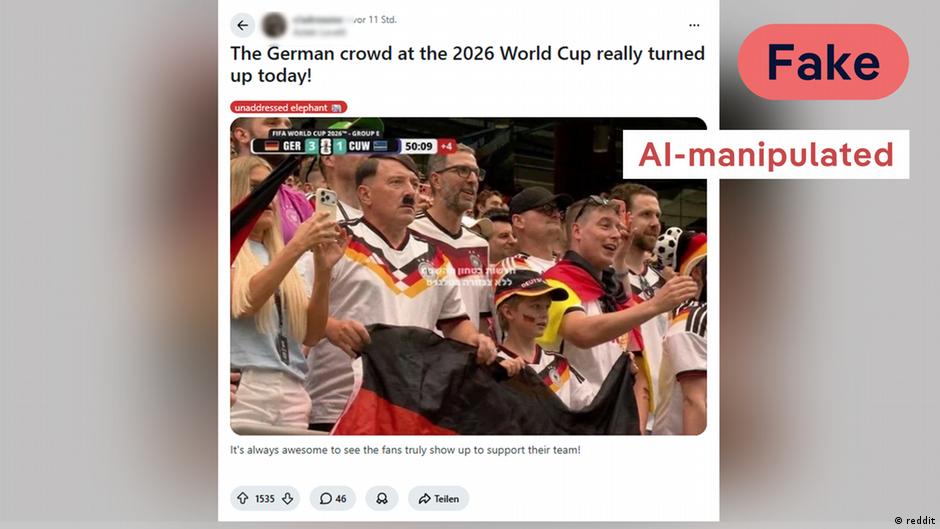
On the pitch, the focus was on the national team’s impressive 7-1 win over Curaçao during Sunday’s FIFA World Cup match in Germany.
However, outside the field, many social media users were fixated on something entirely different: an image of a fan inside the stadium wearing a German shirt, holding a German flag and resembling Adolf Hitler.
The image was shared across multiple platforms, receiving millions of views.
it post on xFor example, has been viewed more than 3 million times it’s on instagram Has received more than 460,000 likes.
This claim also spread in many languages spanish on facebook And dandruff on threads.
Some posts also contained overtones of anti-German sentiment, such as reddit postIt sarcastically read: “It’s always wonderful to see fans actually support their team!”
However, the image is not authentic.
DW Fact Check: Fake and AI manipulated.
Here’s how we came to this conclusion.
1) Look for the real image
The purported image of the Hitler lookalike appears to be a screenshot from the television broadcast of the match, including a timestamp corresponding to the time of stoppage time in the first half.
Soon after, Kai Havertz scored a penalty and made Germany’s score 3-1. The fans were happy and celebrating.
A review of the original broadcast shows the same group of fans celebrating after Havertz’s goal, but with one key difference: the alleged Hitler lookalike is nowhere to be seen.
Instead, the original footage shows a gray-haired man who bears no resemblance to Hitler.
You can see the obvious differences by sliding between the two images shown above: one is the actual broadcast (in this case from the German public broadcaster ARD on the right), while the other is an image manipulated with AI.
It is important to note that for major sporting events such as the World Cup, an official broadcast is produced by the organizing body (in this case, FIFA) and distributed as a central feed to partner broadcasters.
This means that the main images are the same across all channels, with only small elements customized by individual broadcasters.
Beyond the central broadcast, a further clue to the composition of the fan group can be found by examining images from photo agencies accredited for the match.
For example, this photo below by Berlin-based agency Imago, which often covers major sporting events, captures the same group of fans from a different perspective, yet without any Hitler-like appearance.
Although it was not possible to verify what time the image was taken based on the metadata provided by the agency, it can be considered further evidence that no such person was part of the group.
2) Is it AI?
Another step in verifying the authenticity of an image is to determine whether it was created or manipulated using artificial intelligence.
Many AI chatbots now offer the ability to check if their systems have been used to create or manipulate an image.
This is possible because such devices embed digital watermarks. It is invisible to the naked eye, but can be detected when using tools to verify content.
A search using OpenAI, the US-based organization behind ChatGPT, shows that its tools were indeed used to create an image resembling Hitler.
OpenAI’s analysis said it found “a SynthID watermark that originated from OpenAI.”
Further investigation using another tool, this time from Google’s Gemini, provided additional clues.
While it indicates that no Google AI systems were used to manipulate the image, it also notes that “a visual analysis and context checking strongly indicate that this image has been digitally altered or generated.”
A third tool, X Grok, describes the image as a “classic fake” while responding to a user’s question on X under the viral post.
It says: “This photo is not genuine. It has been digitally edited (AI or Photoshop) to include Adolf Hitler in the 2026 World Cup crowd.”
While these tools should always be used with caution, as they can sometimes make mistakes, in this case three independent tools came to the same conclusion, strengthening the analysis based on the original footage.
3) Think about context
While the World Cup is known as a celebratory event that showcases fans and cultures from around the world, a supporter resembling the Nazi dictator who started World War II and was the central figure responsible for the Holocaust would likely have caused a major controversy in the stands.
Such an incident would likely have attracted the immediate attention of broadcasters or stadium officials. It would also probably have met with strong disapproval from many of the German fans present in the stadium.
This fake image is part of a broader trend of disinformation, much of it generated or manipulated by AI, that has circulated before and during the World Cup.
For example, DW Fact Check’s recent article on this topic examined fake websites claiming to sell World Cup tickets.
Boris Gellert and Torsten Neuendorf contributed to this article.
Edited by: Uta Steinwehr and Wesley Dockery