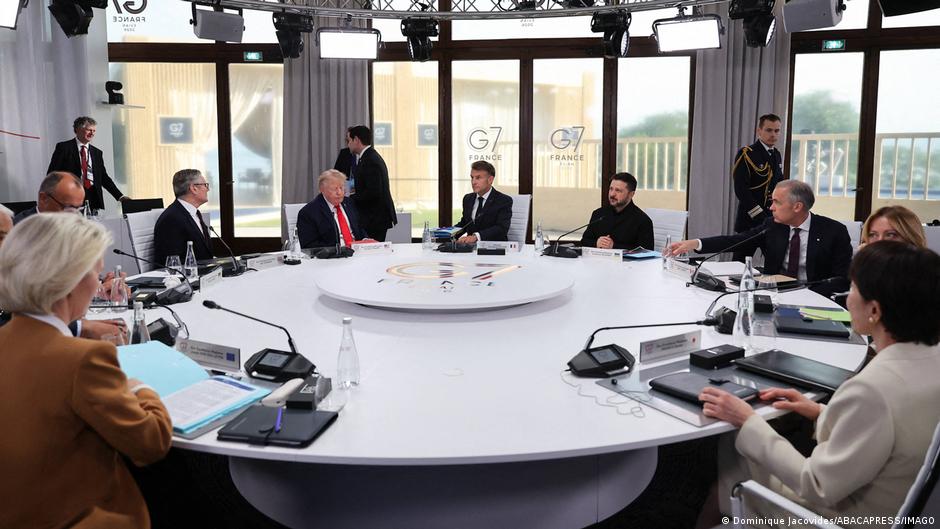
The recently announced preliminary agreement between Washington and Tehran is raising cautious optimism among European leaders that the “very costly” confrontation could finally end and the Strait of Hormuz could be reopened.
“Implementation is the priority,” European Commission President Ursula von der Leyen said in Evian ahead of the G7 summit, where the agreement is expected to be widely discussed.
While Germany, France, the United Kingdom and Italy, the so-called E4, have expressed willingness to lift sanctions on Iran, von der Leyen made clear that any such move would depend on measurable change on the ground and insisted on strict conditions before sanctions could be eased.
“We have a sanctions framework that is responding to two main features: human rights violations and weapons of mass destruction,” he said. “The principle of sanctions is that we need real change on the ground before we can even think about removing them. Sanctions are meant to change behaviour.”
Von der Leyen, along with European Council President Antonio Costa, is representing the EU at the summit and is setting the tone at the Hotel Royal ahead of the arrival of heads of state and government.
The Commission president said any relaxation of restrictions would require credible and verifiable progress.
“If behavior is changing in a credible and verifiable way, then restrictions can be eliminated – but the other way around is also true,” he said. “You cannot lift sanctions caused by human rights violations and weapons of mass destruction unless there is a change in behavior.”
At the G7 summit, a key question will be what exactly US President Donald Trump expects from European partners to help secure and maintain the Iran deal.
On Ukraine, attention will turn to whether the agreement between Iran and the United States could create new momentum for peace talks between Russia and Ukraine. Much will likely depend on whether Trump re-engages diplomatically – and whether Europeans can secure a meaningful seat at the table.
In Brussels, the open question remains whether the EU has a concrete strategy to convince Washington that its participation is essential to any lasting agreement.