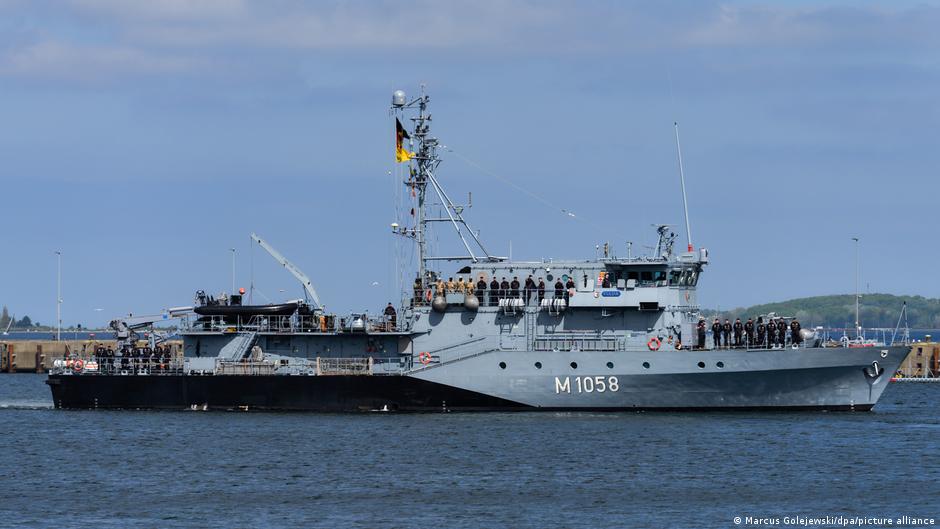
The German military, or Bundeswehr, is preparing for a possible mine-clearing mission in the Strait of Hormuz. The German Defense Ministry announced Thursday that the minesweeper Fulda and the tender ship Mosel, previously deployed to the eastern Mediterranean, had passed through the Suez Canal earlier that morning. The ships are now expected to cross the Red Sea in five to seven days and then reach the port of Djibouti. Further preparations for the mission will take place there. There are a total of about 140 soldiers on board the ship.
“German units are being pre-positioned for a possible mission in the Strait of Hormuz,” Defense Minister Boris Pistorius said in Brussels on Thursday. But the emphasis is on “possible”, because now that the deal has been signed between the US and Iran, many questions remain. The Defense Ministry said the necessary conditions included “a permanent end to hostilities, a basis in international law and a mandate from the Bundestag.” The German parliament, the Bundestag, must approve any armed foreign deployment.
As it happens, sea mine clearance is one of the Bundeswehr’s specialties. “We have a lot of practice because, as you probably know, the North Sea and the Baltic Sea are the two maritime places in the world where there are the most remains of unexploded devices from the two world wars,” Johannes Peters, an expert on maritime security at the Institute for Security Policy at Kiel University, told DW.
There are millions of objects in the North Sea and the Baltic Sea, including mines, ammunition and other types of explosives, which have been lying there for the last 70 years or more, he said.
Strait of Hormuz as a strategic point
After the Iran War began in late February, Iranian forces effectively blockaded the Strait of Hormuz and reportedly began laying sea mines. The blockade had a widespread impact on the global transportation of oil and liquefied natural gas, causing fuel prices to rise sharply around the world.
In order for the strait to once again become a safe sea trade route, hostilities must permanently end and the mines cleared. But it is a complex undertaking. “Sea mines are extremely difficult to detect,” said Nitya Labh, a maritime security expert at Chatham House, a London-based think tank.
“There are different types, ones that can float on the surface of the water, ones that can be attached to the floor, but float in midair and explode whenever they sense or detect a ship nearby. And then there are those that can be placed on the sea floor.”
This means that even if mines are located, it may take weeks or months to clear them.
Sea mines: quick to lay, hard to clear
“We don’t know the exact amount of mines, and we don’t know the exact area where the mines may have been laid,” Peters said. “So there are a lot of uncertainties currently.” Although sea mines can be laid quickly, clearing them is a difficult task. “But that’s really the purpose of the ship,” he said.
German Navy minesweepers are designed to detect sea mines without being detected. Many mines respond to magnetic fields generated by steel, but minesweepers have hulls made of non-magnetic steel. Minesweepers can also operate at very low speeds in stealth mode, so as not to trigger a ship’s propeller or engine explosion.
Unmanned systems carried by minesweepers are indispensable for clearance operations. “Seehund” surface drones simulate the acoustic and magnetic signals of large ships to deliberately detonate mines, while underwater drones such as “Seefuchs” can identify and destroy mines underwater. When that technology fails, mine variations are deployed.
But a key condition for a mine-clearing mission is that neighboring countries – in this case countries like Iran and Oman – must give their consent.
According to French President Emmanuel Macron, about 20 countries have already pledged to make concrete contributions to the mission. “It’s really important that Germany, France, Britain, if they participate, they have to be clear that they are not parties to the conflict, that they are not taking sides with the US or Iran. They have to remain neutral,” Profit said.
He also believes that participation of navies of Gulf countries like Oman or Saudi Arabia in the mission would also be desirable.
The real conversation has yet to begin
So whether there will be a naval mission or not also depends on how the initial memorandum of understanding between Iran and the US is implemented. The agreement serves as the starting point for negotiations on controversial issues, particularly Iran’s nuclear program, and these talks aim to reach a final agreement within 60 days.
On Wednesday, Chancellor Friedrich Merz dashed hopes for a quick start to the Bundeswehr mission, saying the Bundestag would not be able to address the mission until the last week of parliament before the summer recess starting on July 6.
Nevertheless, the Navy is already making its position. Pistorius insisted, “We are ready in any situation. When the time comes, we will be ready.” If deployment occurs, ships can be quickly moved to the Strait of Hormuz. Until then, German ships are taking part in the EU naval mission ASPIDES, which monitors sea lanes in the Red Sea.
This article has been translated from German.