“A great victory” and “a turning point for Lebanon” – this is how Naim Qassem, leader of the Lebanese group Hezbollah, described on Wednesday the memorandum of understanding that stopped fighting between Iran and the US this week.
Qassem thanked the Iranians for “annexing Lebanese territory through agreement” and “forcing Israel to stop its aggression.”
Hezbollah was founded in 1982 with the support of Iran, and one of its primary goals then was to end the Israeli occupation of southern Lebanon. It has a military and political wing and is supported by most of Lebanon’s Shia Muslim community. Today it plays a major role in Lebanese society and politics, has often been described as a “state within a state” and remains an opponent of Israel.
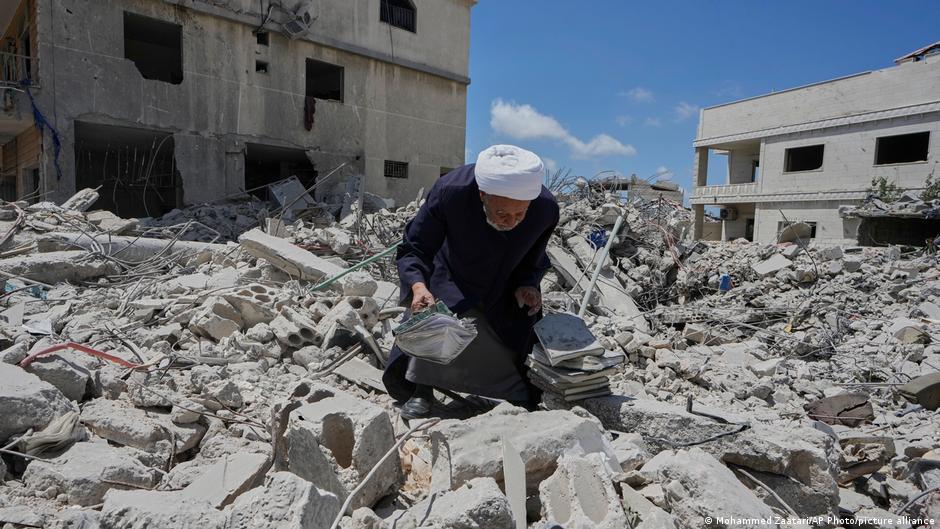
Since Qassem’s comments, fighting has continued in southern Lebanon, with Hezbollah targeting Israeli troops and Israel continuing to destroy southern villages and use bombs and drones. Sixty days of talks between the US and Iran, during which the details will be worked out, were due to begin in Switzerland on Friday, but were postponed in the morning due to Iran’s opposition to the fighting in Lebanon.
Yet, despite its troubled start, analysts say the deal on the table favors Hezbollah’s allies in Tehran.
How ‘great’ is Hezbollah’s victory?
“The memorandum of understanding virtually gives Iran everything it wanted and gives Trump everything it had [before attacking Iran, together with Israel, in February],” says James M. Dorsey, an expert in the field at Singapore’s Rajaratnam School of International Studies. “And certainly, at least initially, it looks like a victory for Hezbollah.”
But whether this is actually the case remains to be seen, Dorsey told DW.
The first paragraph of the memorandum states that the US, Iran and allies will declare an “immediate and permanent” cessation of military operations on “all fronts”, including in Lebanon.
The agreement signed on Wednesday by the US, Iran and brokered by Pakistan also says the two will ensure Lebanon’s “territorial integrity and sovereignty.”
Israel currently occupies about 600 square kilometers in southern Lebanon and calls it a “security buffer zone” necessary to protect civilians in northern Israel from Hezbollah rockets. Critics of Israel say this is an invasion and occupation.
“The Iranians, for all practical purposes, said it meant two things,” Dorsey explained. “There will be no further military action and there will be an Israeli withdrawal from Lebanon. So the litmus test of the Iranian position will be whether or not Israel is forced to abide by those conditions, and whether Trump says to Israel, ‘You have no choice.'”
If Israel withdrew, it would be to Hezbollah’s advantage. Many of Lebanon’s Shia Muslim communities live in the south and more than one million have been displaced by Israeli troops, who have also demolished entire villages there.
More money for Hezbollah
The US-Iran memorandum also mentions billions of dollars in funding for Iran’s reconstruction, as well as freeing up Iranian funds and allowing Iran to continue selling oil.
Diplomats from the region told reuters news agency That, once the freeze on its funds was lifted, Iran said it would send more money to Hezbollah.
Lebanese commentator Karim Chebaklo, who is also a board member of Beirut’s port authority, said, “If Iran’s oil revenues resume without any restrictions on where it goes, the external pressures that would make it harder to maintain Hezbollah’s funding will be reduced.” wrote in an editorial this week.
The Lebanese government is trying to rein in and disarm Hezbollah in order to stop Israeli bombing. The group’s military wing is widely seen as having pushed Lebanon into the current conflict after firing rockets at Israel in early March following the Israeli assassination of Iranian leader Ali Khamenei.
But as Chebko points out, one of the ways the Lebanese government put pressure on Hezbollah was because of “economically weak Iran”. Chebko argued that if Iran becomes more generous and sends more cash to Hezbollah, “it pushes the question of disarmament further.”
no guarantee
However, none of the potential “victory” for Hezbollah is guaranteed by the US-Iran agreement. Neither of the two belligerents fighting in Lebanon – Israel and Hezbollah – nor the Lebanese government were signatories to the US-Iran deal.
To the Lebanese government, the agreement makes it appear as if Hezbollah’s sponsor, Iran, is dictating Lebanese foreign policy.
Earlier this year the Lebanese government entered into direct talks with Israel about a Hezbollah disarmament agreement, which was supposed to facilitate peace and Israel’s withdrawal. This was the first direct talks between the two countries in more than 30 years. Hezbollah itself was strongly opposed to such an engagement with Israel.
For the Israeli government, this week’s agreement seizes what it sees as an opportunity to continue humiliating Hezbollah.
Soon after the details of the memorandum became clear, several Israeli politicians said that their troops would not leave Lebanon, despite increasing pressure from the US, Israel’s largest ally and military supplier. Israeli officials also told journalists that their country is engaged in tense negotiations with the US for permission to remain in Lebanon.
Was there a ceasefire or not?
“Iran insists that Lebanon is part of the deal and we’ve seen twice in the last two weeks that when Iran stood up for Lebanon, Trump responded by taking action against Israel,” explains Dorsey of the Rajaratnam School. “And the truth of the matter is that Israel was not consulted and was not at the table. All this creates [Israeli prime Minister Bejmanin] Netanyahu is the loser in all this – depending on how this plays out politically. And the jury’s still out on that one”
Later on Friday, Reuters reported that Hezbollah and Israel had agreed to a ceasefire starting the same afternoon. However, soon after the announcement, more Israeli airstrikes were reported on southern Lebanon and a military spokesman said that Israeli forces retained “full operational freedom” in Lebanon.
Despite heavy losses of fighters, equipment and even political support, Hezbollah “may still emerge stronger from this war,” said Anthony Samrani, editor-in-chief of the Beirut-based newspaper. L’Orient-Le JourExplained in a question-and-answer session this week. “Imagine a scenario in which the US forces Israel to withdraw from the south as part of a final agreement with Iran… Hezbollah would then claim to have ‘liberated’ the south and manage its reconstruction as it sees fit, in accordance with its interests.”
But the most likely scenario, he concluded, “is a double burden for Lebanon: an Israeli occupation and a defiant Hezbollah. The south will remain a zone of war and suffering…And if Beirut and Tel Aviv eventually reach an agreement, the main issue will become the power struggle between the two.” [Lebanese] state and [Hezbollah] Militia.”
Edited by: R. How