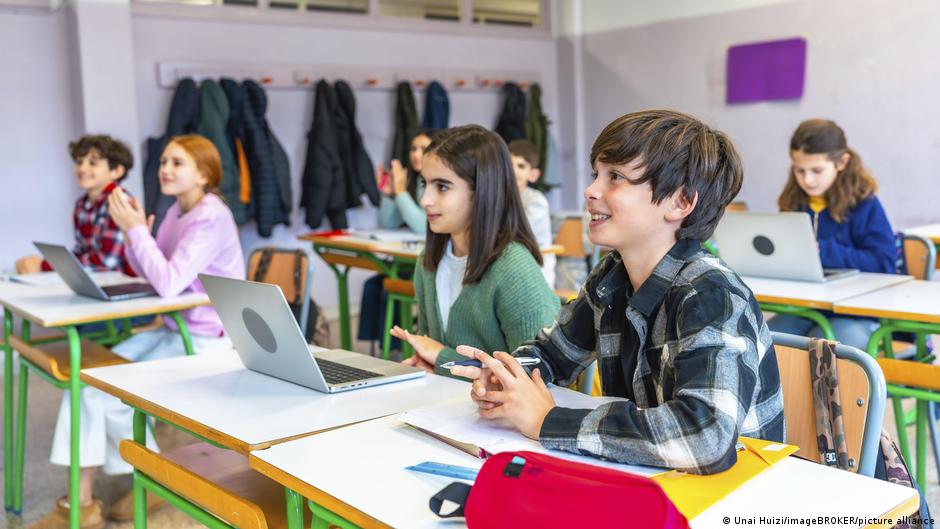
Ketteler SchoolAn elementary school in the northern part of the western German city of Bonn is not in a wealthy area. Almost all of the 250 students come from families that have moved to Germany within one generation. Many people do not speak German at home. One in three students needs individual support. However, the school has consistently scored above average on achievement tests in the state of North Rhine-Westphalia.
Germany’s two-tier education system sends children into either a university track or a trade-school track by the time they reach adolescence. The percentage of students at the Kettelerschule who transfer to university-track institutions after four years of primary school has increased from 0.5% to 30% over the past 20 years.
A big part of this success is Christian Lang-Winter, who joined the Kettelerschule as a young teacher in 2004, became principal and started “turning everything upside down”.
“It became clear to me very quickly that I would either leave or change schools,” Lange-Winter told DW. “I want our children to be able to learn everything here so that later they have the same opportunities as children from families where children are given ample opportunities from the beginning.”
As one of her first official acts, Lang-Winter implemented a system of teaching students grouped into “learning families” that spanned multiple grade levels. This means that children aged 6 and 9 learn together and support each other.
Lang-Winter’s team of teachers, social workers, and special needs teachers has made reading a priority, especially for first grade students. “We need high-quality language support for all children living in this country so they can speak German really well,” Lange-Winter said. “Otherwise, education won’t work: if I don’t have the language, I can’t be educated.”
The Kettlerschule works together with nearby day cares. On Mondays and Wednesdays, preschoolers go to Kettlerschule for 90 minutes. Elementary school children come to day care to read aloud to younger children. “I want to know everything I can about these kids in advance so I can support them as quickly as possible,” Lang-Winter said.
‘Educational gap’
according to germany National Report on EducationSuccess in school is largely determined by students’ social background, especially their parents’ income and education level.
A UNICEF study ranked Germany 20th out of 43 developed countries when it comes to math and reading skills for 15-year-olds. Adolescents from socially disadvantaged families are five times more likely to fail to meet minimum standards in reading than their privileged peers. The consequences are dire: the proportion of young people leaving school without a diploma in Germany has risen to 8%.
German Education Minister Karin Prien is worried. He told German public broadcaster ARD that such problems arise even before children go to school. “What we’re seeing now is that the educational gap essentially starts at birth, widens until age 6 and then doesn’t diminish,” Preen said. “Children in day care need to learn German and receive better support for their other developmental deficiencies.” Before Parliament goes into summer recess, she plans to introduce legislation that would set nationwide standards.
widening educational gap
The BSK Federal Student Conference has long drawn attention to the lack of equal opportunity in the German education system. “Education should not depend on social background, a family’s financial means or where one lives,” Isabelle Seltenreich, the organization’s press coordinator, wrote in an email to DW.
Seltenreich wrote that BSK is calling for targeted long-term support for schools in disadvantaged areas, better staffing and resources, smaller class sizes and multidisciplinary teams that include social workers and psychologists. Equally important, he wrote, is the extension of individual support.
“Schools must be able to accommodate diverse learning needs and support every student as best they can, rather than further exacerbating existing inequities,” Seltenreich wrote. “No student should fall victim to the flaws in the system.”
flawed education system
Silke Müller, who taught for 16 years, takes a dig at the German education system in her 2026 book: “Schule gegen Kinder” (Schools Against Children).
Müller told DW that Germany has failed to provide equal opportunities for children and youth. The system is not designed to support every child equally; Instead, he said, it depends entirely on who students encounter in their educational environments.
Muller said an ideal school “would have to be designed from the child’s perspective: learning would no longer be organized into separate classes and subjects – and it would focus on developing skills.” He said that schools should give up fixation on grades and focus on personal development.
no real debate
Almost nothing has changed in Germany’s approach to education in the past 30 years, said Bob Bloom, a former teacher who has about 240,000 followers. Instagram.
Bloom said the question of how to effectively educate students is no longer asked because there is no easy answer. Instead, the debate focuses on certain aspects. “It’s all about smartphone bans, smartphone bans, smartphone bans,” Bloom said. “And maybe even ban social media.”
Prine recently said that education is a “critical issue for our nation.” Bloom agrees with the Education Minister, but, he said, this has not been reflected in the priorities of recent governments.
“When you do surveys on political issues, education is almost always in the top three,” Bloom said. “But this is not reflected in reality. I would go so far as to say that no real debate on education has even started in Germany.”
This article was originally written in German.