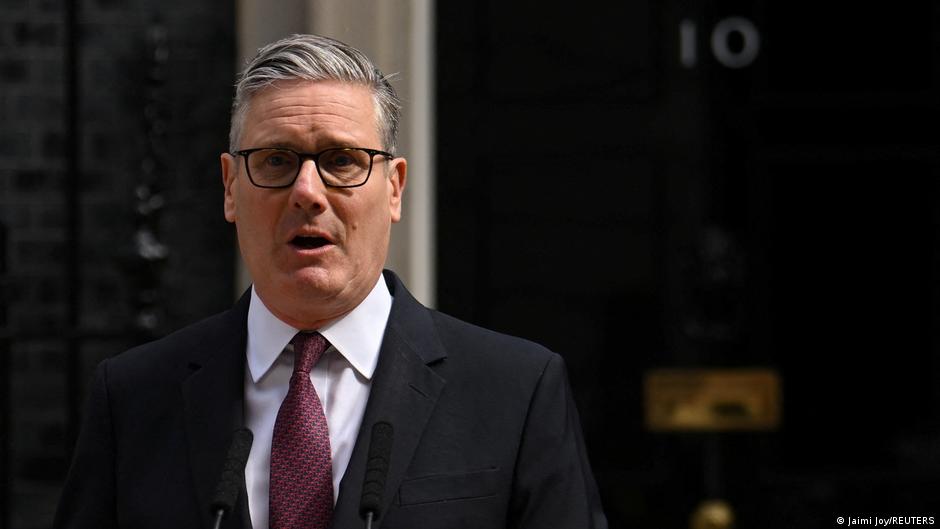
British Prime Minister Keir Starmer said on Monday he would step down amid growing political pressure.
He outlined his plans after a weekend of reflection, in which ministers said they were considering what was best for the country.
“The question my party is now asking is whether I am in the best position to lead us into the next general election,” Starmer told reporters from a lecturer outside 10 Downing Street.
“I have heard the answer of my parliamentary party to that question, and I heartily accept that answer.”
“Every decision I take is about putting the country I love first,” he said.
“I will therefore resign as leader of the Labor Party. I have spoken to His Majesty the King this morning to inform him of my decision.”
what happens next?
Nominations to replace Starmer as leader of the Labor Party and thus British Prime Minister will open on 9 July.
“I will remain prime minister until the contest is over,” Starmer said. “And I will do everything possible to ensure an orderly transfer of power.”
The clear frontrunner is former Manchester mayor Andy Burnham, who is returning to the British Parliament after winning a by-election on Sunday. He has already contested the Labor Party leadership election twice.
Less than two hours after Starmer’s announcement, Burnham confirmed that he would succeed him as party leader and Prime Minister.
“Keir has given great service to our country and I want to thank him for his leadership and dedication during such challenging times,” Burnham said.
“His decision marks the beginning of a change, and it is important that this process is conducted in an orderly and responsible manner. I will put myself forward as part of this process.”
Former health secretary Wes Streeting, who was expected to challenge for the leadership and resigned as health secretary last month in protest at Starmer’s leadership, said he would support Burnham.
It is unclear whether Burnham will enjoy a coronation or whether other MPs will emerge as challengers.
Pressure increases against Starmer
Starmer’s announcement came after days of intense speculation, with journalists gathering outside Downing Street awaiting clarity on his position.
Junior minister Jacqui Smith had previously said that Starmer was thinking “really hard” about his future and supported his decision.
It was a major reversal of fortunes for the British Prime Minister, who had led the Labor Party to a landslide victory in 2024 after 14 years of Conservative government in Britain.
Both parties voted overwhelmingly for the rising, far-right Reform UK Party. It has led opinion polls for more than a year.
Why was Starmer unpopular?
Starmer’s term in office got off to a shaky start when his government announced a highly unpopular policy to remove winter fuel payments for millions of elderly people. The plan was not in the Labor Party’s election manifesto and the party eventually backed down after widespread criticism.
Starmer also backed down from plans to impose an inheritance tax on family farms, while his decisions to raise the payroll tax and minimum wage boosted business growth.
His cabinet was also rocked by several scandals, including that of his former deputy prime minister, Angela Rayner, who stepped down last year over unpaid property taxes.
Most recently, Starmer fired the British ambassador to the US, Peter Mandelson, after revelations that the envoy had deep ties to deceased sex offender Jeffrey Epstein. Official government documents revealed that Starmer was warned about the reputational risks of appointing Mandelson, but proceeded to do so nonetheless.
The scandal dogged Starmer for months and led to the resignation of the top civil servant at Britain’s Foreign Office, as well as two of his close aides. Starmer later admitted in parliament that his decision was “wrong” at the time.
Don’t let algorithms hide news. If you rely on our team for reliable reporting, please take a moment to choose us as your Preferred source on Google by clicking here And press the “Star” or “Favorite” button, so you always see our verified news first.