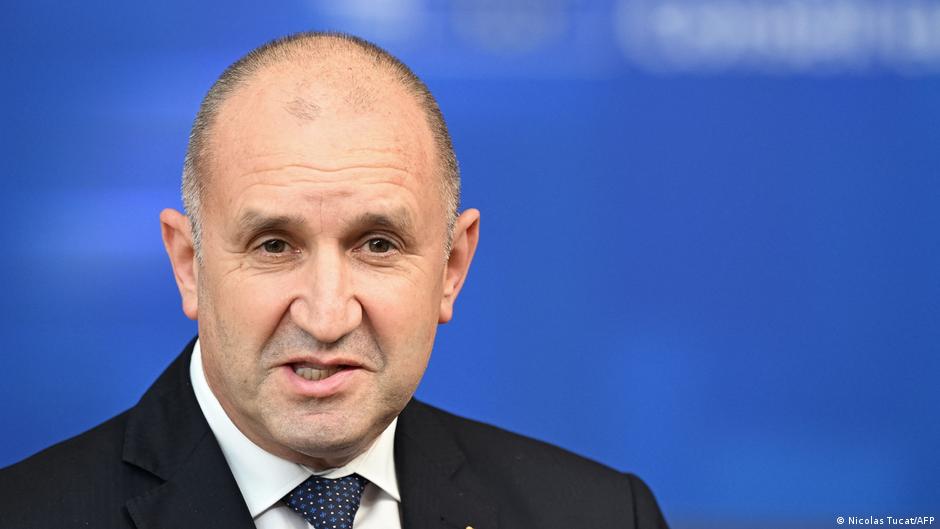
When the EU moved to include Russian Orthodox Church head Patriarch Kirill and former Lukoil chairman Vagit Alekperov in its latest package of sanctions against Russia, only one member state objected: Bulgaria.
During his first European Council meeting as Bulgarian Prime Minister on 18 June, Rumen Radev said his country would veto the package, which includes 34 individuals and 47 entities, unless both Russians were removed from the list.
While Radev supported the opening of EU accession negotiations with Ukraine and met with Ukrainian President Volodymyr Zelensky in Brussels to discuss energy security and drone manufacturing, he publicly defended the role of the Russian Orthodox Church in Bulgarian history and described Alekperov as someone who had invested “resources and efforts” in Bulgaria’s only oil refinery.
Radev’s veto threat comes just nine days after Bulgaria imposed an embargo on state arms supplies to Kiev and days after a Russian drone attacked the Kiev Pechersk Lavra monastery, raising concerns that Bulgaria’s foreign policy could prioritize domestic matters over EU unity over Russia.
What is Bulgaria’s connection with Lukoil?
“We will not allow sanctions to harm Bulgaria and its economy,” Radev told Bulgarian journalists in Brussels in a doorstep interview on June 18.
He said these measures could disrupt supplies of fertilizers and spare parts for the Sofia metro, but added that his main concern was the risk to Lukoil’s oil refinery operations in Burgas.
Following US sanctions on the Russian company in 2025, Bulgaria took control of its domestic operations by appointing a special state administrator.
In response, Litasco, Lukoil’s Swiss subsidiary and formal owner of its Bulgarian assets, argued that the move was an unlawful expropriation and warned it could pursue legal remedies.
Why object to sanctions against Alekperov?
The dispute could cost Bulgaria up to €3 billion ($3.43 billion) in liabilities, according to Bulgaria’s Economics Minister Alexander Pulev.
Although local media report that there has been no official confirmation of the arbitration yet, Radev alluded to the potential controversy, arguing that sanctioning Lukoil founder Vagit Alekperov, who stepped down as company chairman and resigned from its board of directors in 2022, would be tantamount to “shooting an ax in the foot.”
The Prime Minister failed to explain how sanctions against Alekperov would affect Lukoil’s operations in Bulgaria or why defending him in Brussels would impact any potential legal dispute.
Radev’s religious arguments
While Radev advocated keeping politics out of religious questions, he also said that the Bulgarian Orthodox Church should speak out on sanctions against Russian Patriarch Kirill.
However, since Bulgaria is constitutionally a secular state, the Church has no authority over Bulgaria’s foreign policy.
Faced with the fact that the Russian patriarch is one of the most loyal supporters of Russia’s aggression in Ukraine, Radev responded that he “doesn’t care about him but about the Russian Orthodox Church.”
He then linked his opposition to the restrictions to the church’s contribution to the liberation of Bulgaria from Ottoman rule after the Russo-Turkish War in 1878, saying “We are one family.”
Patriarch Kirill avoided sanctions in 2022 after Hungary’s then-Prime Minister Viktor Orban threatened to veto another EU sanctions package against Russia.
lack of clarity
The lack of clarity in Radev’s arguments regarding both Alekperov and Patriarch Kirill prompted a sharp reaction from Bulgaria’s two largest opposition parties, GERB and Democratic Bulgaria.
He accused the government of allowing foreign policy to be shaped by Russian interests.
Although Bulgaria would not be the first EU state to block or delay EU sanctions against Russia – Hungary and Slovakia have done so in the past – such a move would be a first for Bulgaria, which had not previously blocked any EU sanctions package since Russia’s full-scale invasion of Ukraine in February 2022.
Pro-Russian Bulgarians support Radev’s decision
But Radev’s rhetoric resonated among pro-Russian Bulgarians, who praised his veto threat. according to Latest Eurobarometer survey45% of Bulgarians – almost double the EU average – do not support sanctions against Russia.
However, according to historian Alexander Stoyanov of the Bulgarian Academy of Sciences, the historical arguments Radev used to support his veto threat were inaccurate.
“Emperor Peter I abolished the patriarchy at the beginning of the 18th century and took control of the church,” he told DW. He further stated, “The Russian Church had no independent role or influence regarding Bulgaria’s independence outside the policies of the Russian Empire.”
The Prime Minister also noted Russia’s large role in freeing Bulgaria from “Ottoman slavery” – a politically charged term rejected by historians, who instead speak of “Ottoman rule”.
Stoyanov said, “This is not a slip of the tongue, this is using history for political propaganda.”
Other conservative states supported the sanctions package
Other Orthodox Christian-majority countries in the EU, including Greece and Romania, approved sanctions against the Russian patriarch over his support of the war in Ukraine.
“There are some member states that are concerned about the change in Bulgaria’s position, right now, when it seems like the right time to put final pressure on Russia to finally reach negotiations,” Vessella Tcherneva, deputy director of the European Council on Foreign Relations, told DW.
Cherneva questioned Bulgaria’s reasoning behind the veto of the expected sanctions: “Even if this is a way to strengthen domestic political support for Radev, the benefits for Bulgaria in the European context are quite questionable,” she said.
two talking to the audience
Radev left the European Council summit with a political victory under his belt after the European Commission gave the green light to Bulgaria’s fourth payment request for a new tranche of its COVID-19 recovery funding under the EU Recovery and Resilience Facility (RRF).
He used the occasion to argue that domestic critics were overstating his case for vetoing the approval and that the EU institutions were showing confidence in Bulgaria’s new government.
Bulgaria could follow through on its threat to veto the sanctions package during the meeting of EU Permanent Representatives (CORPR) in July. If that happens, and until an agreement is reached, Patriarchs Kirill and Alekperov could remain off the sanctions list.
“The idea that one can be constructive within the Council of Europe and then go out and talk about national interest for the Bulgarian public is not new,” Vessella Cherneva told DW. “The question is how long Bulgarian society will be willing to tolerate this anomaly.”
Edited by: Angiel Flanagan