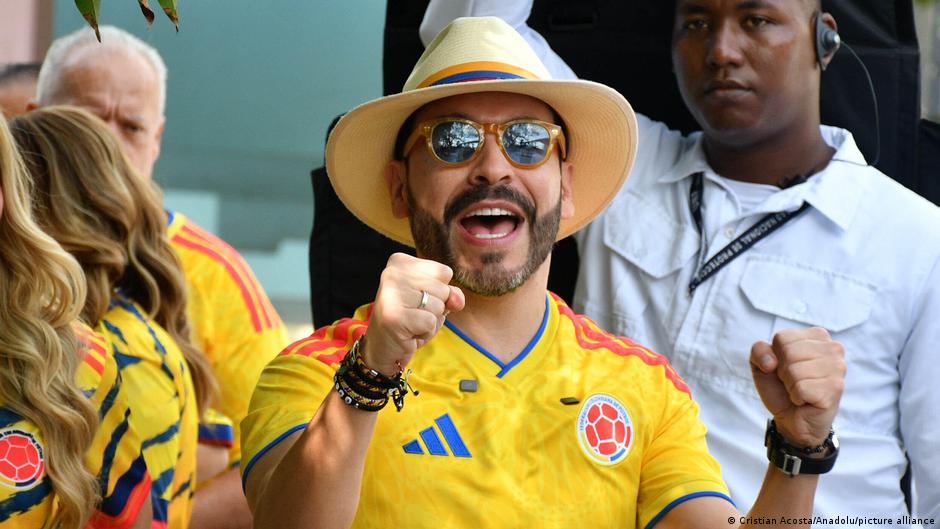
Colombia has elected a new president, and the results have the potential to transform the country in the long term. According to preliminary results, far-right lawyer Abelardo de la Espriella has won the presidential race by a narrow margin with 49.66% of the vote, beating leftist ruling party candidate Iván Cepeda, who received 48.7% of the vote.
The margin of approximately 250,000 votes is the smallest in the history of Colombian presidential elections.
De la Espriella, a 47-year-old lawyer, entrepreneur and political newcomer, will succeed Gustavo Petro, the country’s first leftist president. For Colombia, this would likely mean a significant shift to the right and a departure from key initiatives of the previous administration, particularly in the areas of peace, security, energy and social policy. At the same time, de la Espriella is taking over a country that is deeply divided politically.
no social consensus
The real outcome of this election lies in the outcome rather than the narrow margin between the candidates: about half of the voters supported Petro’s current course, while the other half supported a fundamental change in direction.
“Colombia has voted, and it could hardly have been so close,” Kristin Wessmann, head of the German Konrad Adenauer Foundation’s office in Bogotá, told DW.
“Politically, the country is almost evenly divided,” he said, “and the real challenge now begins in governing a deeply divided country and meeting the high expectations of a government capable of providing greater security, economic stability and action.”
Sabine Kurtenbach, interim president of the German Institute for Global and Area Studies (GIGA), offers a similar assessment of the election results.
“Colombia is completely divided,” he told DW.
According to Kurtenbach, the country now needs “a president who will try to build bridges and who will not further this polarization.”
Viviana García Pinzón of the Arnold Bergstresser Institute also told DW that the country has been shaped by “two very different social models.” The results show “very clearly how divided the country is.”
Who is Abelardo de la Espriella?
De la Espriella is by no means a traditional politician. He first became known as a criminal defense attorney, representing high-profile clients including paramilitary leaders and suspected drug traffickers. Later, he made a name for himself as an entrepreneur, television personality and commentator. His public persona is provocative and media-savvy.
During the election campaign, he presented himself as an anti-establishment candidate and a national-conservative reformer. His supporters call him “El Tigre” – the Tiger. Politically, de la Esperilla is associated with the politics of Donald Trump, El Salvador President Nayib Bukele, and Argentine President Javier Meili. Trump openly supported him and he has already received congratulations from the American Republican Party.
De la Espriella’s election victory was based primarily on his promise to deal harshly with the country’s security crisis. After years of increasing violence by guerrilla groups, drug cartels and other armed elements, this message resonated with many voters.
End of ‘Paz Total’?
The biggest change in policy so far will be in security and peace policy. While Petro, with his “Total Peace” (Paz Total) strategy, focused on negotiations with guerrilla groups and criminal organizations, de la Espriella has announced the end of that approach. Instead of negotiations, they aim to exert military pressure, including airstrikes against armed groups, resumption of aerial spraying against coca cultivation, construction of mega-prisons, and closer security cooperation with the US.
Political observer García Pinzón sees this as a fundamental change. De la Asprilla’s concept, she says, is based on “a militaristic, heavy-handed policy” and is largely based on the approach adopted by El Salvador’s Nayib Bukele.
Elizabeth Dickinson, deputy director for Latin America at the International Crisis Group, warns against further exacerbating social divisions.
“Whoever rules will have to win the trust of the other half,” he said. “This is not the time for revenge or extremist politics, but to move towards reconciliation.”
He also pointed out that the areas most affected by these problems voted overwhelmingly for opposition candidate Iván Cepeda. “This is a signal against military tactics in particular,” he said.
Many new policies ahead
The new administration is also indicating a break with existing economic policies. De la Espriella wants to significantly reduce the size of government, strengthen the private sector and promote investment. His most controversial proposals include reducing the government workforce by up to 40%, promoting fracking, and increasing the use of fossil fuels. The energy transition pushed by petro is thus likely to be at least partially reversed.
“Return to fossil fuels” is how Kurtenbach summarizes the new president’s energy policy. He wants to “shut down” the energy transition. At the same time, she also warns not to take his election promises lightly. Like Petro before him, de la Espriella does not have a majority in parliament.
Yan Basset, a political scientist at the Universidad del Rosario in the capital, sees this as the biggest challenge of the coming months.
“No candidate has a majority in parliament,” he told DW. The new president must first build a stable coalition and reunify the country after a highly polarized election campaign.
first protest
However, election night already showed how difficult this could be. In Bogotá and Cali, thousands of supporters of the defeated leftist camp took to the streets. Some demonstrations turned into clashes with police. AFP news agency reported barricades, burning tires and slogans against the new president.
In his victory speech, de la Espriella spoke of the beginning of a “new era” for Colombia. Whether this will truly mark a political new beginning depends on whether he succeeds in garnering support beyond his own camp. Experts interviewed by DW are remarkably unanimous on one point: The new president’s biggest challenge will not be the fight against guerrillas, but rather dealing with a country that is almost politically divided in two.
This article was originally published in German.