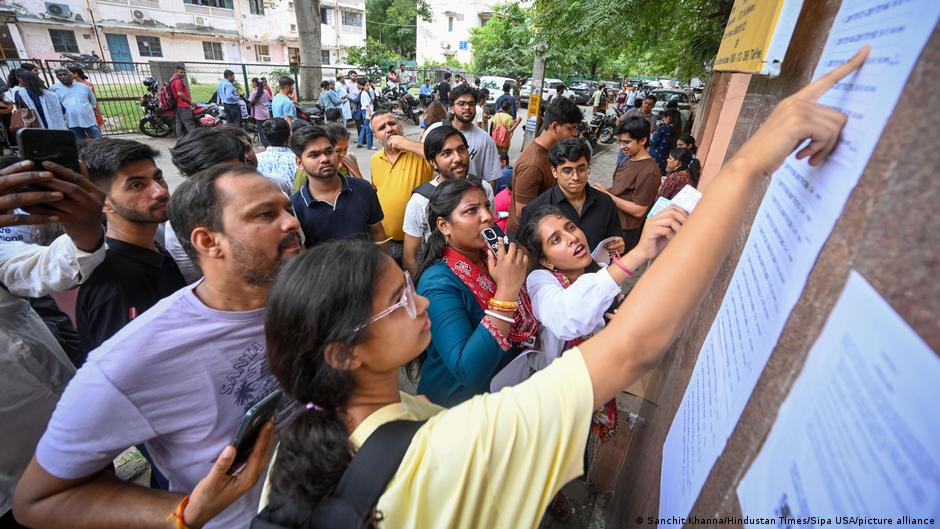
When 18-year-old Nelima Patel sat down to retake the National Eligibility cum Entrance Test (NEET) medical entrance exam in the western Indian city of Ahmedabad on Sunday, she felt completely exhausted before the exam even started.
The original exam was canceled in early May over suspicions that questions had been leaked. Patel had to prepare again, going through uncertainty, exhaustion and anxiety.
“It was mentally exhausting, but I had to take care of myself while writing,” Patel told DW. “It took a lot of preparation.”
“Just a few days ago, another student I knew committed suicide. It was all very upsetting,” she said.
A generation under constant pressure
Across the country, thousands of students found themselves in a similar situation.
What was supposed to be the culmination of years of preparation suddenly turned into another round of insecurity after the cancellation of the original exam.
This weekend, more than 2 million medical aspirants took the re-examination at thousands of centers under multi-layered security, including strict monitoring measures like facial authentication, biometric checks and thousands of signal jammers.
India offers about 130,000 medical undergraduate seats for the 2.27 million students taking the NEET medical entrance exam this year – distributed across more than 800 medical colleges across the country.
This means that less than one candidate out of 17 can secure a place in a medical college.
For many students and their families, the stress is too great.
Rukmini Madhavan, whose son, Mahesh, also took the re-test, said, “It is unfair to make children go through such a torturous process.”
“If they don’t make the cut-off, the problems escalate and can lead to psychological harm,” he said.
growing crisis of student crisis
The emotional stress associated with NEET has once again exposed a larger and more disturbing reality of the growing student crisis in India.
What is worrying is that 12 NEET aspirants have reportedly died by suicide since the exam controversy started.
Some left notes behind describing the immense stress they were under, while others expressed concern about having to endure another round of preparation and testing.
Their deaths have raised new questions about an education system in which a handful of exams often determine access to universities, careers and, many believe, a family’s future.
Many of these students come from low-income or rural backgrounds, where parents take massive private loans, sell land, or spend savings to finance years of expensive coaching institute fees.
‘More than a warning’
The issue of suicide in India extends far beyond NEET.
According to the latest National Crime Records Bureau data released last month, 14,488 student suicides were recorded in the country in 2024.
Students accounted for 8.5% of total suicides in the country and represented the fifth largest occupational category among suicide victims.
This figure was 4.3% higher than the previous year and continued a decade-long increase that has alarmed mental health experts, educators and policy makers.
“We have created a culture where success is celebrated in very narrow ways, while failure is often stigmatized,” neuropsychiatrist Anjali Nagpal told DW. “This is more than a warning, as it can leave young people feeling caught between expectations and reality.”
a highly competitive ecosystem
Students spend months or even years preparing for entrance exams like NEET, JEE and many government recruitment exams.
Teenagers across the country often relocate to places known as coaching hubs like Kota in Rajasthan, where they enter a world dominated by rankings, mock tests, cut-offs and constant competition.
“The pressure to succeed is immense. Failure can mean another year of coaching fees, another year of uncertainty and another year of trying again,” Jagdish Kumar, a student from Delhi, told DW.
The pressure is increased by parental expectations, financial sacrifices and the widespread belief that one exam can change the course of an entire life.
Educationist Apoorvanand Jha said that the crisis over national examinations has fundamental flaws that stem from an insecure structural obsession.
“Forcing a huge country to have highly centralized, single-point national examinations does not improve standards,” he told DW.
“Instead, it creates highly vulnerable single points of failure that jeopardize the future of millions of young students, completely delaying university calendars and academic sessions,” Jha underlined.
Top court expressed concern
The Supreme Court of India has expressed concern over the worsening nature of the student crisis.
In a series of observations, the top court identified a “disturbing pattern” of student suicides in educational institutions and cautioned against treating them as isolated incidents.
A court-mandated national task force headed by a former Supreme Court judge identified several factors exacerbating the crisis, including extreme academic competition, caste-based discrimination, financial stress, weak grievance redressal systems and inadequate access to mental health support.
From exam hall to politics
The deaths of the students have now become a rallying issue for the Cockroach Janata Party (CJP), a youth movement that emerged from an online satire campaign but has quickly become one of India’s most talked-about political incidents.
CJP’s protest continues in the capital New Delhi. It has seized on the NEET controversy, arguing that repeated exam irregularities and administrative failures are eroding trust in the system on which millions of students depend for social mobility.
CJP chief Abhijit Dipke has urged Prime Minister Narendra Modi’s government to pay compensation of Rs 10,000,000 (€92,418) to the families of students who allegedly committed suicide amid exam-related controversies.
“Some of these families had taken loans to educate their children. One can only imagine what these families were going through,” Dupke said. Whose party is demanding the resignation of Education Minister Dharmendra Pradhan.
The movement began as a response to a senior government member comparing some unemployed youth to “cockroaches”. Its online campaign soon struck a chord with a generation grappling with high unemployment, exam scams and growing economic insecurity.
draw public attention to the problem
The NEET controversy reflected concerns about a future increasingly being shaped by a handful of make-or-break tests.
For Kumar, who is preparing for next year’s exams, the issue is less about politics and more about the emotional toll of an inefficient educational system.
“It’s survival of the fittest and the system is set up for that,” he said.
If you are suffering from severe emotional stress or suicidal thoughts, do not hesitate to seek professional help. You can find information about where to get such help, no matter where you live in the world, on this website: https://www.befrienders.org/
In India, you can find crisis services and support options Here.
Edited by: Srinivas Majumdaru